Hach DR300 Phosphate Pocket Colorimeter: Complete Review & Reference (2026)
Disclosure: This page contains affiliate links. If you purchase through our links, we may earn a commission at no extra cost to you. See our affiliate disclosure.
Sources: Hach DR300 User Manual DOC022.97.90639 Ed.5 (09/2021) • Method DOC316.53.01470 Ed.2 (Phosphonates, 12/2018) • Method DOC316.53.01471 Ed.3 (Reactive Phosphorus, 12/2018)
Part No. LPV445.97.06110 (Americas) • PhosVer® 3 Chemistry • Method 8048 (0.02–3.00 mg/L PO₄³−) • Method 8007 (0.1–125 mg/L) • IP67 Waterproof
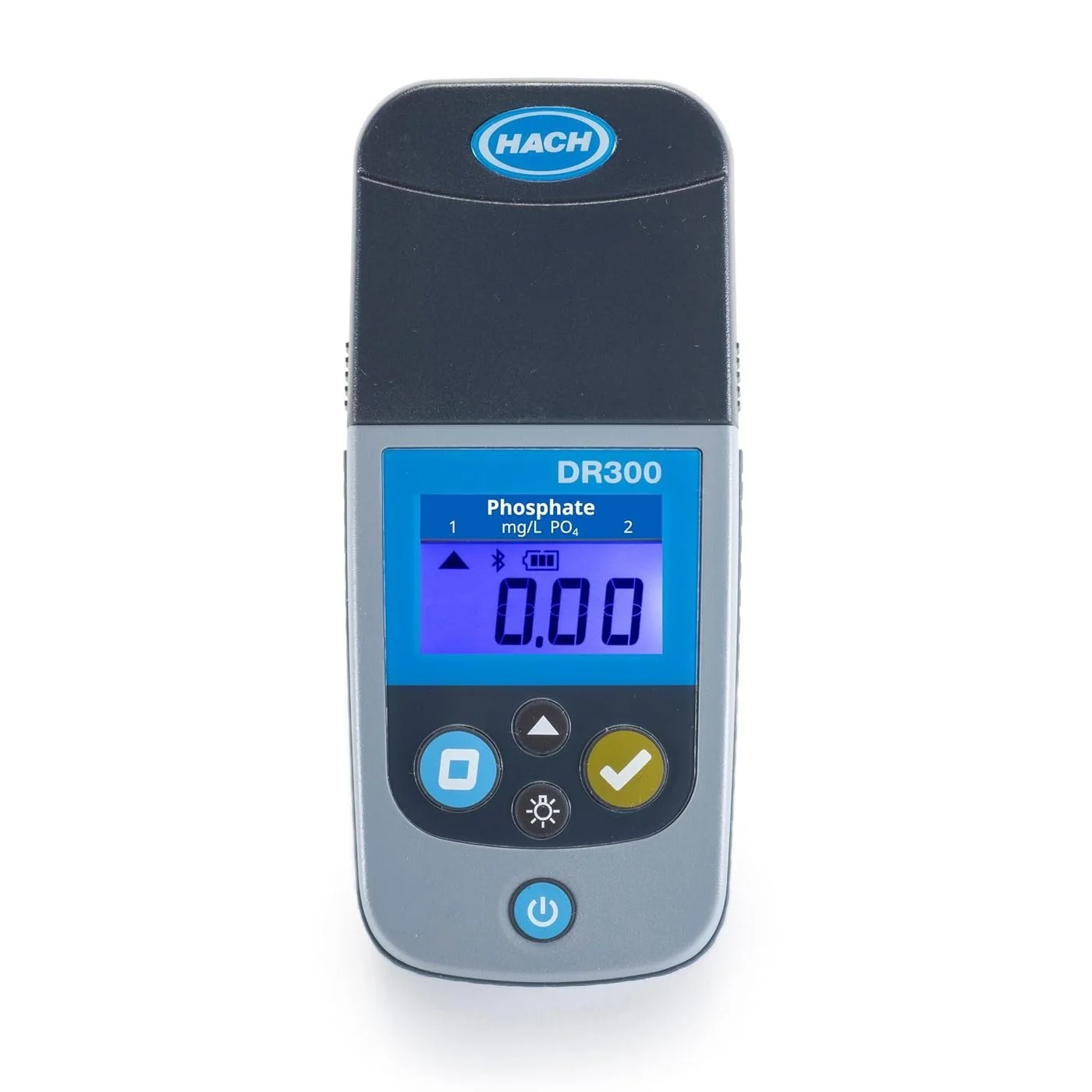

Two Methods, One Instrument — What the DR300 Phosphate Measures
The Hach DR300 LPV445.97.06110 is the phosphate model in the DR300 Pocket Colorimeter family. It supports two distinct test methods using the same PhosVer® 3 reagent chemistry, targeting different phosphate forms at different concentration ranges. Understanding which method you need — and why they are not interchangeable — is the most important thing to know before using this instrument.
Range: 0.02–3.00 mg/L
UV digestion: Not required
Read window: 2–10 minutes
USEPA accepted (EPA 365.1)
Applications: Wastewater compliance, drinking water, environmental monitoring
Range: 0.1–125 mg/L (5 sub-ranges)
UV digestion: Required (~10 min)
Built-in dilution factor: 10×
Applications: Cooling tower water, boiler feedwater, industrial scale/corrosion inhibitor monitoring
| Application | Method | Why Phosphate Monitoring Matters |
|---|---|---|
| Municipal wastewater effluent | Method 8048 | Phosphorus discharge limits in NPDES permits; USEPA-accepted method for compliance reporting |
| Drinking water treatment | Method 8048 | Orthophosphate dosing for lead and copper corrosion control (USEPA LCR); verify dose in distribution |
| Cooling tower water | Method 8007 | Phosphonate-based scale and corrosion inhibitors require monitoring to verify effective dosing concentration |
| Boiler feedwater & return condensate | Method 8007 | Phosphonate inhibitor residual monitoring; over-treatment wastes chemical, under-treatment causes scaling |
| Industrial process water | Method 8007 | Phosphonate corrosion inhibitors in closed-loop systems, heat exchangers, and industrial cooling circuits |
| Environmental water monitoring | Method 8048 | Nutrient monitoring in rivers, lakes, and stormwater runoff; eutrophication assessment |
| Food & beverage CIP systems | Method 8048 | Phosphate cleaner residual verification in rinse water after clean-in-place cycles |
How PhosVer® 3 Chemistry Works
Method 8048 — Reactive Phosphorus (Orthophosphate)
Orthophosphate reacts with ammonium molybdate in an acid medium to produce a mixed phosphate/molybdate complex. Ascorbic acid (contained in the PhosVer® 3 reagent) then reduces this complex, producing an intense molybdenum blue color directly proportional to the orthophosphate concentration. The blue color develops within 2 minutes at temperatures above 15°C.
Method 8007 — Phosphonates (Two-Step Process)
Phosphonates are organic phosphorus compounds (HEDP, ATMP, PBTC, DETPMP, HPAA, and others) used as scale and corrosion inhibitors in industrial water treatment. They cannot be directly measured by PhosVer® 3. Method 8007 uses a two-step process:
A UV lamp immersed in the sample (with potassium persulfate added) oxidizes phosphonate compounds, converting them to measurable orthophosphate. This digestion requires approximately 10 minutes with the UV lamp running.
The orthophosphate produced in Step 1 reacts with PhosVer® 3 to produce molybdenum blue. A simultaneously processed blank (undigested sample) zeros out any pre-existing orthophosphate — the result represents only phosphonate-derived phosphate.
Phosphonate Conversion Factors
Method 8007 results are reported as mg/L PO₄³−. To convert to the actual phosphonate compound concentration, multiply by the compound-specific factor:
| Phosphonate Compound | Abbreviation | Conversion Factor | Typical Application |
|---|---|---|---|
| 1-Hydroxyethylidene-1,1-diphosphonic acid | HEDP | × 1.15 | Cooling towers, boilers |
| Aminotrimethylene phosphonic acid | ATMP | × 0.88 | Scale inhibition, cooling water |
| 2-Phosphonobutane-1,2,4-tricarboxylic acid | PBTC | × 1.50 | Cooling towers, high-temp systems |
| Diethylenetriaminepenta(methylene phosphonic acid) | DETPMP | × 0.68 | Oilfield, high-calcium systems |
| 2-Hydroxyphosphonocarboxylic acid | HPAA | × 1.19 | Cooling water, food processing |
| Polyaminopolyether methylenephosphonate | PAPEMP | × 0.74 | Industrial cooling, marine |
| Hexamethylenediaminetetra(methylene phosphonic acid) | HDTMP | × 0.72 | Industrial scale inhibition |
Sample Collection and Storage
Method 8048 — Reactive Phosphorus
Method 8007 — Phosphonates
Collect samples in clean plastic containers. Process as soon as possible. Phosphonate compounds are generally stable at ambient temperature but can degrade in high-pH conditions or with microbial activity. Do not add acid preservatives to phosphonate samples as acid degrades the persulfate reagent used in Step 1.
Method 8048 Procedure — Reactive Phosphorus (0.02–3.00 mg/L)
Powder Pillow Procedure
Rinse a clean 25 mm glass sample cell three times with sample
Always triple-rinse with the actual sample before the measurement fill. This removes any phosphate contamination from previous use.
Fill the 25 mm cell to the 10-mL mark with sample
Use sample water at a temperature above 15°C. Color development rate decreases significantly below 15°C — allow cold samples to warm before testing.
Add one PhosVer® 3 Phosphate Reagent Powder Pillow
Add the full contents of one pillow to the 10 mL sample.
Cap and swirl for 30 seconds — start timer
Cap the cell and swirl vigorously for 30 seconds to fully dissolve the reagent. Start a 2-minute timer immediately. Blue color will develop if phosphate is present.
Prepare the blank: fill a second cell to 10 mL (no reagent)
No powder pillow added to the blank cell. This accounts for any color in the sample itself.
At exactly 2 minutes: insert blank, install cap, press ZERO
When the 2-minute timer expires, insert the blank cell (no reagent), install the instrument cap, and press ZERO. Do not read before 2 minutes — color has not fully developed.
Remove blank, insert reagent cell, press READ
Swap to the sample cell (with reagent), install cap, press READ. Result displays in mg/L PO₄³−. Must read within 10 minutes of the 2-minute start point.
AccuVac® Ampul Procedure — Method 8048
Submerge ampul tip completely in the sample
Keep the ampul tip below the surface. Use a vessel deep enough to keep the tip submerged throughout the fill.
Snap tip while submerged — keep submerged until full
Break the scored tip while fully submerged. Maintain submersion until the ampul is completely filled. If air enters before filling is complete, discard and use a new ampul.
Cap and invert — start 2-minute timer
Wipe the exterior dry. Cap the ampul. Invert 3 to 5 times to mix internal reagent with sample. Start the 2-minute timer immediately. Blue color develops if phosphate is present.
At 2 minutes: insert into AccuVac® adapter, install cap, press READ
Insert the ampul into the AccuVac® adapter in the instrument. Install instrument cap. Press READ at or after the 2-minute mark, within the 10-minute window.
Method 8007 Procedure — Phosphonates (0.1–125 mg/L)
Step 1: Sample Volume Selection
The phosphonates method spans five sub-ranges depending on sample volume. Select the appropriate volume before beginning. The built-in calibration applies a 10× dilution factor to all results, so the displayed value is automatically corrected.
| Expected Sample Concentration | Sample Volume to Use | Multiplier | Range Covered |
|---|---|---|---|
| 0.1–3.0 mg/L PO₄³− | 40 mL | 1.0× | Lowest concentration |
| 0.2–6.0 mg/L PO₄³− | 20 mL | 2.0× | — |
| 0.5–15 mg/L PO₄³− | 8 mL | 5.0× | — |
| 1.0–30 mg/L PO₄³− | 4 mL | 10× | — |
| 5.0–125 mg/L PO₄³− | 1 mL (dilute to 40 mL) | 40× | Highest concentration |
| Dilute to 40-mL mark with deionized water after adding the selected sample volume. | |||
Step 2: UV Persulfate Digestion
Add selected sample volume to a 50-mL volumetric flask
Use the sample volume from the range table above. Add potassium persulfate reagent (Hach Item 2087469) to the flask.
Dilute to the 50-mL mark with deionized water
Bring the volume to exactly 50 mL using deionized water. Mix well.
Prepare a blank simultaneously
Add the same sample volume as Step 1, but also add PhosVer® 3 powder pillow directly (no UV digestion). Dilute to 50 mL. This blank accounts for pre-existing orthophosphate in the sample.
Immerse UV lamp in the sample flask — 10 minutes
Immerse the UV lamp fully in the 50-mL sample flask. Run the UV lamp for approximately 10 minutes. The exact time may vary — verify with the method document for your specific phosphonate compound. Do not use the UV lamp on the blank.
Add PhosVer® 3 powder pillow to the digested sample
After UV digestion is complete and the lamp is removed, add one PhosVer® 3 powder pillow to the digested sample flask. Mix well.
Transfer 10 mL of the digested mix to a sample cell — start 2-minute timer
Transfer 10 mL of the digested and PhosVer® 3-treated sample to a 25 mm glass sample cell. Start the 2-minute timer.
Zero with blank cell, then read sample cell at 2 minutes
At the 2-minute mark, zero the instrument with the blank cell (no reagent + PhosVer® 3), then read the sample cell. The result in mg/L PO₄³− includes the 10× built-in dilution factor. Multiply by the compound-specific conversion factor if needed.
Interferences — Complete Reference
Method 8048 — Reactive Phosphorus
| Interferent | Tolerance Level | Effect / Treatment |
|---|---|---|
| Arsenate (AsO₄³−) | Any detectable level | Positive interference — arsenate reacts identically to phosphate with PhosVer® 3. Cannot be distinguished. Report results as “phosphate or arsenate” if arsenate contamination is possible. |
| Silicate (SiO₂) | Up to 50 mg/L | Silicate at very high concentrations causes slight positive interference. Typical natural water levels are not a concern. |
| Chromium (Cr) | Up to 10 mg/L as CrO₄²− | Hexavalent chromium causes slight interference. Trivalent chromium is not an interferent at typical levels. |
| Copper (Cu) | Up to 10 mg/L | Tolerated at typical industrial water concentrations. |
| Iron (Fe) | Up to 10 mg/L | Tolerated. High iron may cause slight color interference — verify with standard additions if iron exceeds 5 mg/L. |
| Sulfide | Up to 1 mg/L | Reduces molybdenum blue — negative interference at high concentrations. Pre-treat with hydrogen peroxide (1 drop 30% H₂O₂ per 100 mL) if sulfide odor is present. |
| Turbidity | Must be minimal | Filter through 0.45-micron membrane before testing. Record filtration in lab notes for compliance samples. |
| Temperature | Above 15°C required | Color development is temperature-dependent. Below 15°C, reaction rate decreases significantly — allow cold samples to reach room temperature. Extend timing to 3–5 minutes if sampling in cold conditions. |
Method 8007 — Phosphonates
| Interferent | Tolerance (at 5 mL sample) | Notes |
|---|---|---|
| Orthophosphate (PO₄³−) | Zeroed out by blank | Pre-existing orthophosphate is automatically subtracted by the blank procedure. This is the primary reason for running the blank simultaneously. |
| Copper (Cu) | Up to 100 mg/L | Limit decreases if sample volume increases above 5 mL (50 mg/L at 10 mL, for example). |
| Iron (Fe) | Up to 20 mg/L | High iron may cause color interference. Filter if iron exceeds this level. |
| Nickel (Ni) | Up to 5 mg/L | Exceeding the tolerance may cause positive or negative interference. |
| Chromium (Cr VI) | Up to 5 mg/L | Hexavalent chromium interference. Common in industrial cooling tower blowdown. |
| Zinc (Zn) | Up to 50 mg/L | Zinc-based corrosion inhibitors common in cooling tower formulations — verify limits if zinc treatment is used alongside phosphonate. |
| Turbidity | Must be minimal | Filter through 0.45-micron before testing. Record filtration for industrial logs. |
Accuracy Verification
Method 8048 — Standard Additions
Items: Phosphate Standard Solution, 50 mg/L PO₄³− ampule (Item 17110); TenSette® Pipet 0.1–1.0 mL (Item 1970001); three 25-mL mixing cylinders.
Add 0.1, 0.2, and 0.3 mL of 50 mg/L standard to three 25-mL portions
Prepare three spiked samples. Mix each well.
Run full Method 8048 procedure on each (smallest spike first)
Record results for all three spiked samples.
Calculate expected increase
Expected = 50 mg/L × 0.1 mL ÷ 25 mL = 0.2 mg/L PO₄³− per 0.1 mL spike. Results within ±10% are acceptable.
Method 8048 — Standard Solution Method
Prepare a 2.00 mg/L PO₄³− working standard
Pipet 4.00 mL of 50 mg/L phosphate standard into a 100-mL Class A volumetric flask. Dilute to the 100-mL mark with deionized water. Mix well. Prepare fresh daily.
Run the full test procedure on this standard
Treat the 2.00 mg/L working standard as a sample. Expected result: 2.00 mg/L ± 10%. Results consistently outside this range indicate reagent degradation or instrument drift — check reagent lot and run an SCA.
Method 8007 — Colorimetric Validation (No UV Digestion)
Reagents, Apparatus & Replacement Parts
Required Reagents
| Reagent | Method | Hach Item No. |
|---|---|---|
| PhosVer® 3 Phosphate Reagent Powder Pillow, 10 mL | 8048 & 8007 | 2106069 |
| PhosVer® 3 Phosphate AccuVac® Ampul | 8048 only | 2507025 (verify) |
| Potassium Persulfate Reagent Powder Pillow | 8007 only | 2087469 |
Required Apparatus
| Item | Method | Hach Item No. |
|---|---|---|
| Sample cell, 25 mm round glass (10 mL) | 8048 & 8007 | 2427606 |
| UV lamp, 254 nm (120V) | 8007 only | 2082800 |
| UV lamp, 254 nm (230V) | 8007 only | 2082802 |
| Volumetric flask, 50-mL Class A | 8007 only | 1457443 (or equiv.) |
| TenSette® Pipet 0.1–1.0 mL | Both | 1970001 |
| TenSette® Pipet tips (50/pk) | Both | 2185696 |
| Phosphate Standard, 50 mg/L PO₄³− | Both (verification) | 17110 |
Instrument Replacement Parts
| Part | Item No. |
|---|---|
| DR300 Instrument cap | LPV445.97.08100 |
| Sample cell cap (for 25 mm cell) | LPV445.97.08200 |
| AccuVac® adapter | LPV445.97.08300 |
| Sample cell brush | 1889640 |
| Batteries, AAA (4-pack) | Standard AAA alkaline |
Error Codes
The DR300 Phosphate model shares the full E-00 through E-66 error code set with all DR300 instruments. See the DR300 Chlorine Reference page for the complete error code table and recovery procedures.
Phosphate-specific note: E-03 (SCA standard out of range) on the phosphate model most commonly occurs when the working standard prepared for SCA verification falls outside the instrument's expected range. Verify that your 2.00 mg/L working standard was prepared correctly (4.00 mL of 50 mg/L stock into 100 mL total volume) before re-attempting SCA.
Quick Reference Summary
| Parameter | Method 8048 (Reactive) | Method 8007 (Phosphonates) |
|---|---|---|
| Analyte | Orthophosphate (PO₄³−) | Organic phosphonates |
| Range | 0.02–3.00 mg/L | 0.1–125 mg/L (5 sub-ranges) |
| Chemistry | PhosVer® 3 (molybdenum blue) | |
| UV digestion | Not required | Required (~10 min) |
| Read window | 2–10 minutes | 2–10 minutes (colorimetric step) |
| USEPA accepted | Yes (EPA 365.1, 4500-P-E) | No |
| Blank required | Yes (no reagent blank) | Yes (undigested sample blank) |
| Built-in dilution factor | None | 10× (results auto-corrected) |
| Arsenate interference | Yes — reacts identically | Zeroed by blank procedure |
| Precision | 1.0 ± 0.04 mg/L | Varies by sub-range |
Related DR300 References
- Hach DR300 Chlorine — Complete Reference & Review
- Hach DR300 Iron FerroVer® — Complete Reference & Review
- Hach DR300 Bromine — Complete Reference & Review
- Hach DR300 Chlorine Dioxide — DPD Method 8138, Glycine Pre-Treatment
- Hach DR300 Ammonia — Nessler Method 8038 & Salicylate Method 10031
- Hach DR300 Nitrate — NitraVer® 5 Cadmium Reduction Method 8039
- Hach DR300 Manganese — PAN Method 8034, 0.006–0.700 mg/L Mn
- Hach DR900 Multiparameter Colorimeter — 48+ Parameters, 90+ Methods
- Hach DR1900 Portable Spectrophotometer — 340–800 nm, Full Spectrophotometer
- Colorimeter vs Spectrophotometer — Complete Buyer's Guide
- All Commercial Water Lab Guides