Hach DR300 Bromine Pocket Colorimeter: Complete Review & Reference (2026)
Disclosure: This page contains affiliate links. If you purchase through our links, we may earn a commission at no extra cost to you. See our affiliate disclosure.
Sources: Hach DR300 User Manual DOC022.97.90639 Ed.5 (09/2021) • Method DOC316.53.01443 Ed.2 (HR, 12/2018) • Method DOC316.53.01444 Ed.2 (LR, 12/2018)
DPD Method 8016 • LR: 0.05–4.50 mg/L Br₂ • HR: 0.2–10.0 mg/L Br₂ • IP67 Waterproof
What the DR300 Bromine Model Measures & Who Uses It
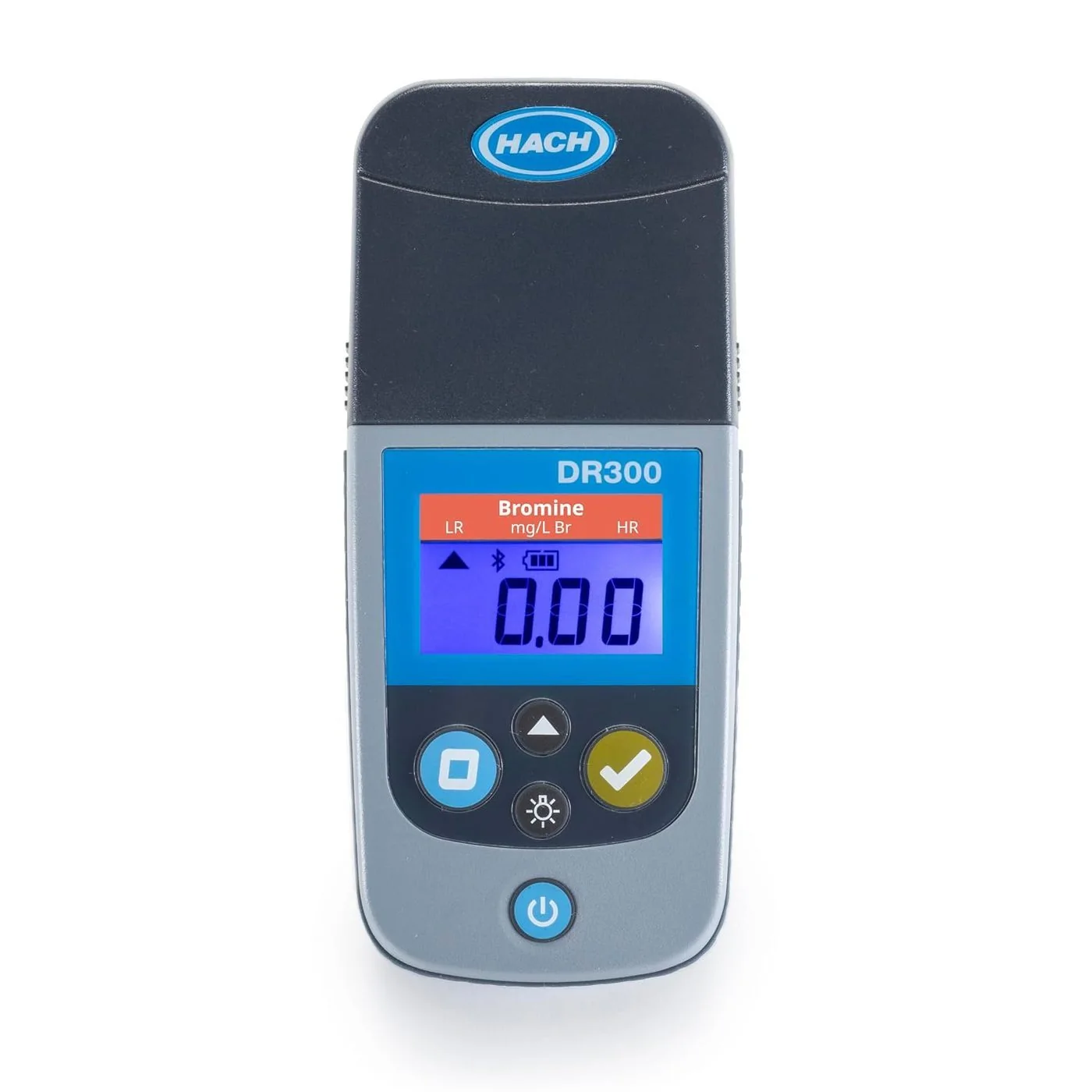
The Hach DR300 Bromine pocket colorimeter measures total bromine residuals — including hypobromite (OBr¹−), hypobromous acid (HOBr), and bromamines — using the DPD (N,N-diethyl-p-phenylenediamine) colorimetric method (Method 8016). Unlike the iron or chlorine models, the bromine DR300 is available in two distinct range configurations that differ in cell size, sample volume, and reagent quantity — not simply a software switch.
| Application | Typical Range Used | Why Bromine |
|---|---|---|
| Cooling towers | HR (0.2–10.0 mg/L) | Bromine biocides effective across wider pH range than chlorine; bromamines retain biocidal activity |
| Indoor pools & hot tubs | LR (0.05–4.50 mg/L) | Less odor than chlorine; stable at high temperatures; standard in spa applications |
| Industrial HVAC water treatment | HR (0.2–10.0 mg/L) | Brominators used where chlorine is too corrosive or pH fluctuates widely |
| Wastewater disinfection | HR or LR depending on dose | Used in industrial effluent where combined halogen residuals matter |
| Food & beverage process water | LR (0.05–4.50 mg/L) | Bromine disinfection verification in CIP systems and rinse water |
How the DPD Method Works for Bromine
Bromine residuals react with DPD (N,N-diethyl-p-phenylenediamine) to form a pink color directly proportional to total bromine concentration. The DPD Total Chlorine Reagent contains both the DPD indicator and a buffer system. No separate oxidation or conversion step is needed — the pink color develops immediately upon reagent addition.
The LR procedure uses 1 powder pillow in 10 mL of sample. Lower indicator concentration matches the lower analyte concentration, keeping the calibration linear across the 0.05–4.50 mg/L range.
The HR procedure uses 2 powder pillows in only 5 mL of sample — a 4× increase in indicator-to-sample ratio. This extends the measurement range to 10.0 mg/L Br₂ without changing the instrument optics or chemistry.
The 2.25× Chlorine Conversion Factor — Critical for Accuracy Verification
The DPD method responds equally to chlorine and bromine on a molar basis, but bromine has a higher molecular weight (159.8 g/mol vs 70.9 g/mol for Cl₂). This creates a fixed conversion relationship documented in both method documents:
HR: 2.0–8.0 mg/L Br₂ required
LR vs HR — Which Configuration Do You Need?
| Feature | Low Range (LR) | High Range (HR) |
|---|---|---|
| Measurement range | 0.05–4.50 mg/L Br₂ | 0.2–10.0 mg/L Br₂ |
| Sample volume | 10 mL | 5 mL |
| Powder pillows per test | 1 | 2 |
| Sample cell | 25 mm round glass cell | 1 cm square cell |
| AccuVac® option | Yes (30 mL self-fill) | No — Powder Pillow only |
| Precision | 2.25 ± 0.11 mg/L | 11.3 ± 0.5 mg/L |
| SCA standard range | 2.00–4.00 mg/L Br₂ | 2.0–8.0 mg/L Br₂ |
| Best for | Pools, spas, drinking water, low-dose industrial | Cooling towers, high-dose industrial, HVAC |
Pre-Test Requirements (Both LR and HR)
Clean, scratch-free sample cells only
Scratches in the optical path permanently affect readings. Use only optically clear cells. Inspect before each use.
Triple-rinse the sample cell
Rinse the cell and cap three times with the sample before filling. This conditions the cell walls and removes residual reagent from previous tests.
Wipe all exterior surfaces
Wipe with a lint-free cloth — no fingerprints or liquid on any optical surface. Check for condensation on cold samples.
Install the instrument cap BEFORE pressing ZERO or READ
The cap must be installed before any measurement. Reading without the cap installed will give incorrect results because ambient light enters the sample chamber.
Over-range or yellow color: dilute and retest
If the result is over-range, or if the sample turns yellow (not pink) after reagent addition, dilute with bromine-demand-free water and retest. Multiply result by dilution factor.
New reagent lot: measure a blank
For each new lot of reagent, measure a reagent blank using deionized water in place of sample. Subtract blank value from all subsequent sample results.
Post-test rinse
After each test, immediately empty and rinse the sample cell and cap three times with deionized water. Do not allow reagent to dry in the cell.
Sample Collection — Critical Requirements
Low Range Procedure — Powder Pillow (0.05–4.50 mg/L Br₂)
Fill the 25 mm round glass cell to the 10-mL mark
Use sample water. Triple-rinse before filling for measurement.
Add 1 DPD Total Chlorine Powder Pillow
Add contents of one DPD Total Chlorine Reagent Powder Pillow to the filled cell.
Cap the cell and swirl to mix
Cap securely. Swirl gently for approximately 20 seconds until reagent is fully dissolved. Pink color will develop if bromine is present.
Insert cell and install cap — press ZERO immediately
Insert the sample cell into the instrument, install the cap, and press ZERO promptly. The DPD color develops quickly — do not delay zeroing.
Fill a second cell with fresh sample for the blank
Fill a second 25 mm cell to the 10 mL mark with the same sample water. No reagent is added to the blank cell.
Remove reagent cell, insert blank cell, press ZERO
Remove the reagent-containing cell. Insert the blank cell (no reagent). Press ZERO to establish the baseline. Install cap before zeroing.
Remove blank, insert reagent cell, press READ
Remove the blank cell. Re-insert the cell containing the reagent-mixed sample. Install cap. Press READ. The display shows mg/L Br₂.
Low Range AccuVac® Ampul Procedure (0.05–4.50 mg/L Br₂)
Submerge ampul tip completely in the sample
Keep the tip below the water surface. If the tip breaks contact with the sample before the ampul is full, air enters and the result is invalid. Use a container deep enough to keep the tip submerged throughout filling.
Snap the tip while submerged — keep tip submerged until full
Snap the scored tip while the ampul tip is fully submerged. Maintain submersion until the ampul is completely filled. If the tip clears the surface before full, discard and use a new ampul.
Cap the ampul with the AccuVac® cap
Wipe the exterior dry with a lint-free cloth. Cap the ampul.
Invert the ampul 3 to 5 times to mix
Invert gently to mix the internal reagent with the sample. Pink color develops if bromine is present.
Insert into the AccuVac® adapter in the instrument
Insert the capped ampul into the AccuVac® adapter (ensure the adapter is seated in the instrument). Install the instrument cap. Press READ.
High Range Procedure — Powder Pillow (0.2–10.0 mg/L Br₂)
Fill the 1 cm square cell to the 5-mL mark
Use the square cell supplied with the HR instrument. Fill to exactly 5 mL with sample water. Triple-rinse the cell before the measurement fill.
Add 2 DPD Total Chlorine Powder Pillows
Add the contents of exactly two DPD Total Chlorine Reagent Powder Pillows to the 5 mL sample. Do not add only one — HR requires double reagent quantity.
Cap and swirl to mix
Cap securely. Swirl for approximately 20 seconds until reagent is fully dissolved. Intense pink color will develop at higher bromine concentrations.
Insert cell and install cap — press ZERO immediately
Insert the 1 cm square cell, install instrument cap, and press ZERO promptly. Do not delay — DPD color develops quickly.
Fill a second 1 cm cell with 5 mL fresh sample (no reagent)
This is the blank. Same cell type, same volume, no powder pillows added.
Remove reagent cell, insert blank, press ZERO
Swap to blank cell, install cap, press ZERO to set baseline.
Remove blank, insert reagent cell, press READ
Swap back to reagent cell, install cap, press READ. Display shows mg/L Br₂ in the HR range.
Interferences — Complete Reference
The following interference levels apply to both LR and HR procedures unless specifically noted. Interference testing was conducted at approximately 3 mg/L Br₂ sample concentration.
| Interferent | Tolerance Level | Effect / Treatment |
|---|---|---|
| Chlorine (Cl₂) | Responds equally to bromine | The DPD method does not distinguish between chlorine and bromine. Results reflect TOTAL halogen (Cl₂ + Br₂). If both are present, result includes both. No correction without independent chlorine measurement. |
| Monochloramine | Responds at <5% of free Cl₂ rate | Low interference under typical conditions. Can affect results when chloramine concentrations are high relative to free bromine. |
| pH | 4–8 optimal | Accuracy decreases significantly outside this range. Adjust sample pH to 6–7 using dilute H₂SO₄ or NaOH if pH is outside tolerance. |
| Hardness | Up to 1,000 mg/L CaCO₃ | No significant interference at typical cooling tower or pool hardness levels. |
| Iron (Fe) | Up to 2 mg/L | At concentrations above 2 mg/L, iron may cause a positive interference. Pre-filter through 0.45-micron membrane if iron is a concern. |
| Manganese (Mn) | Up to 0.1 mg/L | Manganese above 0.1 mg/L causes positive interference. Treat or dilute samples with high manganese. |
| Turbidity | Must be minimal | Turbid samples scatter light and produce falsely high readings. Filter through 0.45-micron before testing if turbidity is visible. |
| Temperature | 15–25°C for best accuracy | DPD color development rate is temperature-dependent. Allow hot samples (from hot tubs or industrial processes) to cool toward ambient before testing. |
| Oxidizing agents | May cause positive interference | Ozone, chlorine dioxide, and other oxidizing biocides react with DPD. Results reflect total oxidant equivalents, not bromine alone. |
| Reducing agents | May cause negative interference | Strong reducing agents (sulfite, thiosulfate) consume bromine before measurement. Test immediately after sampling; do not add dechlorinating agents to bromine samples. |
Accuracy Verification — Standard Additions Method
LR Standard Additions
Items required: Chlorine Standard Solution 25–30 mg/L, 2-mL PourRite® Ampule (Item 2630020); Ampule breaker; TenSette® Pipet 0.1–1.0 mL (Item 1970001) with tips; three 10-mL portions of fresh sample.
Add 0.1 mL, 0.2 mL, and 0.3 mL of standard to three 10-mL portions
Prepare three spiked samples using fresh, unread sample water. Mix each well before testing.
Run the full LR Powder Pillow procedure on each spiked sample
Test smallest spike first. Record results for all three.
Calculate expected Br₂ increase
Expected Cl₂ increase per 0.1 mL spike = label concentration × 0.1 mL ÷ 10 mL sample. Multiply by 2.25 to get expected Br₂ increase. Results within ±10% of expected indicate acceptable performance.
HR Standard Additions
Items required: Same chlorine standard solution; TenSette® Pipet; three 5-mL portions of fresh sample (HR uses 5 mL, not 10 mL).
Add 0.1 mL, 0.2 mL, and 0.3 mL to three 5-mL portions
HR uses half the sample volume of LR, which doubles the spike concentration per unit volume.
Run full HR procedure on each spiked sample
Test smallest spike first. Two powder pillows per test, 1 cm square cell, 5 mL volume.
Calculate expected Br₂ increase
Expected Cl₂ increase = label concentration × 0.1 mL ÷ 5 mL sample. Multiply by 2.25 for expected Br₂ increase. Compare measured increase to expected within ±10%.
SCA (Standard Calibration Adjust) — Bromine Ranges
| Configuration | Required SCA Standard Range | Notes |
|---|---|---|
| LR | 2.00–4.00 mg/L Br₂ | If using chlorine standard: Cl₂ mg/L × 2.25 must fall within this range |
| HR | 2.0–8.0 mg/L Br₂ | If using chlorine standard: Cl₂ mg/L × 2.25 must fall within this range |
Reagents, Apparatus & Replacement Parts
Required Reagents
| Reagent | LR | HR | Hach Item No. |
|---|---|---|---|
| DPD Total Chlorine Reagent Powder Pillow, 10-mL | 1 per test | 2 per test | 2105569 |
| DPD Total Chlorine AccuVac® Ampul | 1 per test | Not available | 2502025 |
| DPD Total Chlorine Powder Pillow, 25-mL | — | — | 2105669 (alt) |
Required Apparatus
| Item | LR | HR | Hach Item No. |
|---|---|---|---|
| Sample cell, 25 mm round glass (10 mL) | ✓ | — | 2427606 |
| Sample cell, 1 cm square (5 mL) | — | ✓ | 2427700 (verify) |
| AccuVac® adapter | LR only | — | Included with LR kit |
| TenSette® Pipet 0.1–1.0 mL | ✓ | ✓ | 1970001 |
| TenSette® Pipet tips (50/pk) | ✓ | ✓ | 2185696 |
| Chlorine Standard, 25–30 mg/L, 2-mL PourRite® | ✓ | ✓ | 2630020 |
Instrument Replacement Parts
| Part | Item No. |
|---|---|
| DR300 Instrument cap | LPV445.97.08100 |
| Sample cell cap (for 25 mm cell) | LPV445.97.08200 |
| AccuVac® adapter | LPV445.97.08300 |
| Batteries, AAA (4-pack) | Standard AAA alkaline |
| Sample cell brush | 1889640 |
| Cleaning solution for sample cells | LPV445.97.08500 |
Error Codes — Full Reference
Error codes are shared across the DR300 platform. See the DR300 Chlorine Reference for the complete E-00 through E-66 error code table and recovery procedures. Bromine-specific note: E-03 (SCA out of range) on the bromine model means the standard used for SCA does not fall within the required Br₂ range (2.00–4.00 mg/L LR or 2.0–8.0 mg/L HR). Verify your chlorine standard concentration and apply the 2.25× conversion factor before re-attempting SCA.
Quick Reference Summary
| Parameter | LR Value | HR Value |
|---|---|---|
| Range | 0.05–4.50 mg/L Br₂ | 0.2–10.0 mg/L Br₂ |
| Method | DPD Method 8016 | |
| Sample volume | 10 mL | 5 mL |
| Powder pillows | 1 | 2 |
| Cell type | 25 mm round glass | 1 cm square |
| AccuVac® option | Yes (Item 2502025) | No |
| Color developed | Pink (intensity proportional to Br₂) | |
| Over-range indicator | Yellow color in sample — dilute and retest | |
| Cl₂ conversion | Cl₂ mg/L × 2.25 = Br₂ mg/L | |
| SCA standard range | 2.00–4.00 mg/L Br₂ | 2.0–8.0 mg/L Br₂ |
| Precision | 2.25 ± 0.11 mg/L | 11.3 ± 0.5 mg/L |
Related DR300 References
- Hach DR300 Chlorine — Complete Reference & Review
- Hach DR300 Iron FerroVer® — Complete Reference & Review
- Hach DR300 Phosphate — Complete Reference & Review
- Hach DR300 Chlorine Dioxide — DPD Method 8138, Glycine Pre-Treatment
- Hach DR300 Ammonia — Nessler Method 8038 & Salicylate Method 10031
- Hach DR300 Nitrate — NitraVer® 5 Cadmium Reduction Method 8039
- Hach DR300 Manganese — PAN Method 8034, 0.006–0.700 mg/L Mn
- Hach DR900 Multiparameter Colorimeter — 48+ Parameters, 90+ Methods
- Hach DR1900 Portable Spectrophotometer — 340–800 nm, Full Spectrophotometer
- Colorimeter vs Spectrophotometer — Complete Buyer's Guide
- All Commercial Water Lab Guides