Hach DR300 Manganese Pocket Colorimeter: Complete Review & Reference (2026)
Disclosure: This page contains affiliate links. If you purchase through our links, we may earn a commission at no extra cost to you. See our affiliate disclosure.
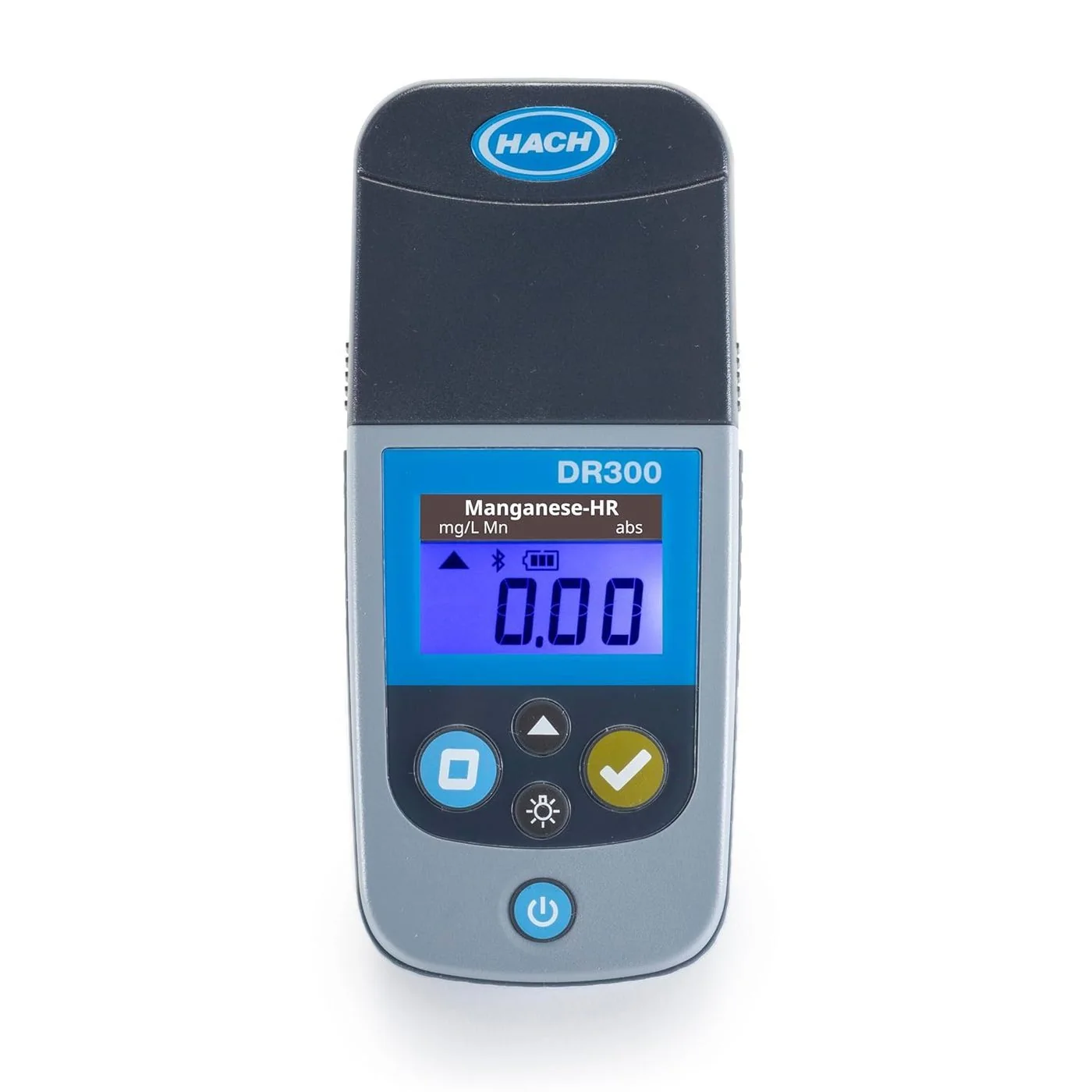
PAN Method 8034 • 0.006–0.700 mg/L Mn • Dissolved Manganese • IP67
Source: Hach DR300 User Manual DOC022.97.90639 Ed.5 (09/2021) • Method 8034 (PAN Indicator)
Manganese in Water Supply — The Problem and the Measurement
Manganese is a naturally occurring element that enters water supplies primarily from geological sources — the weathering of manganese-bearing rocks and minerals. It is particularly common in groundwater and in water from the hypolimnion (deep, anoxic layer) of stratified lakes and reservoirs. Under low-oxygen conditions, insoluble oxidized manganese (MnO₂, brown-black particulates) is reduced to soluble Mn²+ (manganous ion, colorless), which dissolves in the water.
When this manganese-laden water reaches oxygenated conditions — either through treatment (aeration, chlorination, potassium permanganate addition) or simply upon contact with distribution system piping — the Mn²+ reoxidizes and precipitates as dark brown or black MnO₂ particles. These deposits cause black staining of laundry, plumbing fixtures, and plumbing infrastructure, and give water an objectionable metallic taste.
Dissolved vs Total Manganese — Critical Distinction
| Sample Type | What DR300 Measures | Pre-Treatment Required |
|---|---|---|
| Clear groundwater sample | Dissolved Mn²+ — accurate without pre-treatment | None required |
| Turbid or colored sample | Dissolved Mn²+ only (particles settle or scatter light) | Filter through 0.45-micron membrane before testing |
| Oxidized/treated water with MnO₂ particles | May underestimate total manganese — particulate Mn not measured | Acid digestion (HNO₃ + heat) to dissolve all Mn forms; then test |
| Distribution system sample with black particles | Dissolved fraction only; particles not measured | Acid digestion for total manganese |
Manganese vs Iron — Two Parameters, Two Instruments
Manganese and iron share similar geochemistry and are frequently co-occurring in groundwater and anoxic source water. They require separate DR300 models because their colorimetric methods are completely different — and the reagents do not cross-react.
| Parameter | DR300 Model | Method | Range | Reagent |
|---|---|---|---|---|
| Iron (dissolved + total) | DR300 Iron FerroVer® | FerroVer, Method 8008 | 0.02–5.00 mg/L Fe | FerroVer Powder Pillow or AccuVac |
| Manganese (dissolved) | DR300 Manganese | PAN, Method 8034 | 0.006–0.700 mg/L Mn | PAN Indicator Solution |
| FerroVer does not respond to manganese at water treatment concentrations. PAN does not respond to iron. Both instruments are needed when monitoring water sources with co-occurring iron and manganese. | ||||
EPA & WHO Standards for Manganese
| Standard | Value | Basis |
|---|---|---|
| EPA SMCL (aesthetic) | 0.05 mg/L Mn | Non-enforceable; staining, taste, and odor above this level |
| EPA Health Advisory (long-term) | 0.3 mg/L Mn | Neurological effects from chronic exposure; adults |
| EPA Health Advisory (infant short-term) | 1.0 mg/L Mn | Neurological effects in formula-fed infants |
| WHO Guideline Value | 0.08 mg/L Mn | WHO Guidelines for Drinking-water Quality, 4th Ed. |
| EU Parametric Value | 0.05 mg/L Mn | Council Directive 98/83/EC |
| The DR300 range of 0.006–0.700 mg/L covers all reference values above. The 0.006 mg/L detection limit allows monitoring well below the 0.05 mg/L SMCL. | ||
How PAN Method 8034 Works
PAN (1-(2-Pyridylazo)-2-naphthol) is a highly selective chelating agent for transition metals. In acidified water containing Mn²+, PAN forms a stable orange-yellow metal-chelate complex. The color intensity at the measurement wavelength is proportional to the manganese concentration. The reaction is completed in approximately 2 minutes at room temperature and the color is stable for at least 5 minutes within the read window.
The method is specific to dissolved Mn²+ because only the reduced, soluble form reacts with PAN under the test conditions. Oxidized manganese species (Mn³+, Mn⁴+) in particulate form do not dissolve and therefore do not react.
Standard Test Procedure
Filter sample if turbid (0.45-micron membrane)
If measuring dissolved manganese only, filter turbid or colored samples through a 0.45-micron membrane filter before testing. For total manganese, perform acid digestion instead of filtering.
Fill sample cell to the specified volume
Use the appropriate cell type for your DR300 configuration. Triple-rinse cell with sample before the measurement fill.
Add Ascorbic Acid reagent — mix
Ascorbic acid acts as a reducing agent and removes any traces of oxidized manganese back to Mn²+ in the dissolved fraction, and eliminates chlorine interference. Add and invert to mix.
Add Alkaline Cyanide reagent — mix
Masking reagent that complexes iron and other interfering metals, preventing them from reacting with PAN. Critical for samples with elevated iron. Add and invert to mix.
Add PAN Indicator Solution — mix — start 2-minute timer
Add the PAN indicator. Cap and invert to mix. Orange-yellow color develops if dissolved manganese is present. Start the 2-minute timer immediately.
At 2 minutes: zero with blank, then read sample
Zero the instrument with the blank cell (sample water with no reagents), swap to the sample cell, press READ. The read window is 2 to 5 minutes from PAN addition. After 5 minutes, color may begin to shift.
Interferences
| Interferent | Effect | Treatment |
|---|---|---|
| Iron (Fe) | PAN reacts with iron; Alkaline Cyanide masking reagent in the procedure eliminates this interference up to approximately 5 mg/L Fe | Alkaline Cyanide reagent (step 4) masks iron; no additional treatment needed below 5 mg/L Fe |
| Iron >5 mg/L | Positive interference; Alkaline Cyanide masking capacity exceeded | Dilute sample if iron is very high; or treat with excess EDTA to complex iron before masking |
| Residual chlorine | Oxidizes Mn²+ before PAN reaction; falsely low results | Ascorbic acid (step 3) eliminates chlorine; ascorbic acid must be added first |
| Copper (Cu >1 mg/L) | Reacts with PAN; positive interference | Alkaline Cyanide also masks copper; may need higher masking reagent dose at very high Cu |
| Turbidity/particulate MnO₂ | Does not react with PAN but may cause optical interference | Filter through 0.45-micron before testing dissolved Mn |
| Temperature <10°C | PAN chelation rate decreases at low temperature | Allow cold samples to warm to room temperature; extend wait time to 3 minutes |
Treatment Context — Manganese Removal
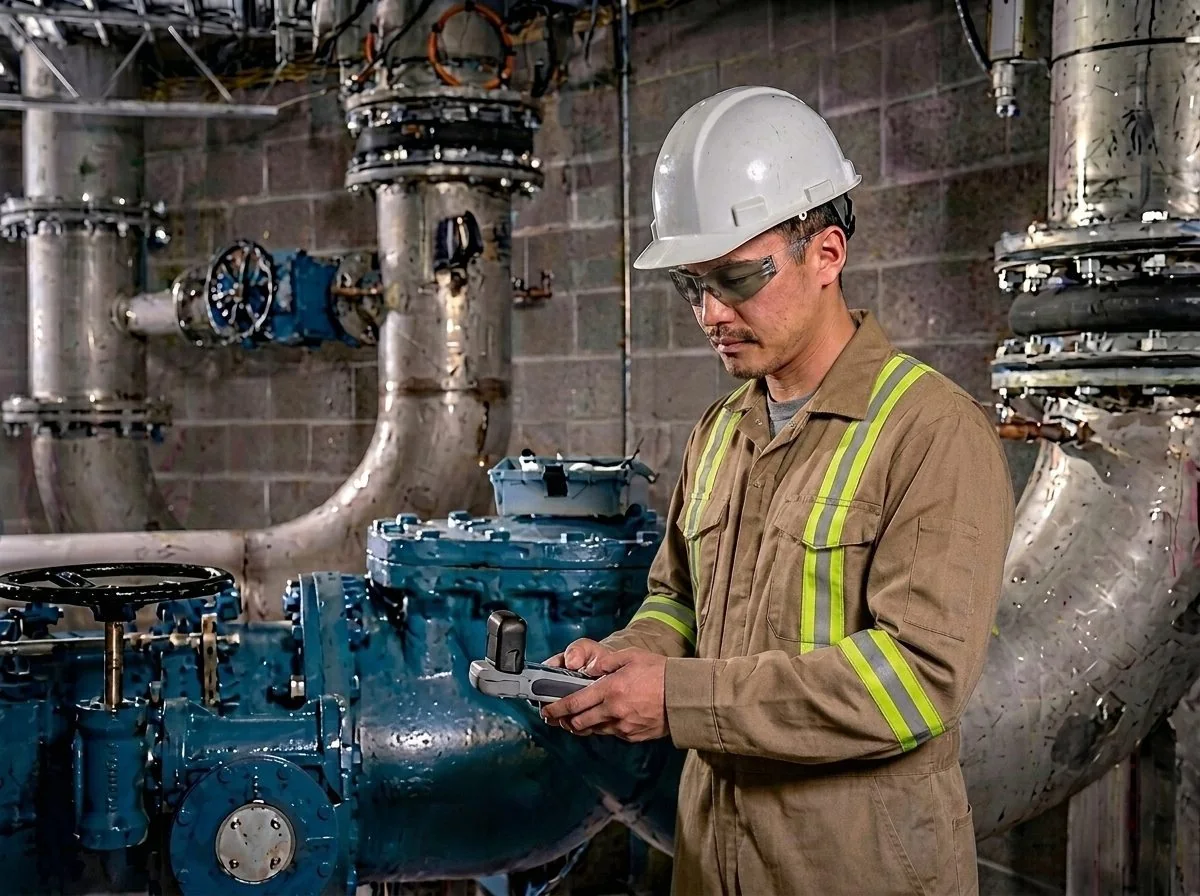
The DR300 Manganese is used throughout the treatment process for monitoring and process control:
| Treatment Point | Monitoring Purpose | Typical Range |
|---|---|---|
| Raw groundwater / source water | Establish baseline; size treatment system | 0.01–3.0+ mg/L (widely variable by geology) |
| After aeration or pre-oxidation | Verify manganese oxidation for filtration | Should decrease vs. raw; oxidized Mn²+ precipitates |
| After greensand or MnO₂ filtration | Confirm removal; monitor filter exhaustion | Should be <0.05 mg/L in product water |
| After KMnO₄ treatment | Confirm adequate dose; excess KMnO₄ causes pink water | Target <0.05 mg/L in filter effluent |
| Finished water / distribution | SMCL compliance; staining complaint investigation | Target <0.05 mg/L; customer complaints typically at >0.1 mg/L |
Reagents & Parts Reference
| Item | Hach Item No. | Notes |
|---|---|---|
| PAN Indicator Solution | 2289826 (verify) | Primary colorimetric reagent; added last in the sequence |
| Ascorbic Acid Reagent | Included in Mn test kit | Eliminates chlorine interference; added first |
| Alkaline Cyanide Reagent | Included in Mn test kit | Masks iron and copper; add before PAN |
| DR300 instrument cap | LPV445.97.08100 | Must be installed before ZERO or READ |
| Sample cell cap | LPV445.97.08200 | Caps cell between reagent additions |
| Batteries, AAA (4-pack) | Standard AAA alkaline | Replace all 4 simultaneously |
| Alkaline Cyanide reagent contains cyanide compounds — handle with care, wear gloves and eye protection, do not acidify (generates HCN gas). Dispose as hazardous waste. Confirm current item numbers at hach.com. | ||
Related DR300 & Hach Instrument References
- Hach DR300 Iron FerroVer® — 0.02–5.00 mg/L Fe (frequently co-monitored with Mn)
- Hach DR300 Chlorine (Free & Total)
- Hach DR300 Phosphate
- Hach DR300 Bromine
- Hach DR300 Chlorine Dioxide
- Hach DR300 Ammonia
- Hach DR300 Nitrate
- Hach DR900 Multiparameter Colorimeter
- Hach DR1900 Portable Spectrophotometer
- Colorimeter vs Spectrophotometer — Complete Buyer’s Guide
- All Commercial Water Lab Guides