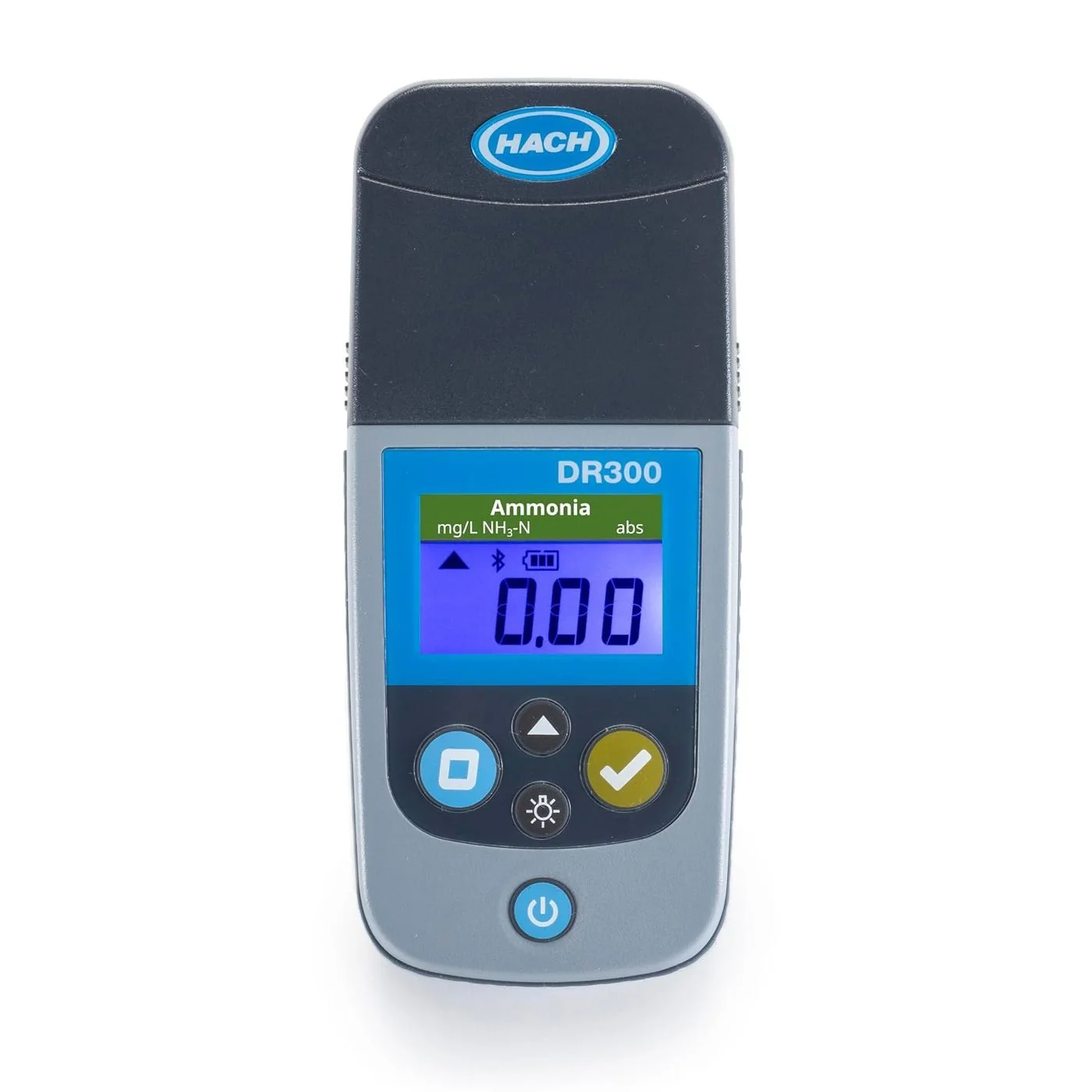
Hach DR300 Ammonia Pocket Colorimeter: Complete Review & Reference (2026)
Disclosure: This page contains affiliate links. If you purchase through our links, we may earn a commission at no extra cost to you. See our affiliate disclosure.
Nessler Method 8038 (LR: 0.01–2.50 mg/L NH₃-N) • Salicylate Method 10031 (HR: 0.4–50.0 mg/L NH₃-N) • IP67
Source: Hach DR300 User Manual DOC022.97.90639 Ed.5 (09/2021) • Methods 8038 & 10031

Two Methods, One Instrument — Choosing Nessler vs Salicylate
The DR300 Ammonia model is unique in the DR300 family because it supports two fundamentally different colorimetric methods targeting different concentration ranges and different regulatory applications. Understanding which method to use is the most important operational decision for this instrument.
Color: Yellow-orange
Read window: 1–10 minutes
Reagent: Contains mercury (hazardous waste)
Best for: Drinking water, nitrification monitoring, low-level environmental samples
Advantage: Highest sensitivity (0.01 mg/L detection)
Color: Blue (indophenol)
Read window: 15–20 minutes
Reagent: Mercury-free
Best for: Wastewater compliance, high-strength samples, nitrification control
Advantage: Higher range, no mercury disposal
Ammonia in Water Treatment — Why It Matters
Ammonia-nitrogen (NH₃-N) is monitored across the full water treatment spectrum for different reasons at each stage:
| Application | Typical Range | Method | Why Monitored |
|---|---|---|---|
| Drinking water source | 0.1–5.0 mg/L | Nessler LR or Salicylate HR | Source water quality; affects chloramination chemistry and chlorine demand |
| Chloraminated distribution system | 0.01–0.5 mg/L | Nessler LR | Nitrification monitoring; rising ammonia signals nitrifier activity consuming chloramine |
| Wastewater influent | 15–50 mg/L | Salicylate HR | Influent loading characterization; process control for biological nitrification |
| Wastewater effluent | 1–10 mg/L | Salicylate HR or Nessler LR | NPDES permit compliance; most discharge permits have NH₃-N limits |
| Nitrification/denitrification process | 1–30 mg/L | Salicylate HR | Biological process control; optimize aeration and carbon source addition |
| Aquaculture/fish hatchery | 0.01–1.0 mg/L | Nessler LR | Ammonia toxicity to fish; unionized NH₃ is the toxic form (pH-dependent) |
| Industrial process water | Varies widely | Select by concentration | Contamination indicator; process chemistry control |
Ammonia Units — NH₃-N vs NH₃ vs NH₄⁺ Conversions
DR300 ammonia results are reported as NH₃-N (ammonia expressed as nitrogen). Many permits and standards use the same units, but some use total ammonia (NH₃) or ammonium (NH₄⁺). The conversion factors:
Example: 5.0 mg/L NH₃-N = 6.08 mg/L NH₃
Example: 5.0 mg/L NH₃-N = 6.44 mg/L NH₄⁺
Nessler Method 8038 Procedure (LR: 0.01–2.50 mg/L)
Fill the sample cell to the appropriate volume
Use the 16 mm glass test vial with the cell adapter installed. Fill to the mark specified for the LR Nessler method.
Add Mineral Stabilizer reagent and Polyvinyl Alcohol Dispersing Agent
These conditioning reagents prepare the sample matrix by complexing interfering metal ions and suspending turbidity. Add in the order specified: Mineral Stabilizer first, then Polyvinyl Alcohol Dispersing Agent. Invert to mix.
Add Nessler Reagent — start 1-minute timer
Add Nessler reagent and invert to mix. Yellow-orange color develops if ammonia is present. Start the 1-minute timer immediately. The minimum wait before reading is 1 minute.
Read within 10 minutes of reagent addition
Insert cell into instrument (cell adapter must be in place), install cap, zero with blank, then read. The acceptable read window is 1 to 10 minutes. After 10 minutes, color may begin to fade or shift.
Salicylate Method 10031 Procedure (HR: 0.4–50.0 mg/L)
Fill the sample cell to the specified volume
Use the 16 mm test vial with cell adapter. Fill to the appropriate mark for the Salicylate method volume.
Add Ammonia Salicylate Reagent — mix
Add one Ammonia Salicylate Reagent Powder Pillow. Cap and invert to mix until dissolved.
Add Ammonia Cyanurate Reagent — mix — start 15-minute timer
Add one Ammonia Cyanurate Reagent Powder Pillow. Cap and invert to mix. Start a 15-minute timer immediately. Blue-green color develops if ammonia is present.
At exactly 15 minutes — zero with blank then read
At the 15-minute mark: insert the blank cell (sample water with no reagent), press ZERO. Swap to the reagent cell, press READ. Read within the 15–20 minute window. Color is stable for up to 20 minutes from reagent addition; beyond 20 minutes it may fade.
Interferences — Both Methods
| Interferent | Nessler LR | Salicylate HR | Treatment |
|---|---|---|---|
| Residual chlorine | Positive interference — destroys Nessler color | Destroys indophenol color | Add 1 drop sodium thiosulfate solution (3.5%) per 25 mL sample before testing; mix and proceed immediately |
| Turbidity | Positive interference at high turbidity | Positive interference | Filter through glass fiber or 0.45-micron membrane; correct for baseline turbidity with blank |
| Hardness (>500 mg/L CaCO₃) | Precipitate forms with Nessler; causes turbidity | Minor effect | Pre-treat with EDTA solution to complex calcium and magnesium; or dilute sample |
| Amines (primary) | Positive interference — react like ammonia | Some reaction | Distillation pre-treatment separates true ammonia from amines; required for highly contaminated industrial samples |
| Hydrogen sulfide (H₂S) | Interferes with color | Interferes with color | Acidify and aerate briefly to drive off H₂S before testing; re-check pH |
| pH outside 6–8 | Affects Nessler reaction | Affects indophenol formation | Adjust to pH 7 ± 1 before testing if sample is strongly acidic or alkaline |
Wastewater Compliance Context
Ammonia is one of the most commonly regulated parameters in NPDES wastewater discharge permits. The regulatory framework has two components:
| Regulation | Basis | Typical Limit |
|---|---|---|
| Aquatic toxicity — chronic | Unionized NH₃ is toxic to fish; toxicity increases with pH and temperature | Site-specific; often 1–10 mg/L NH₃-N in effluent depending on receiving water |
| Oxygen demand | Nitrification by Nitrosomonas and Nitrobacter consumes dissolved oxygen in receiving water | Limits set to protect DO in receiving water; often seasonal (summer more stringent) |
| Nitrogen removal | Nutrient impairment of receiving waters; eutrophication concerns | Total nitrogen limits often accompany NH₃-N limits in nutrient-sensitive waters |
| Consult your NPDES permit for specific limit values. NH₃-N limits vary widely by receiving water classification, state, and seasonal conditions. | ||
Reagents & Parts Reference
| Item | Method | Hach Item No. | Notes |
|---|---|---|---|
| Nessler Reagent | LR (8038) | 2119134 | Contains mercury; hazardous waste disposal required |
| Mineral Stabilizer | LR (8038) | 2355953 | Added before Nessler; complexes interfering metals |
| Polyvinyl Alcohol Dispersing Agent | LR (8038) | 2355953 (kit) | Disperses turbidity before Nessler addition |
| Ammonia Salicylate Reagent Powder Pillows | HR (10031) | 2605345 | First reagent added in Salicylate procedure |
| Ammonia Cyanurate Reagent Powder Pillows | HR (10031) | 2605445 | Second reagent; starts 15-minute timer |
| 16 mm glass test vials | Both | 2427700 (verify) | Used with cell adapter in DR300 compartment |
| Cell adapter | Both | Included with instrument | Required for 16 mm vials; do not omit |
| Sodium thiosulfate, 3.5% solution | Both (dechlorination) | 2640349 (verify) | For dechlorinating chlorinated samples before testing |
| Confirm current item numbers at hach.com. For Nessler reagent disposal: treat as mercury-containing hazardous waste per local regulations. | |||
Related DR300 & Hach Instrument References
- Hach DR300 Chlorine (Free & Total)
- Hach DR300 Iron FerroVer®
- Hach DR300 Phosphate (Methods 8048 & 8007)
- Hach DR300 Bromine (DPD Method 8016)
- Hach DR300 Chlorine Dioxide (Method 8138)
- Hach DR300 Nitrate (Cadmium Reduction Method 8039)
- Hach DR300 Manganese (PAN Method 8034)
- Hach DR900 Multiparameter Colorimeter — 48+ Parameters
- Hach DR1900 Portable Spectrophotometer
- Colorimeter vs Spectrophotometer — Complete Buyer’s Guide
- All Commercial Water Lab Guides