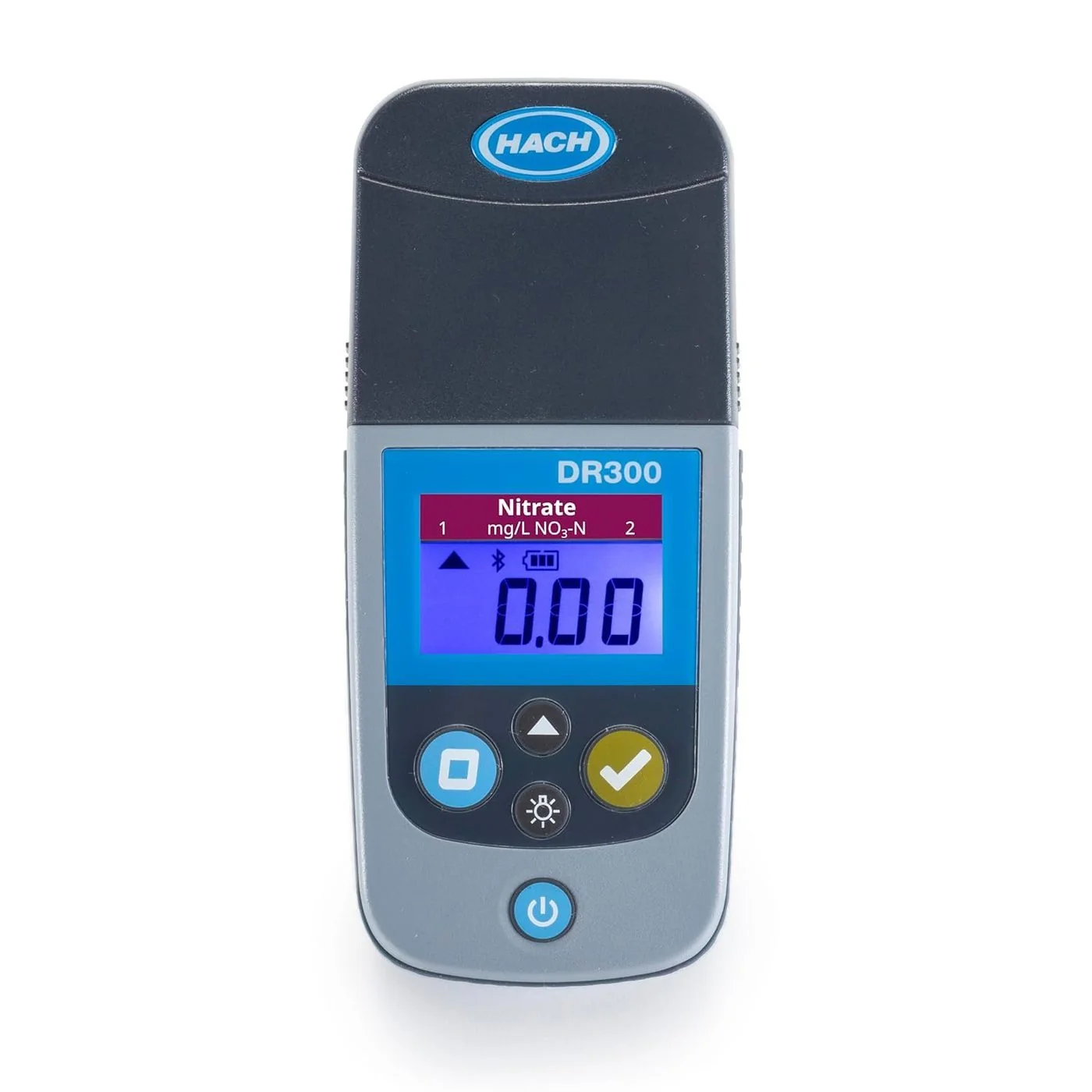
Hach DR300 Nitrate Pocket Colorimeter: Complete Review & Reference (2026)
Disclosure: This page contains affiliate links. If you purchase through our links, we may earn a commission at no extra cost to you. See our affiliate disclosure.
Cadmium Reduction Method 8039 • LR: 0–0.50 mg/L NO₃−-N • HR: 0–30.0 mg/L NO₃−-N • IP67
Source: Hach DR300 User Manual DOC022.97.90639 Ed.5 (09/2021) • Hach Method 8039 (NitraVer® 5)

EPA Drinking Water Standard — The 10 mg/L MCL
Nitrate is one of the most tightly regulated parameters in drinking water because of its acute health effect on infants. The mechanism is methemoglobinemia: nitrate is reduced to nitrite in the gastrointestinal tract of infants (whose stomach pH is higher than adults), and nitrite oxidizes hemoglobin to methemoglobin, which cannot carry oxygen. This can be fatal in infants under 6 months.
US Safe Drinking Water Act
Multiply NO₃-N × 4.43
≈11.3 mg/L as NO₃-N
Infants; methemoglobinemia risk
Unit Conversion — NO₃-N vs NO₃-
Permits, standards, and instruments may report in either unit. Always confirm before comparing results or reporting against a limit:
| To Convert | Multiply By | Example |
|---|---|---|
| NO₃-N → NO₃- (nitrate ion) | 4.43 | 10 mg/L NO₃-N × 4.43 = 44.3 mg/L NO₃- |
| NO₃- → NO₃-N | 0.226 | 44.3 mg/L NO₃- × 0.226 = 10 mg/L NO₃-N |
| DR300 Nitrate reports in mg/L as NO₃-N. US EPA MCL is stated as NO₃-N. EU Nitrate Directive is stated as NO₃-. | ||
How the Cadmium Reduction Method Works
The NitraVer® 5 reagent contains cadmium sulfate and a diazotizing/coupling agent combination. In the presence of cadmium metal, nitrate (NO₃−) is reduced to nitrite (NO₂−). The nitrite then reacts with the sulfanilic acid component of the reagent to form a diazonium salt, which couples with gentisic acid to form a pink-red azo dye. The pink color intensity is proportional to the original nitrate (plus any pre-existing nitrite) concentration.
Standard Test Procedure (Both LR and HR)
Check sample pH — adjust if outside 5–9
The cadmium reduction and azo coupling reactions require pH 5–9. Outside this range, results will be inaccurate. Adjust strongly acidic or alkaline samples with NaOH or HCl to the acceptable pH range before testing. Record the adjustment.
Fill the sample cell to the specified volume
Use the appropriate cell for your DR300 configuration. Triple-rinse the cell with sample before the measurement fill.
Add NitraVer® 5 Nitrate Reagent Powder Pillow — cap and shake 1 minute
Add the full contents of one NitraVer® 5 powder pillow to the sample. Cap and shake vigorously for exactly 1 minute. The shaking activates the cadmium reduction. Pink color develops if nitrate/nitrite is present. Start the timer immediately after the 1-minute shake is complete.
Wait 1 minute — then read within 5 minutes
After the 1-minute shake, wait 1 additional minute for color to develop. Then insert cell, install cap, zero with blank, and read. The acceptable read window is 1 to 5 minutes after the shake period ends. Do not read before 1 minute (color development incomplete) or after 5 minutes (color may fade).
Applications
| Application | Range | Key Context |
|---|---|---|
| Drinking water compliance | LR (0–0.50) or HR (0–30.0) | EPA MCL 10 mg/L NO₃-N; HR covers the MCL; LR for low-level groundwater monitoring |
| Groundwater monitoring | LR or HR | Agricultural areas; septic system plumes; varies from <0.5 to >30 mg/L |
| Agricultural runoff / irrigation water | HR | Nitrate leaching from fertilizers; stormwater compliance; irrigation quality for sensitive crops |
| Wastewater effluent | HR | NPDES total nitrogen compliance; biological denitrification process control |
| Aquaculture | LR or HR | High nitrate toxic to shrimp and sensitive fish; recirculating aquaculture systems accumulate nitrate |
| Food and beverage process water | LR | Nitrate limits in water used for certain food products; brewing water quality |
| Environmental monitoring | LR or HR | Lake and river eutrophication; nutrient load assessment |
Interferences
| Interferent | Effect | Treatment |
|---|---|---|
| Nitrite (NO₂−) | Positive interference — measured together with nitrate | Measure nitrite separately; true nitrate = total reading minus nitrite value |
| pH <5 or >9 | Cadmium reduction and azo coupling both pH-dependent | Adjust to pH 5–9 before testing; record adjustment in lab notes |
| Chloride (>200 mg/L) | High chloride can interfere with cadmium reduction efficiency | Dilute high-chloride samples (seawater, brine); multiply result by dilution factor |
| Residual chlorine | May oxidize the azo dye and produce falsely low results | Dechlorinate with sodium thiosulfate before testing; add 1 drop 3.5% Na₂S₂O₃ per 25 mL |
| Color >20 APHA units | Background color adds to absorbance measurement | Zero the instrument with sample water (no reagent) to subtract background color |
| Turbidity | Scatters light; positive interference | Filter through 0.45-micron membrane before testing colored or turbid samples |
Reagents & Parts Reference
| Item | Hach Item No. | Notes |
|---|---|---|
| NitraVer® 5 Nitrate Reagent Powder Pillow (pkg/100) | 2107228 | Primary reagent; cadmium-containing hazardous waste after use |
| NitraVer® 5 Nitrate Reagent Powder Pillow (pkg/25) | 2107225 | Smaller quantity for lower-volume applications |
| Sodium thiosulfate solution, 3.5% (for dechlorination) | 2640349 (verify) | Add 1 drop per 25 mL sample to remove residual chlorine before testing |
| DR300 instrument cap | LPV445.97.08100 | Must be installed before ZERO or READ |
| Batteries, AAA (4-pack) | Standard AAA alkaline | Replace all 4 simultaneously |
| All cadmium-containing reagent waste must be collected and disposed of as hazardous waste. Confirm current Hach item numbers at hach.com before ordering. | ||
Related DR300 & Hach Instrument References
- Hach DR300 Chlorine (Free & Total)
- Hach DR300 Iron FerroVer®
- Hach DR300 Phosphate
- Hach DR300 Bromine
- Hach DR300 Chlorine Dioxide
- Hach DR300 Ammonia
- Hach DR300 Manganese (PAN Method 8034)
- Hach DR900 Multiparameter Colorimeter
- Hach DR1900 Portable Spectrophotometer
- Colorimeter vs Spectrophotometer — Complete Buyer’s Guide
- All Commercial Water Lab Guides