Hach DR300 Iron FerroVer® Pocket Colorimeter: Complete Review & Reference (2026)
Disclosure: This page contains affiliate links. If you purchase through our links, we may earn a commission at no extra cost to you. See our affiliate disclosure.
Sources: Hach DR300 User Manual DOC022.97.90639 Edition 5 (09/2021) • Hach Method DOC316.53.01458 Edition 2 (12/2018)
Part No. LPV445.97.22110 (Americas) • USEPA FerroVer® Method 8008 • 0.02–5.00 mg/L Fe • IP67 Waterproof
What the DR300 Iron FerroVer® Measures & Who Uses It
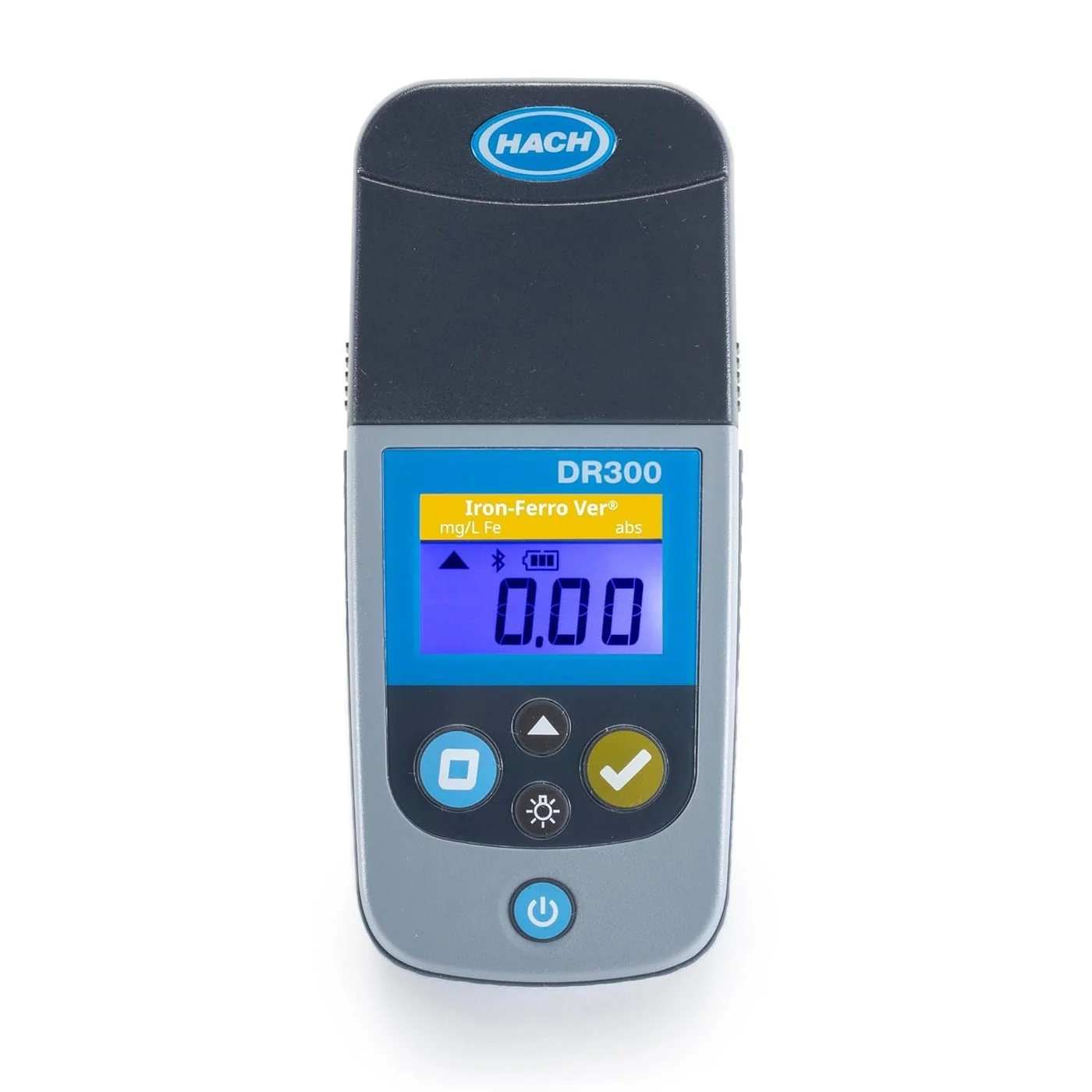
The Hach DR300 LPV445.97.22110 is a single-parameter portable photometer factory-configured for Total Iron measurement using FerroVer® reagent chemistry — USEPA approved Method 8008. Unlike the chlorine DR300 which has LR and HR switching, the iron model operates on a single range (0.02–5.00 mg/L Fe) and uses only 25 mm glass sample cells throughout. The 0.02 mg/L lower limit is well below the EPA secondary maximum contaminant level for iron (0.3 mg/L) and sensitive enough for virtually all drinking water, wastewater, industrial, and environmental applications.
| Application | Why Iron Measurement Matters |
|---|---|
| Drinking water treatment | Iron causes taste, odor, and staining above 0.3 mg/L (EPA secondary standard); monitoring ensures compliance and prevents customer complaints |
| Well water and groundwater | Naturally occurring iron is common; test results guide iron filter selection, sizing, and system performance verification |
| Wastewater effluent | USEPA-approved method supports regulatory compliance reporting for iron in discharge permits (Federal Register, June 27, 1980) |
| Industrial cooling towers & boilers | Iron indicates corrosion; monitoring guides corrosion inhibitor dosing and system maintenance scheduling |
| Food and beverage | Process water iron affects product taste; boiler feed water iron causes scaling in heat exchangers |
| Mining and acid mine drainage | High-iron drainage monitoring; dilution technique handles concentrations above 5.00 mg/L |
| Seawater analysis | Method scope explicitly includes seawater; digestion required for total iron |
How FerroVer® Chemistry Works
FerroVer® reagent performs two simultaneous functions when added to a water sample:
Converts all soluble iron AND most insoluble iron forms (oxides, rust particles) to soluble ferrous iron (Fe²+). Without this step, only dissolved iron would be detected.
Fe²+ reacts with the 1,10-phenanthroline indicator to form an orange complex. Intensity is directly proportional to iron concentration. The DR300’s LED measures absorbance and converts to mg/L Fe.
| What You Want to Measure | Sample Preparation |
|---|---|
| Total iron (all forms including oxides and rust) | Digest unfiltered sample with heat and acid; adjust pH to 3–5 with 5 N NaOH before testing |
| Dissolved iron only (soluble forms) | Filter sample through 0.45-micron membrane immediately after collection, before acidification; no digestion required |
The Critical Timing Window — Most Common Error Source
Technical Specifications
| Specification | Detail |
|---|---|
| Product number | LPV445.97.22110 (Americas) • LPV445.99.22110 (EU — includes reagents) |
| Parameter | Total Iron (Fe) — all soluble iron and most insoluble forms via FerroVer® |
| Measurement range | 0.02–5.00 mg/L Fe (single range — no LR/HR switching) |
| Method | USEPA FerroVer® Method 8008 (DOC316.53.01458); regulatory status: Federal Register June 27, 1980 |
| Method precision | 1.00 ± 0.2 mg/L Fe at 95% confidence interval (laboratory conditions) |
| Sample cell | 25 mm (10 mL) GLASS round cell ONLY (Item 2427606) — no plastic cells for this model |
| IP rating | IP67 — waterproof at 1 m for 30 minutes (battery compartment closed and locked) |
| Light source | LED, fixed wavelength ±2 nm, factory-calibrated for FerroVer® iron method |
| Detector | Silicon photodiode • Filter bandwidth: 15 nm |
| Absorbance range | 0 to 2.5 Abs (E-15 error above 3.5 Abs) |
| Power | 4 × AAA alkaline batteries — NO rechargeable batteries • ~5,000 tests |
| Data storage | Last 50 measurements with time stamp; auto-overwrites oldest |
| Bluetooth® | Via optional Hach Communication Dongle (LPV446.99.00012) — enables Claros® connectivity |
| Operating temperature | 0–50°C (32–122°F); 0–90% RH non-condensing |
| Dimensions | 6.9 × 15.7 × 3.4 cm • Weight: 0.25 kg |
| Warranty | 1 year Americas / 2 years EU |
Procedure A — Powder Pillow Method (15 Steps)
The standard field and laboratory procedure. Requires two 25 mm glass cells: one for the blank and one for the reacted sample.
Set instrument to Iron parameter
Push the Range key (up arrow, top-left). The display confirms the Iron (Fe) parameter is active.
Prepare the sample cell
Rinse a 25 mm glass sample cell and cap three times with the sample water. Fill to the 10-mL mark with sample. This cell will receive the reagent.
Add FerroVer® reagent
Add the entire contents of one FerroVer® Iron Reagent Powder Pillow (Item 2105769, 10-mL size) to the sample cell.
Swirl to mix
Swirl the sample cell to dissolve the powder completely. Undissolved powder affects results.
Start 3-minute reaction timer — mandatory
Set and start a timer for exactly 3 minutes. The orange color develops during this window. Do not zero or read before the timer expires.
Prepare the blank (while sample reacts)
Rinse a second 25 mm glass sample cell and cap three times with the same source water. Fill to the 10-mL mark. Close the cap. No reagent is added to the blank.
Clean the blank cell (at 3:00)
When the timer expires, wipe the exterior of the blank cell with a lint-free cloth. Remove all fingerprints, liquid drops, and residue from the optical surface.
Insert blank into cell holder
Place the blank in the cell holder with the diamond orientation mark pointing toward the keypad.
Install the instrument cap — critical
Place the cap fully over the cell holder. Must be completely seated before pressing Zero. This is the most common cause of E-01 errors.
Zero the instrument
Press Zero. Display shows “––––” then “0.00”. Instrument is zeroed against the blank.
Remove blank
Remove the blank sample cell from the holder.
Clean the reacted sample cell
Wipe all exterior surfaces of the reacted sample cell with a lint-free cloth. Any residue on the optical path affects the reading.
Insert sample within 5 minutes of timer expiry
Place the reacted sample in the cell holder, diamond mark toward the keypad. You have 5 minutes from the 3:00 mark (total window: 3:00–8:00). Results become less accurate after 8 minutes.
Install the cap again
Place the instrument cap fully over the cell holder before pressing Read.
Press Read — record result
Press Read. Result displays in mg/L Fe and is automatically stored with a time stamp. If the value flashes, it is outside the 0.02–5.00 range — dilute and retest if high.
Procedure B — AccuVac® Ampul Method (15 Steps)
The AccuVac® is a vacuum-sealed pre-filled reagent ampul. When the tip is snapped and submerged, the vacuum draws exactly the correct sample volume automatically — no pipetting or volume measurement required. The ampul serves directly as the sample cuvette for the Read step.
| Feature | Powder Pillow | AccuVac® Ampul |
|---|---|---|
| Sample volume measurement | Operator fills to 10-mL mark | Automatic — vacuum draws exact volume |
| Reagent addition | Open pillow and pour into cell | Pre-loaded; no dispensing |
| Cells needed | 2 glass cells (blank + sample) | 1 glass cell (blank) + AccuVac ampul |
| Best for | Lab and controlled field conditions | Field use in wind, rain; reduces spill risk |
| Cost per test | Lower | Higher (pre-filled ampuls) |
Set instrument to Iron
Push the Range key (top-left).
Collect sample in beaker
Pour at least 40 mL of sample into a 50-mL beaker (Item 50041H). The AccuVac fills by vacuum — enough volume must be present to fully submerge the tip.
Fill the AccuVac® ampul — keep tip submerged
Snap the ampul tip. Keep the tip fully submerged in the sample until the ampul is completely filled. Lifting the tip prematurely introduces air and voids the vacuum fill.
Mix
Invert the AccuVac ampul several times to mix the sample with the pre-loaded reagent inside.
Start 3-minute reaction timer
Same mandatory timing as Powder Pillow method.
Prepare the blank
Rinse a 25 mm glass cell and cap three times with sample. Fill to 10-mL mark. No reagent added.
Zero with blank (at timer expiry)
Clean blank cell exterior → insert with diamond mark toward keypad → install cap → press Zero (same as Powder Pillow Steps 7–10).
Remove blank
Remove the blank cell from the holder.
Clean the AccuVac® ampul exterior
Within 5 minutes of timer expiry: wipe all exterior surfaces of the AccuVac ampul with a lint-free cloth.
Insert AccuVac® ampul into 25 mm holder
The round-bottom AccuVac ampul fits directly into the 25 mm cell holder.
Install cap
Place cap fully over cell holder.
Press Read
Result displays in mg/L Fe and is stored automatically.
Interferences — Complete Reference
| Interference | Effect | Pre-Treatment |
|---|---|---|
| Turbidity | Scatters light independently of iron color — produces falsely high readings | Pre-treat blank with 0.1 g RoVer® Rust Remover (Item 30001); swirl to dissolve before zeroing. Or filter through 0.45-micron membrane (Item 253000). Apply same treatment to both blank and sample. |
| Color (sample has inherent color) | Absorbs at the measurement wavelength — biases results | Prepare reagent blank: measure the reagent blank absorbance by adding FerroVer® to deionized water and reading against a deionized water blank; subtract the reagent blank value from all sample results. |
| Phosphate >1 mg/L (as PO₄³−) | Interferes by precipitating iron | Reduce phosphate concentration by dilution or alternative method; or use standard addition method to verify results. |
| Strong oxidizing agents (e.g., chlorine) | Oxidize Fe²+ back to Fe³+ during reaction, preventing color development — gives falsely low results | Add sodium thiosulfate to quench residual oxidants before testing. Confirm by standard additions. |
| High chromium or copper concentrations | May interfere at very high concentrations | Dilute sample; verify by standard additions method. |
| Bismuth, cadmium, mercury, molybdate, silver (each >10 mg/L) | Various interference mechanisms at high concentrations | These concentrations are rare in environmental and potable water; standard additions verification recommended if suspected. |
| Condensation on cold samples | Water droplets on cell exterior scatter light | Wipe cell exterior with lint-free cloth immediately before insertion. |
Iron-Specific Field Diagnostics
| Symptom | Likely Cause | Solution |
|---|---|---|
| Result consistently low vs. expected | Reaction timer not complete when zeroing; color underdeveloped | Ensure full 3-minute reaction before zeroing; zero only after timer expires |
| Result above 5.00 mg/L (E-04 flashing) | Sample iron exceeds range | Dilute with deionized water (e.g., 1:5); multiply result by dilution factor |
| Results vary between replicates | Inconsistent cell orientation; fingerprints; bubbles in cell | Orient diamond mark consistently toward keypad; wipe thoroughly; invert cell before insertion to remove bubbles |
| Result near zero for sample known to contain iron | Iron present as oxide/rust; no digestion performed | Digest sample with heat and acid; adjust pH to 3–5; retest |
| Orange color in blank (won’t zero at 0.00) | Iron contamination in rinse water or blank water | Use reagent-grade deionized water for blank; measure and subtract reagent blank value |
| High or erratic results in turbid sample | Turbidity scattering — not iron color | Pre-treat with RoVer® Rust Remover or filter through 0.45-micron membrane |
| Reading drifts or drops after Read | Sample read after the 8-minute window | Repeat test and read within 3–8 minutes from reagent addition |
Error Code Reference
| Code | Name | Cause | Solution |
|---|---|---|---|
| E-00 | No Zero | Sample measured before zeroing | Measure blank to zero first |
| E-01 | Ambient light | Instrument cap not fully installed | Seat cap fully; re-zero |
| E-02 | LED error | LED unstable or insufficient output | Replace all 4 batteries; contact Hach if persists |
| E-03 | SCA error | Standard outside SCA adjustment limits | Prepare fresh standard; verify concentration |
| E-04 (flashing) | Out of range | Value above 5.00 or below 0.02 mg/L | High: dilute and retest. Low: check cap; re-zero. |
| E-06 | Absorbance error | Absorbance incorrect in user calibration; fewer than 2 points | Re-enter data; ensure minimum 2 data pairs |
| E-07 | Duplicate standard | Duplicate concentration in user calibration | Enter unique concentrations for each point |
| E-09 | Flash error | Cannot save to memory | Hold Power 5 sec to reset; contact Hach if persists |
| E-10 | Temperature range | Ambient temp outside 0–50°C | Move to within operating temperature range |
| E-12 | Low battery | Battery power insufficient | Replace all 4 AAA alkaline batteries immediately |
| E-13 | Parameter load failure | Memory defective | Contact Hach technical support |
| E-14 | Zero invalid | Cell empty or improperly filled | Fill cell completely; retry |
| E-15 | Absorbance too high | Absorbance above 3.5 Abs | Dilute sample; check for light blockage |
| E-20 | Signal out of range | Excessive ambient light | Ensure cap fully installed; repeat test |
| E-21 | Signal unstable | Fluctuating ambient light | Shield from light sources; repeat test |
| E-22 | Hardware error | Electronic system defective | Contact Hach technical support |
Reagents, Parts & Accessories
| Description | Qty/Test | Pack | Item No. |
|---|---|---|---|
| FerroVer® Iron Reagent Powder Pillows, 10-mL | 1 | 100/pkg | 2105769 |
| FerroVer® Iron Reagent AccuVac® Ampuls | 1 | 25/pkg | 2507025 |
| Sample cells, 25 mm (10 mL) round glass — LR and ALL iron tests | 2 (PP) / 1 (AV) | 6/pkg | 2427606 |
| Beaker, 50 mL (AccuVac® method) | 1 | each | 50041H |
| Stopper for 18-mm tubes and AccuVac® Ampuls | 2 | 6/pkg | 173106 |
| AccuVac® Ampul Snapper | — | each | 2405200 |
| RoVer® Rust Remover (turbid sample pre-treatment) | — | 454 g | 30001 |
| AAA alkaline batteries | — | 4/pkg | 4674300 |
| Instrument cap (cell holder cover) | — | 1 | LPZ445.99.00006 |
| Battery cover | — | 1 | LPZ445.99.00007 |
| Hach Communication Dongle (Bluetooth® / Claros®) | — | 1 | LPV446.99.00012 |
| Soft-sided carrying case / holster | — | 1 | 5953100 |
| Reagents are NOT included with the Americas version (LPV445.97.22110). The EU/International version (LPV445.99.22110) includes reagents. | |||
Verification Standards
| Description | Pack | Item No. |
|---|---|---|
| Iron Standard Solution, PourRite™ Ampules, 50 mg/L, 2 mL | 20/pkg | 1425420 |
| Iron Standard Solution, 100 mg/L Fe | 100 mL | 1417542 |
| Metals Drinking Water Standard, LR (Cu, Fe, Mn) | 500 mL | 2833749 |
| Metals Drinking Water Standard, HR (Cu, Fe, Mn) | 500 mL | 2833649 |
| Water, deionized | 4 L | 27256 |
- Iron in Well Water Guide — Ferrous vs. Ferric, Testing, and Treatment
- Colorimeter vs Spectrophotometer — Complete Buyer's Guide
- Hach DR1900 Portable Spectrophotometer — 340–800 nm, Full Spectrophotometer
- Hach DR300 Chlorine Dioxide — DPD Method 8138, Glycine Pre-Treatment
- Hach DR300 Ammonia — Nessler Method 8038 & Salicylate Method 10031
- Hach DR300 Nitrate — NitraVer® 5 Cadmium Reduction Method 8039
- Hach DR300 Manganese — PAN Method 8034, 0.006–0.700 mg/L Mn
- Hach DR900 Multiparameter Colorimeter — 48+ Parameters, 90+ Methods
- Hach DR300 Chlorine (Free & Total) — LPV445.97.00110
- Agricultural RO Water Treatment — Iron in Irrigation Water
- Industrial Water & Waste Treatment Overview