Home › Reviews › Hach Water Test Kits
Hach Water Test Kits: 5-B, 5-EP, CN-70, CN-66F & CN-66T (2026 Review)
Disclosure: This page contains affiliate links. If you purchase through our links, we may earn a commission at no extra cost to you. See our affiliate disclosure.
Hach's test kit lineup covers the two parameters that matter most for operational water quality decisions: hardness and chlorine. These five kits span routine troubleshooting to precision field measurement — all using the same DPD and EDTA titration methods referenced in Standard Methods for the Examination of Water and Wastewater. Here's what each kit does, where each belongs in a commercial water treatment workflow, and how they connect to photometric instruments when you need more.
Contents
Quick Comparison
| Kit | Parameter | Method | Range | Best For | Amazon |
|---|---|---|---|---|---|
| Hach 5-B | Total Hardness | EDTA drop-count titration | 0–30 gpg | Softener verification, routine checks | View → |
| Hach 5-EP | Total Hardness | EDTA buret titration | 0–30 gpg | Precision QC, baseline measurement | View → |
| Hach CN-70 | Free + Total Cl₂ | DPD powder / visual comparator | 0–10 mg/L | Combined chlorine monitoring, EPA method | View → |
| Hach CN-66F | Free Cl₂ only | DPD powder / color disc | 0.1–3.4 mg/L | Rapid free-chlorine spot checks | View → |
| Hach CN-66T | Total Cl₂ only | DPD tablet / color disc | 0–10 mg/L | Total chlorine monitoring, distribution systems | View → |
Which Kit for Which Application
The right kit depends on what you're measuring and why. The decision tree for commercial water applications:
Hach 5-B Total Hardness Test Kit

The 5-B is the most widely used field hardness kit in commercial water treatment. Drop-count titration with EDTA is straightforward: add the buffer reagent to the sample, add the indicator, then count drops of titrant until the color endpoint changes from red to blue. Each drop represents a fixed hardness increment, and the total count gives grains per gallon directly.
With over 2,000 Amazon reviews and more than 900 units bought per month, the 5-B is the default hardness check for operators verifying softener performance, troubleshooting scale in commercial equipment, and confirming pre-treatment water quality before an RO membrane.
What the 5-B Does Well
The drop-count method is more quantitative than colorimetric strip tests and significantly more portable than a lab titration setup. For commercial operators who need to verify a water softener is regenerating correctly — particularly before an RO membrane where hardness above 1 gpg will shorten membrane life — the 5-B gives actionable numbers in under five minutes.
The kit includes a square sample bottle, measuring tube, and both reagents (ManVer 2 hardness indicator and ManVer EDTA titrant). Components are reusable; only the titrant and indicator are consumable.
Hach 5-EP Total Hardness Test Kit
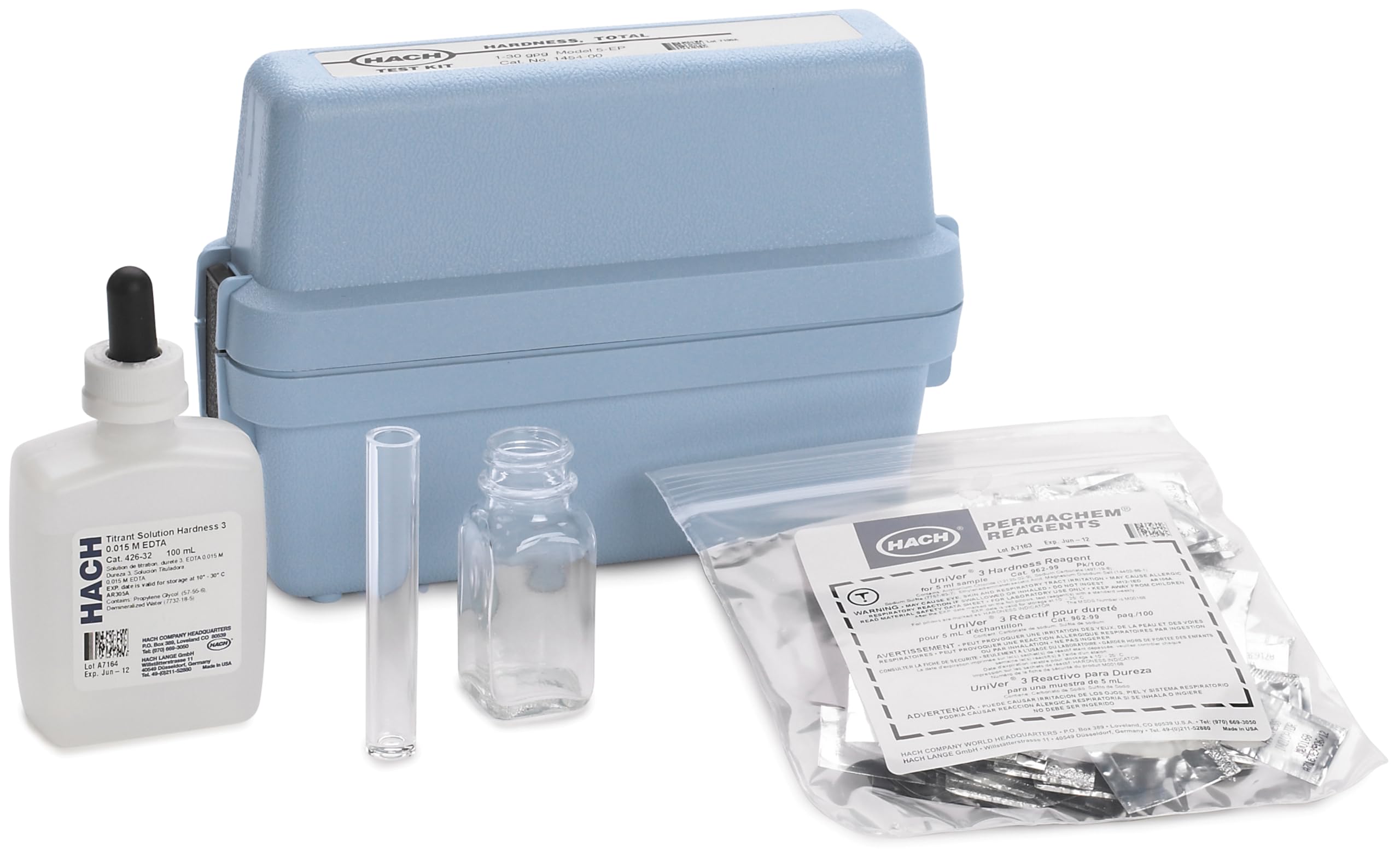
The 5-EP uses the same EDTA chemistry as the 5-B but with a buret for controlled, precise titrant delivery. Where the 5-B counts drops from a squeeze bottle — introducing variability from drop size and angle — the 5-EP's buret delivers consistent increments and a repeatable endpoint. For applications where hardness precision matters, such as verifying softener output before a membrane system or establishing baseline water chemistry for system sizing, the 5-EP is the appropriate tool.
5-B vs. 5-EP: Which to Choose
For most commercial operators performing routine softener checks, the 5-B is sufficient. The 5-EP's advantage is repeatability — the buret eliminates drop-size variability, making the endpoint more consistent between operators and between test runs. Choose the 5-EP when:
- Hardness results will be used to size or specify treatment equipment
- You're verifying pre-treatment before a high-value RO membrane
- Multiple operators are running the test and consistency matters
- You need documentation quality results for a QA/QC record
Hach CN-70 Free & Total Chlorine Test Kit

The CN-70 measures both free and total chlorine in a single kit using DPD powder reagents and a visual color comparator. Free chlorine (DPD-1 reagent) reacts immediately; total chlorine (DPD-3 reagent) adds the combined chlorine fraction, which is chloramines formed when chlorine reacts with ammonia in the water. The difference between total and free gives combined chlorine — the value that indicates chloramine formation in drinking water systems and post-disinfection contact basins.
The CN-70 uses an EPA-approved colorimetric method, making it appropriate for compliance monitoring applications where method traceability is required.
Why Combined Chlorine Matters Commercially
In systems served by chloraminated municipal water, the combined chlorine reading from the CN-70 confirms what type of residual is present at the point of use. For brewery, food processing, and pharmaceutical applications — where chloramine removal is part of the pre-treatment protocol — a combined reading above the free-chlorine value confirms chloramine is present and the Bodyguard Plus or catalytic carbon filter is needed upstream.
Hach CN-66F Free Chlorine Color Disc Kit

The CN-66F measures free chlorine only, using a color disc comparator rather than the two-reagent sequential test of the CN-70. This makes it faster for high-frequency monitoring — the single-reagent workflow gets you a free-chlorine reading in under a minute without running a second test for combined chlorine.
The 0.1–3.4 mg/L range covers the EPA maximum residual disinfectant level (MRDL) of 4.0 mg/L for chlorine and the typical operational target range of 0.2–2.0 mg/L for distribution systems. For applications where combined chlorine data isn't needed, the CN-66F is faster and simpler than the CN-70.
CN-66F vs. CN-70: When Free-Only Is Enough
Choose the CN-66F over the CN-70 when you only need to monitor free chlorine residual — post-filtration checks, chlorination system output verification, or confirming that chlorine is absent after activated carbon filtration before an RO membrane. The CN-70 is the better choice when you need combined chlorine data to identify chloramine formation or monitor a disinfection system's contact efficiency.
Hach CN-66T Total Chlorine Color Disc Kit

The CN-66T measures total chlorine — the sum of free and combined chlorine — using DPD tablets (rather than powder) and a color disc comparator. The tablet format is more field-stable than powder reagents: tablets are less susceptible to moisture uptake during transport and storage, making the CN-66T the practical choice for operators who carry kits in a truck or store them in variable conditions between sampling rounds.
At 0–10 mg/L, the CN-66T shares the same high-end range as the CN-70 and is the appropriate choice when you need total chlorine monitoring without the combined free/total dual-reading protocol of the CN-70.
DPD Tablets vs. DPD Powder
The CN-66T uses DPD tablets where the CN-66F uses powder. In practice: powder dissolves slightly faster and is more widely available in bulk refill packs; tablets are more resistant to clumping from humidity and are easier to use with gloves in the field. For operators running the test indoors with climate control, the difference is minor. For field sampling in variable conditions, the tablet format is more reliable.
Understanding DPD and EDTA Titration
DPD Method (Chlorine Kits)
DPD (N,N-diethyl-p-phenylenediamine) reacts with free chlorine to produce a pink-to-red color proportional to chlorine concentration. Adding a second reagent (iodide) causes combined chlorine to react, giving a reading for total chlorine. The color is matched visually against a comparator disc or reference color chart.
DPD is the basis of EPA Method 330.5 for free and total chlorine and is referenced in Standard Methods 4500-Cl G. Its advantages over earlier orthotolidine (OT) methods are lower toxicity and resistance to manganese interference. Limitations: color matching depends on adequate lighting and consistent color perception between operators; dissolved color in the sample can interfere with readings above background.
EDTA Titration (Hardness Kits)
EDTA (ethylenediaminetetraacetic acid) chelates calcium and magnesium ions in the sample. The Eriochrome Black T indicator is red in the presence of free calcium and magnesium; as EDTA titrant is added, it competes for and captures each ion until the endpoint, where the indicator turns blue. Total hardness is calculated from the volume of titrant consumed.
The method corresponds to Standard Methods 2340 C. Unlike colorimetric strip tests, EDTA titration gives quantitative results that are not affected by sample turbidity or color in the visible range — making it more reliable for well water samples that may carry sediment or tannin color.
When to Upgrade to a Colorimeter
Hach test kits are the right tool for operational monitoring, system troubleshooting, and field verification where results are used to make process adjustments. They are not the right tool when:
| Situation | Why Kits Fall Short | Recommended Instrument |
|---|---|---|
| Regulatory reporting with method traceability | Visual color matching is not auditable; results depend on operator perception | Hach DR900 or DR1900 |
| Low-level chlorine detection (<0.1 mg/L) | Color disc resolution insufficient below 0.1 mg/L | Hach DR300 Pocket Colorimeter |
| High-frequency sampling (>20 tests/day) | Disc matching adds per-test time vs. digital readout | DR300 Pocket Colorimeter |
| Iron, manganese, or phosphate measurement | No colorimetric test kit covers these at commercial ranges | DR300 Iron FerroVer, DR300 Manganese, DR300 Phosphate |
| Multi-parameter water quality surveys | Kits cover one parameter at a time; poor for survey workflows | Hach DR1900 (90+ methods) |
For operators who have outgrown colorimetric kits but aren't ready for a benchtop spectrophotometer, the Hach DR300 Pocket Colorimeter is the natural next step — photometric accuracy in a field-portable instrument, with method-specific reagent packs that extend the same chemistry used in these kits.
FAQ
Which Hach test kit is best for chlorine?
For combined free and total chlorine in one test, the CN-70 is the standard commercial choice. It uses an EPA-approved method and covers 0–10 mg/L. For free-chlorine-only spot checks, the CN-66F is faster. For total-chlorine monitoring in the field with a more stable reagent format, the CN-66T is the best option.
What is the difference between the Hach 5-B and 5-EP?
Both kits use EDTA titration to measure total hardness in the 0–30 gpg range. The 5-B uses drop-count delivery (one drop at a time from a squeeze bottle); the 5-EP uses a buret for more controlled, precise titrant delivery. The 5-B is sufficient for routine softener checks; the 5-EP is better for QC applications or baseline measurements before system sizing.
Do Hach test kits work for well water?
Yes. The EDTA titration method used in the 5-B and 5-EP is actually more reliable for well water than colorimetric strip tests because turbidity and color don't affect the endpoint. For well water with significant iron (>5 mg/L), iron interference on the hardness endpoint is possible — test for it by comparing results before and after removing iron with a Hach iron reduction reagent.
How do I store Hach test kit reagents?
Store reagents sealed, dry, and below 25°C (77°F) away from direct sunlight. DPD powder and tablets are moisture-sensitive — discard if the powder appears pink or the tablets crumble. EDTA titrant is more stable but should be replaced if turbid or discolored. Check the lot expiration on each reagent pack before running a test.
When should I upgrade from a test kit to a colorimeter?
When you need photometric accuracy for regulatory reporting, low-level detection below 0.1 mg/L, or consistent digital readouts across multiple operators. The Hach DR300 Pocket Colorimeter uses the same DPD chemistry as the CN kits but eliminates visual color matching with a photometric sensor — the natural upgrade path when kit-based testing reaches its limits.