Home › Reviews › US Water Systems › Matrixx DROP Bodyguard Plus
Matrixx DROP Bodyguard Plus Review (2026): Commercial Backwashing Carbon Filter
Disclosure: This page contains affiliate links. If you purchase through our links, we may earn a commission at no extra cost to you. See our affiliate disclosure.
The Matrixx DROP Bodyguard Plus is a commercial-scale backwashing carbon filter that combines dual GAC and catalytic carbon media with WiFi-connected DROP smart valve control. Available in 1.25″ and 1.5″ commercial configurations, it removes chlorine, chloramine, THMs, PFAS, VOCs, and a broad spectrum of organic contaminants from whole-property water supplies without cartridge replacement or chemical regeneration.
In this review
Two Models — 1.25″ vs. 1.5″
Both models share the same dual-media carbon technology and DROP smart valve platform. The choice between them is determined by pipe size and daily flow volume.
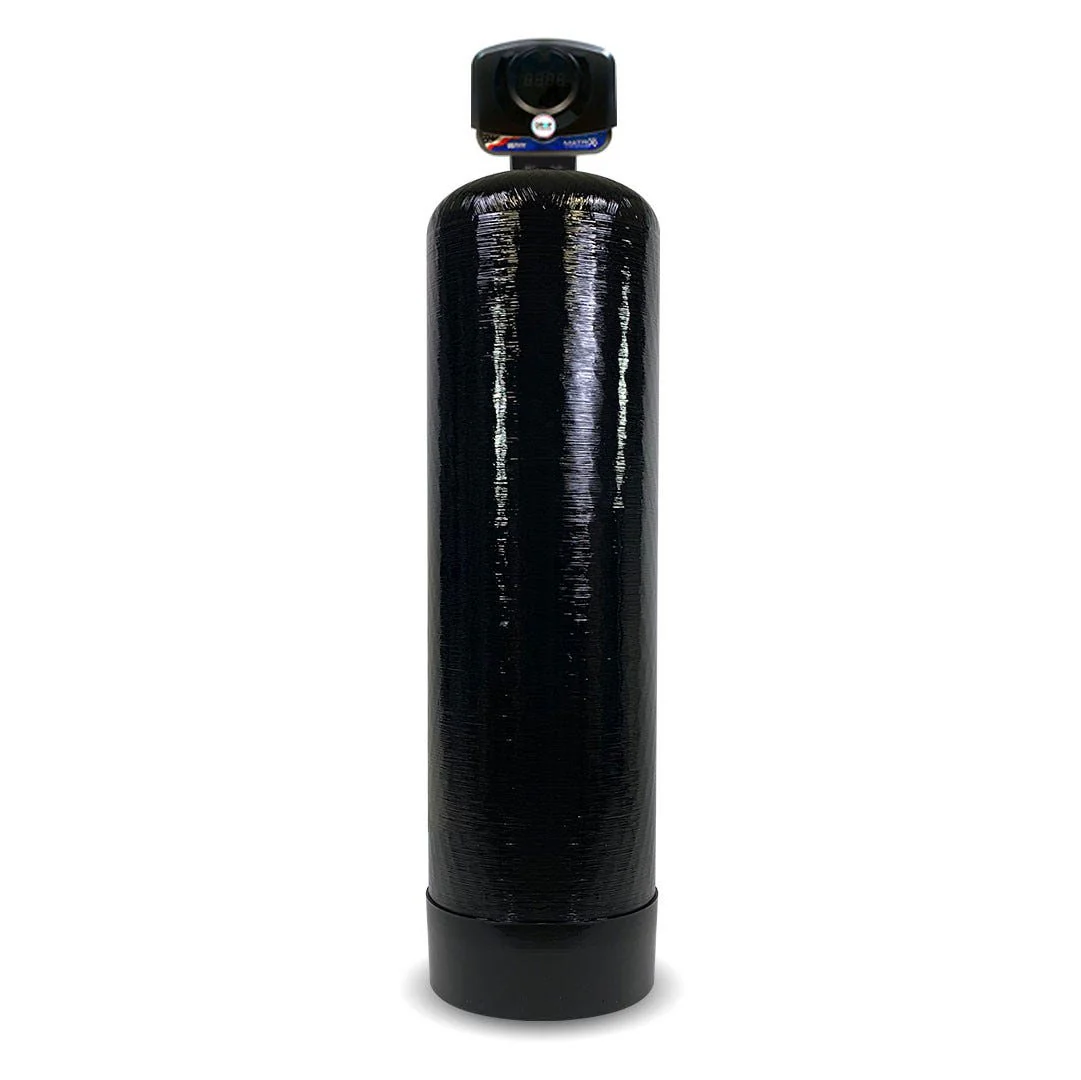
Media: 2 cu. ft. GAC + 2 cu. ft. CGAC
Connection: 1.25″ MPT
Tank warranty: Lifetime
Valve warranty: 10 years
Best for: Light commercial, estate homes, RO pre-treatment
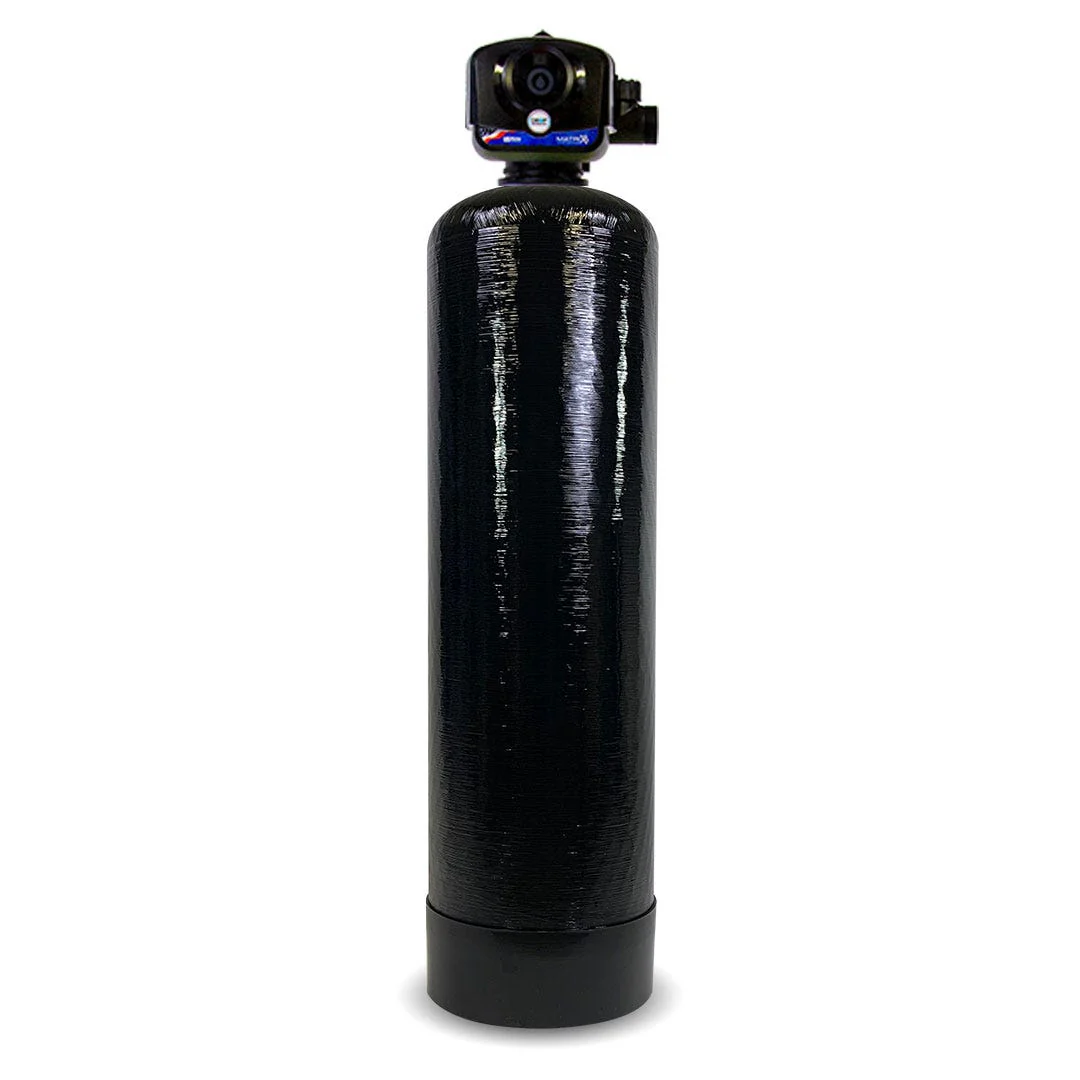
Media: 5 cu. ft. or 7 cu. ft. total (GAC + CGAC)
Connection: 1.5″ MPT
Tank warranty: 10 years
Valve warranty: 7 years
Best for: Larger commercial, car wash, high-volume RO pre-treatment
Dual-Media Technology: Why Both GAC and Catalytic Carbon
This is the design decision that separates the Bodyguard Plus from lower-cost backwashing carbon filters, and understanding it is critical to evaluating whether this system is appropriate for a given water supply.
Layer 1: Granular activated carbon (GAC) — coconut shell
The first carbon layer is coconut shell GAC. Coconut shell is preferred over coal-based carbon for water treatment because it has higher mechanical hardness, lower dust generation, and a larger micro-pore volume that makes it more effective for small organic molecules. GAC removes contaminants through adsorption — molecules adhere to the enormous internal surface area of the porous carbon structure. It is highly effective against free chlorine, THMs, pesticides, herbicides, PFAS, pharmaceuticals, industrial solvents, and taste and odor compounds.
What GAC cannot do effectively: remove chloramine. Monochloramine (NH&sub2;Cl) has a nitrogen-hydrogen bond that is largely inert to standard activated carbon surface sites. GAC systems on chloraminated water will remove trace chloramine through slow surface reactions, but at commercial flow rates and standard carbon bed depths, significant chloramine passes through. This is why approximately one third of municipal utilities — those that have switched to chloramine as their distribution disinfectant — require catalytic carbon, not just GAC, for effective whole-property treatment.
Layer 2: Catalytic granular activated carbon (CGAC)
Catalytic carbon is produced by modifying the surface chemistry of activated carbon through high-temperature treatment, creating surface functional groups with enhanced oxidation-reduction catalytic activity. This surface catalyzes the decomposition of monochloramine through a direct chemical reaction rather than simple adsorption. The N-Cl bond in chloramine reacts with the catalytic surface and breaks down; the carbon surface regenerates continuously through the catalytic cycle rather than becoming exhausted like an adsorption site.
The practical result: a system with both GAC and CGAC handles the complete disinfectant spectrum — chlorine by adsorption on the GAC layer, chloramine by catalytic decomposition on the CGAC layer — regardless of which disinfectant strategy your utility uses today or switches to in the future. Many utilities have migrated from chlorine to chloramine over the past decade, and more are expected to do so as EPA THM formation regulations tighten. A GAC-only system installed today may be inadequate if the utility transitions.
The 35% more carbon advantage
The Bodyguard Plus contains 35% more carbon media than the original Bodyguard design. Contact time — the time water spends in contact with the carbon bed — is the primary determinant of adsorption effectiveness. More media volume at the same flow rate means longer contact time, which means more complete contaminant removal and better performance as the carbon approaches exhaustion near the end of its service life. At commercial flow rates where instantaneous demand can be high, the additional media depth provides the buffer that keeps effluent quality consistent during peak flow events.
What It Removes
DROP Smart Valve
The DROP (Digital Remote Operations Platform) valve replaces the mechanical timer or meter-based control head found on most commercial backwashing filters with a WiFi-connected IoT platform managed through a smartphone app (iOS, Android) or web browser. A single DROP Hub controls up to 12 backwashing filters and 12 softeners simultaneously — the entire treatment train from one interface.
| Feature | Detail |
|---|---|
| App setup time | ~30 seconds per device after initial Hub pairing |
| Remote access | Full scheduling, monitoring, and manual regeneration trigger from any location |
| Hub capacity | 12 backwashing filters + 12 softeners + up to 24 other devices per hub |
| Leak detection — flow monitoring | Detects unusual flow rates; alerts smartphone; remote shutoff capability |
| Leak detection — wireless sensors | Up to 32 wireless leak detectors placeable throughout the facility |
| Multiplex scalability | 1–5 tank systems standard; up to 12 tanks with custom engineering; all on one Hub |
| Power outage behavior | Configurable: Private Well (hold position) or Municipal Supply (default safe position) |
| LED status indicators | Purple flash = WiFi active; alternating front = flow detected; orange = water off; yellow = bypass; fading side-to-side = regeneration in progress |
The dual leak detection is worth noting specifically. Most commercial backwashing filters have no leak monitoring at all. The DROP system’s combination of flow-rate anomaly detection (which catches running fixtures, slow leaks, and pipe failures anywhere in the system) and optional distributed wireless sensors provides a level of water damage protection that is usually only available through separate building automation systems.
Full Specifications
| Specification | 1.25″ (BGPCD-125) | 1.5″ Small (BGPCD-150-5) | 1.5″ Large (BGPCD-150-7) |
|---|---|---|---|
| Tank size | 16″ × 65″ | 18″ × 65″ | 21″ × 62″ |
| Overall height | 73.2″ | 74″ | 74″ |
| Plumbing connection | 1.25″ MPT | 1.5″ MPT | 1.5″ MPT |
| GAC media | 2.0 cu. ft. | 2.5 cu. ft. | 3.5 cu. ft. |
| Catalytic carbon media | 2.0 cu. ft. | 2.5 cu. ft. | 3.5 cu. ft. |
| Gravel underbedding | 75 lbs | 100 lbs | 150 lbs |
| Media capacity | 1,000,000 gal. | 1,000,000 gal. | 1,000,000 gal. |
| Media warranty | 5 years | 5 years | 5 years |
| Backwash duration | 10 min | 10 min | 10 min |
| Rest duration | 2 min | 2 min | 2 min |
| Rapid rinse duration | 10 min | 10 min | 10 min |
| Regen frequency | Every 7 days (recommended) | Every 7 days | Every 7 days |
| Operating pressure | 20–100 psi | 20–100 psi | 20–100 psi |
| Water temperature | 39–100°F | 39–100°F | 39–100°F |
| pH range | 5.0–9.5 | 5.0–9.5 | 5.0–9.5 |
| Iron limit (feed water) | <0.3 ppm | <0.3 ppm | <0.3 ppm |
| Manganese limit | <0.05 ppm | <0.05 ppm | <0.05 ppm |
| Turbidity limit | <3 NTU | <3 NTU | <3 NTU |
| Electrical | 100–240V, 0.3A / 12V DC out | 100–240V, 0.3A / 12V DC out | 100–240V, 0.3A / 12V DC out |
| Certifications | NSF/ANSI 42 & 61 | NSF/ANSI 42 & 61 | NSF/ANSI 42 & 61 |
| Tank warranty | Lifetime | 10 years | 10 years |
| Valve & electronics warranty | 10 years | 7 years | 7 years |
| Sources: US Water Systems Installation & Operation Manuals BGPCD-125, BGPCD-150-5, BGPCD-150-7; CLS-3X00 Product Data Sheet. | |||
Where It Fits in the Treatment Train
The Bodyguard Plus is a pre-treatment stage. Its position in a complete commercial water treatment system follows a specific logic:
Before the water softener: always. Chloramine oxidatively degrades styrene-divinylbenzene ion exchange resin beads in softeners over time — the same mechanism that makes chloramine corrosive to rubber and elastomers. A carbon filter upstream of the softener intercepts the chloramine before it contacts the resin, protecting resin capacity and extending service life. US Water Systems explicitly recommends this sequence for the Synergy and Maverick softeners on municipal water.
Before the RO membrane: essential. Polyamide thin-film composite (TFC) membranes — used in every modern commercial RO system including the Falcon, Defender HD, and Patriot XL — are irreversibly damaged by both chlorine and chloramine. Even low-level chloramine exposure degrades TFC membrane performance over time. A carbon filter upstream of the RO membrane is not optional on chlorinated or chloraminated municipal water; it is a requirement for maintaining rated rejection and membrane service life.
After an iron filter if iron exceeds 0.3 ppm: iron above 0.3 ppm will foul carbon media through physical fouling of adsorption sites and precipitation of iron oxides within the pore structure. This fouling is irreversible. For well water with elevated iron, the Matrixx InFusion peroxide injection iron filter should precede the carbon filter in the treatment sequence.
Iron Limit and Well Water Considerations
The 0.3 ppm iron limit is the most important water quality constraint to verify before specifying the Bodyguard Plus for a well water application. Iron fouling of carbon media is not a performance degradation that can be reversed by backwashing — iron oxides precipitate within the carbon pore structure and permanently reduce adsorption surface area. A carbon filter operating above its iron limit will fail progressively and silently, with no obvious external indication until effluent quality degrades.
For well water, always obtain an iron test result before specifying. A simple colorimetric iron test (the Hach DR300 iron configuration provides field-ready results) is the appropriate diagnostic before system selection. If iron exceeds 0.3 ppm — which is common in well water across the Midwest, Southeast, and Northeast — install an iron filter upstream. The Matrixx InFusion handles dissolved ferrous iron up to 7+ ppm with peroxide injection and is the natural paired upstream stage for well water installations requiring both iron treatment and chemical filtration.
Backwash Cycle and Water Use
The weekly backwash cycle is 25–30 minutes total: 10 minutes backwash, 2 minutes rest, 10 minutes rapid rinse, plus valve movement time. During this cycle, the DROP valve automatically routes untreated bypass water to the building rather than shutting off all water service. This is the correct design for commercial installations — water availability is maintained throughout — but it means the building receives unfiltered water during the regeneration window. Schedule backwash at 2–4 AM or the lowest water use period for the facility.
Backwash water consumption is low relative to the filter’s treatment volume. Unlike softeners that discharge brine with every regeneration, the Bodyguard Plus requires only clean water for backwash — no salt, potassium, or chemical additions of any kind. For facilities concerned with wastewater discharge volume or operating in salt-restricted areas, this is a meaningful practical advantage over softener-forward designs.
Warranty
| Component | 1.25″ (BGPCD-125) | 1.5″ Commercial |
|---|---|---|
| Tank | Lifetime (original residential installation) | 10 years |
| Control valve & electronics | 10 years | 7 years |
| Carbon media | 5 years | 5 years |
| Warranty service | US Water Systems • 1-800-608-8792 • uswatersystems.com | |
| Note: Commercial and industrial installations may affect residential warranty terms. Report shipping damage within 24 hours of delivery. | ||
The lifetime tank warranty on the 1.25″ model is meaningful for an estate home or light commercial installation where the system may run for 20+ years. The 1.5″ commercial models carry a 10-year tank warranty — still strong for commercial equipment in this class, but the distinction between the two is worth noting for buyers evaluating total cost of ownership over long time horizons.
Who Should Buy It
Related reviews and guides
- Matrixx InFusion Iron & Sulfur Filter review — upstream iron removal for well water before the carbon filter stage
- US Water Systems Defender HD Commercial RO review — the Bodyguard Plus is the correct pre-treatment stage for this membrane system on chloraminated water
- US Water Systems Falcon Commercial RO review
- US Water Systems Synergy Twin-Alternating Softener review — pair the carbon filter upstream to protect ion exchange resin from chloramine degradation
- NSF water filter certifications explained — what NSF 42 & 61 (the Bodyguard Plus certifications) actually mean and when other standards apply
- Chloramine in commercial water guide — full technical guide covering removal methods, EBCT requirements, UV photolysis, and sector recommendations
- Brewery water treatment guide — why catalytic carbon is non-negotiable for breweries on chloraminated municipal water
- Commercial iron and sediment filter systems