Crystal Quest Thunder RO Review (2026): 200 & 300 GPD Whole-House Reverse Osmosis
Disclosure: This page contains affiliate links. If you purchase through our links, we may earn a commission at no extra cost to you. See our affiliate disclosure.
The Crystal Quest Thunder is a point-of-entry (P.O.E.) whole-house reverse osmosis system available in 200 and 300 GPD configurations. It targets residential estates, small commercial facilities, and light industrial applications where whole-property RO treatment is required at the entry point rather than a single fixture. Made in the USA by Crystal Quest®, it comes with a three-stage pre-filtration train and TFC High Flow Low Energy membranes.
In this review
200 vs. 300 GPD — Which Model
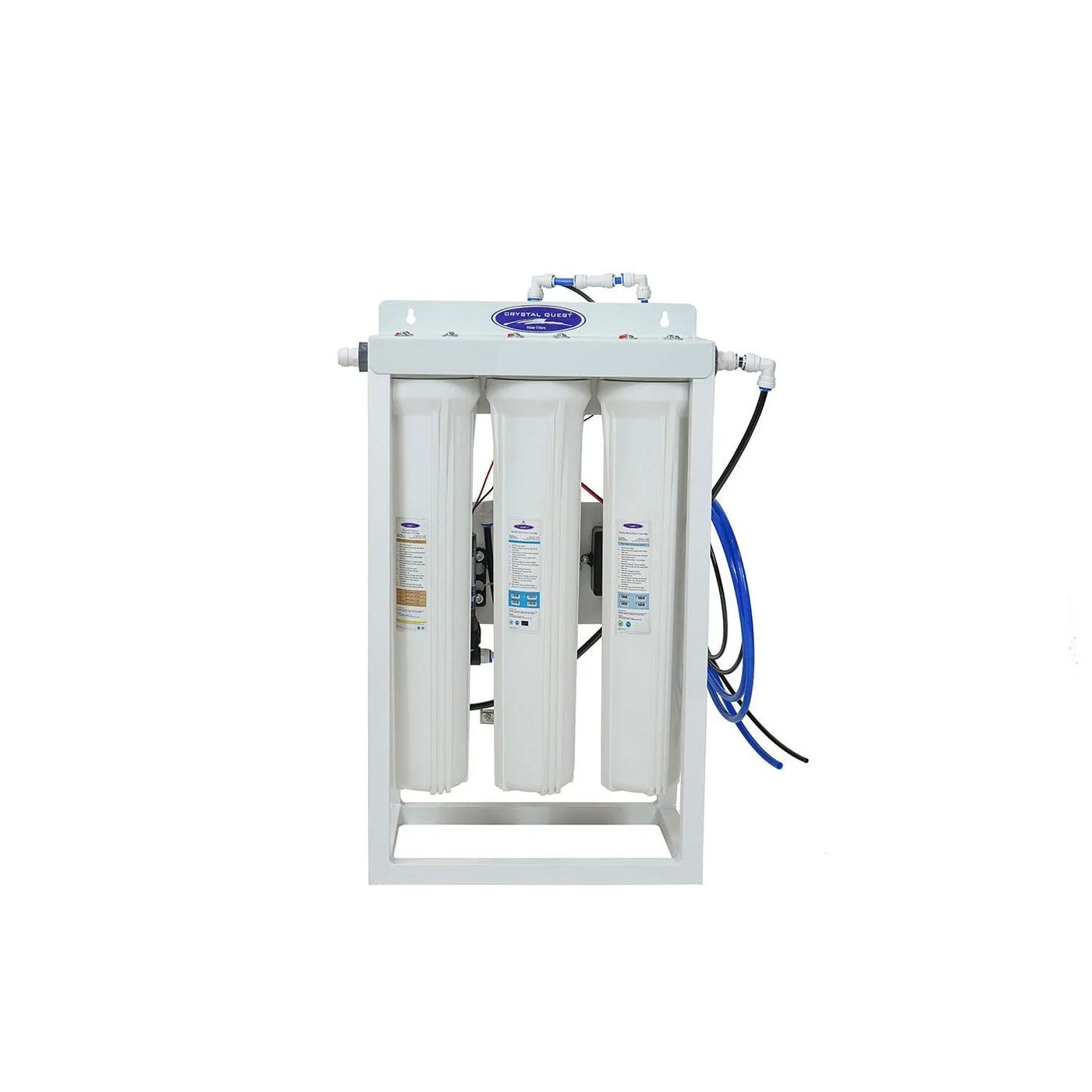
Element: 2514 TFC HF1
Feed connection: 3/8″
120/220V • No onboard pump
Best for: Estate homes, light office use, small food service
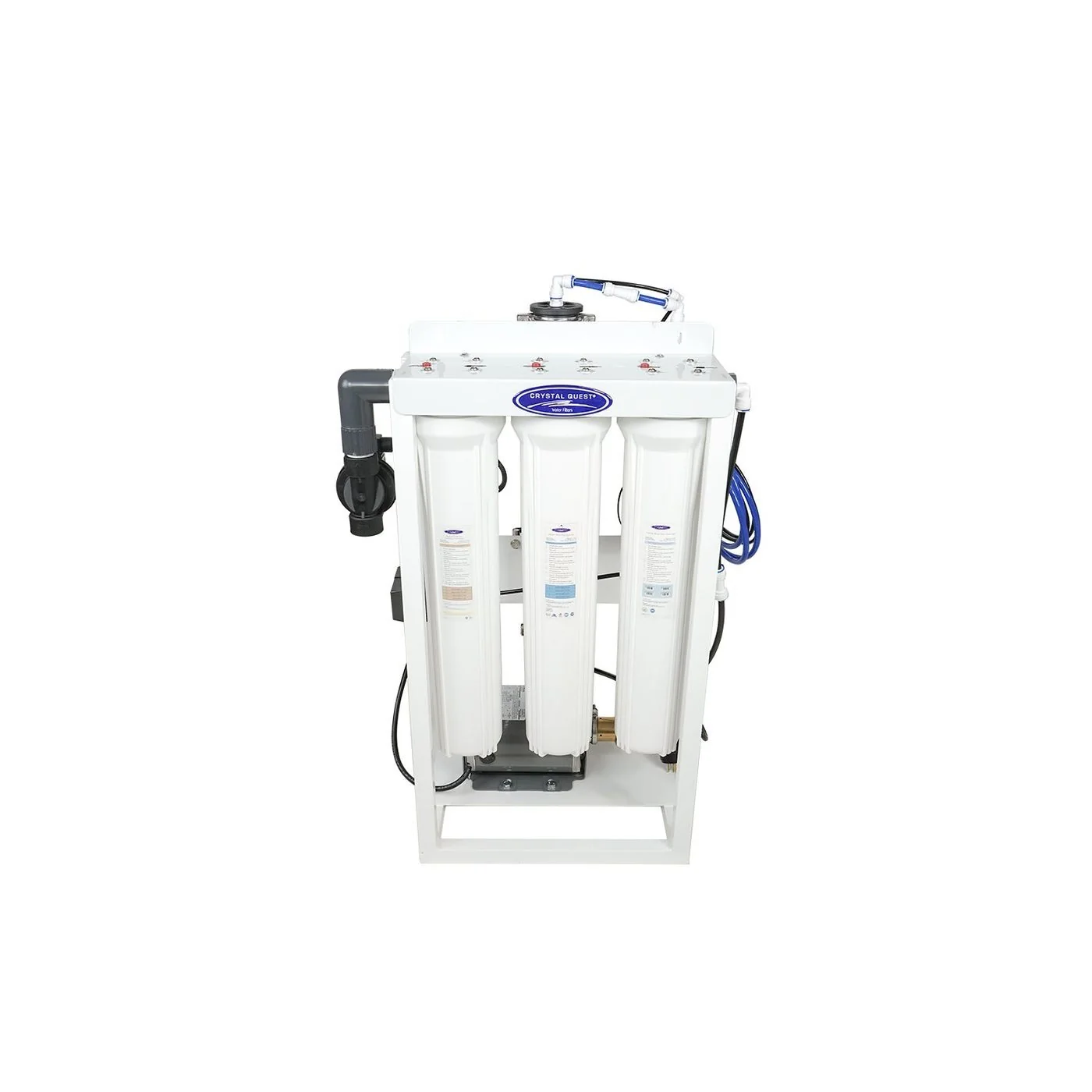
Element: 2521 TFC HF1
Feed connection: 3/8″
120/220V • Multi-stage centrifugal pump
Best for: Larger homes, small restaurants, light commercial
The 200 GPD model runs on line pressure alone — no onboard pump — which limits it to sites with consistent feed pressure of 35–150 psi. The 300 GPD adds a multi-stage centrifugal pump, giving it consistent output regardless of supply pressure variation and making it more appropriate for commercial settings where supply pressure may fluctuate. At 300 gallons per day, the Thunder 300 produces approximately 12.5 gallons per hour — plan storage tank sizing accordingly for peak demand applications.
Full Specifications
Thunder 300
@ 77°F, 150 psi, 550 ppm
96% minimum
Up to 75% with recycle
(max membrane: 400 psi)
60 Hz
or installation
| Specification | Thunder 200 | Thunder 300 |
|---|---|---|
| Output (GPD) | 200 | 300 |
| Dimensions (approx.) | 7″ × 22″ × 31″ | 7″ × 28″ × 33″ |
| Weight (approx.) | 50 lbs | 70 lbs |
| Membrane element | 2514 TFC HF1 | 2521 TFC HF1 |
| Elements (qty.) | 1 | 1 |
| Operating pressure | 150 psi | 150 psi |
| Pump | N/A (line pressure) | Multi-stage centrifugal |
| Voltage / Hertz | 120/220V 1-Phase / 60 Hz | 120/220V 1-Phase / 60 Hz |
| Feed connection | 3/8″ (solenoid valve inlet) | 3/8″ (solenoid valve inlet) |
| Product connection | 1/4″ FNPT | 1/4″ FNPT |
| Concentrate connection | 1″ FNPT | 1″ FNPT |
| Minimum feed flow | 1 GPM | 1 GPM |
| Nominal NaCl rejection | 98.5% | 98.5% |
| Minimum NaCl rejection | 96% | 96% |
| Maximum TDS | 2,000 ppm | 2,000 ppm |
| pH range | 3–11 | 3–11 |
| Temperature range | 40–105°F | 40–105°F |
| Free chlorine limit | <0 ppm (zero tolerance) | <0 ppm (zero tolerance) |
| Iron limit | <0.05 ppm in concentrate | <0.05 ppm in concentrate |
| Manganese limit | <0.05 ppm | <0.05 ppm |
| Hardness max | <15 gpg | <15 gpg |
| Turbidity (SDI) | <5 | <5 |
| Recovery | 33–50% (up to 75% with recycle) | 33–50% (up to 75% with recycle) |
| Warranty | 12 months from receipt or installation (whichever later, max 3 months from ship date) | |
| Test conditions: 550 ppm NaCl, 150 psi, 77°F (25°C), pH 7, 50% recovery. Source: Crystal Quest Thunder Installation and Operation Guide, Rev. 2025. | ||
Three-Stage Pre-Filtration
The Thunder includes three 2.5″×20″ pre-filter housings in series as an integrated part of the system frame. This is a meaningful practical advantage: most commercial RO systems at this price point require separate pre-filter staging, adding installation cost and footprint. The Thunder consolidates everything on one skid.
The three cartridges in order of flow:
Stage 1 — Sediment cartridge (10 micron FSI bag filter). Removes suspended particles, sediment, rust, and turbidity down to 10 microns. Protects the downstream carbon cartridges and the RO membrane from physical fouling. Also a 4.5″×20″ 5 micron stainless steel filter removes particles over 5 microns.
Stage 2 — Carbon block cartridge. Removes chlorine, chloramines, and volatile organic compounds. Carbon block provides more consistent contact time and finer particulate reduction than granular carbon at the same flow rate. This stage is the primary protection for the TFC membrane against chlorine oxidative damage.
Stage 3 — GAC (granular activated carbon) cartridge. Secondary carbon stage for residual taste, odor, and organic compound reduction. Provides additional contact time for any chlorine or chloramine that passed through the carbon block stage.
Feed Water Requirements
| Parameter | Limit | Consequence if exceeded |
|---|---|---|
| Free chlorine | <0 ppm (zero tolerance) | Irreversible oxidation of TFC membrane — voids warranty |
| Iron | <0.05 ppm in concentrate | Iron fouling of membrane surface — irreversible reduction in flux and rejection |
| Total dissolved solids | <2,000 ppm | Reduced rejection, higher energy requirement, potential membrane damage above rated TDS |
| Turbidity (SDI) | <5 | Rapid pre-filter clogging; potential membrane fouling |
| Hardness | <15 gpg | Calcium carbonate scaling on membrane surface at high recovery; reduces flux over time |
| Manganese | <0.05 ppm | Oxidation fouling similar to iron at membrane surface |
| Organics | <1 ppm | Organic fouling of membrane; biofouling in pre-filter housings |
| Silica | <1 ppm | Silica scaling at high recovery; may be irreversible |
| pH | 3–11 | Outside range damages membrane material |
| Temperature | 40–105°F | Above 105°F damages membrane; below 40°F reduces production significantly |
| Minimum feed pressure | 35 psi | Below 35 psi: insufficient pressure for permeate production and pump protection |
Membrane and Rejection
The Thunder uses Thin Film Composite (TFC) High Flow Low Energy membranes — the industry standard for commercial RO systems. TFC membranes provide higher rejection rates (98.5% NaCl nominal) and lower operating pressures than older cellulose acetate membranes, but are significantly more sensitive to oxidants.
The membrane characteristics from the manual:
| Parameter | Specification |
|---|---|
| Nominal NaCl rejection | 98.5% |
| Operating pressure | 150 psi |
| Maximum pressure | 400 psi |
| Chlorine tolerance | <1 ppm (system must deliver 0 ppm to membrane) |
| Maximum temperature | 110°F |
| Turbidity tolerance | 1 NTU (pre-filters must maintain this) |
| Silt Density Index | <5 SDI |
| pH range | 3–11 |
| Expected service life | 2–3 years on properly pretreated water; begins declining after year 1 |
| Test conditions: 550 ppm, 150 psi, 77°F (25°C), pH 7, 15% recovery. Higher TDS and/or lower temperatures reduce production. | |
Temperature significantly affects membrane output. The Thunder’s rated 200 or 300 GPD is at 77°F. At 50°F (cold well water or winter supply), the TFC temperature correction factor is 1.711 — meaning actual production is rated GPD ÷ 1.711. A Thunder 300 at 50°F produces approximately 175 GPD. Plan storage capacity accordingly for cold-climate installations or well-water applications with cold source temperatures.
Recovery Rate and Concentrate
The Thunder’s standard recovery rate of 33–50% means that for every gallon of purified water produced, 1–2 gallons go to drain as concentrate. At 50% recovery, impurities in the concentrate stream are approximately 2× the feedwater concentration. This concentrate must drain freely without back pressure — any restriction raises system pressure and risks membrane damage.
The optional waste recycle valve can push recovery up to 75% by routing a portion of concentrate back to the feed pump inlet. The tradeoff: recycled concentrate elevates the TDS of the water entering the membrane, which increases permeate TDS and stresses the membrane under higher dissolved load. The manual cautions that excessive recycling causes premature membrane fouling and scaling. For applications where water conservation is critical (well water with limited yield, arid regions, or facilities with water restrictions), the recycle option is worth the tradeoff; for facilities on unrestricted municipal supply, standard 50% recovery is the cleaner operating point.
Maintenance Schedule
| Task | Frequency | Indicator |
|---|---|---|
| Replace all three pre-filter cartridges | Monthly minimum | Differential pressure >10–15 psi across housings; or monthly regardless |
| Manual system flush | Weekly | Scheduled; fully open concentrate valve for 10–20 minutes to remove sediment from membrane surface |
| Record operating parameters | Daily (first week); weekly thereafter | Operating log required to maintain warranty |
| Membrane replacement | 2–3 years typical | Permeate flow decline >15% of rated at temperature-corrected conditions; rejection drops below 96% |
| Membrane cleaning (organic fouling) | As needed | Permeate decline without scaling; soda ash or NaOH solution at pH 12, 30°C max |
| Membrane cleaning (inorganic/scale) | As needed | Scaling symptoms; citric acid solution at pH 2, 45°C max; or muriatic acid alternative |
The monthly pre-filter cadence is the highest ongoing maintenance requirement and the most important one. Crystal Quest’s warranty is voided if pre-treatment fails to protect the membrane — and a fouled or exhausted pre-filter cartridge is the most common cause of warranty claims on RO systems. Set a calendar reminder for the first of every month and keep replacement cartridges in stock.
Where It Fits in the Treatment Train
The Thunder’s built-in pre-filtration handles sediment and chlorine from municipal water sources. For well water or challenging municipal sources, additional upstream treatment is required before the Thunder’s inlet:
For standard municipal water below 2,000 ppm TDS with iron under 0.05 ppm and no chloramine: the Thunder handles the full pre-treatment train internally. For chloraminated municipal water: the built-in carbon block provides some chloramine removal, but a dedicated catalytic carbon backwashing filter upstream provides more reliable protection at commercial flow rates. See our Matrixx Bodyguard Plus review for the commercial catalytic carbon option.
Crystal Quest Thunder vs. US Water Systems Falcon vs. Defender HD
| System | GPD range | Max TDS | Pre-treatment | Controller | Best for |
|---|---|---|---|---|---|
| Crystal Quest Thunder | 200–300 GPD | 2,000 ppm | Included (3-stage) | Solenoid + pressure switches | Estate homes, light commercial on municipal water; whole-property RO with self-contained pre-treatment |
| US Water Systems Falcon | 500–2,000 GPD | ~2,000 ppm | Separate required | TDS meter, pressure gauges | Food service, restaurants, higher-volume light commercial; requires separate pre-treatment staging |
| US Water Systems Defender HD | 2,000–16,000 GPD | 6,000 ppm | Separate required | US100 microprocessor | High-TDS well water and brackish; larger commercial; US100 controller with fault detection |
| Commercial Water Lab earns affiliate commissions on qualifying purchases from Crystal Quest (15%) and US Water Systems (10%). | |||||
The Thunder sits below the Falcon in daily output but above it in pre-treatment convenience. Where the Thunder fits best: applications needing whole-property RO at 200–300 GPD with a single skid that handles pre-filtration internally, on municipal water under 2,000 ppm. Where the Falcon or Defender HD fits better: higher daily demand, well water with elevated TDS, or applications where pre-treatment staging is already present and a separate RO skid is preferred.
Who Should Buy It
Related reviews and guides
- Commercial RO pre-treatment guide — what to install before this system for iron, hardness, and chloramine
- Crystal Quest commercial water filtration systems overview
- US Water Systems Falcon Commercial RO review — 500–2,000 GPD step-up
- US Water Systems Defender HD review — 2,000–16,000 GPD high-TDS RO
- Matrixx DROP Bodyguard Plus Carbon Filter review — catalytic carbon upstream for chloramine markets
- Matrixx InFusion Iron Filter review — iron removal upstream when Fe exceeds 0.05 ppm
- Brackish water reverse osmosis guide
- All commercial RO systems