Home › Reviews › Myron L Ultrameter II 6PIIFCE
Myron L Ultrameter II 6PIIFCE Review (2026)
Disclosure: This page contains affiliate links. If you purchase through our links, we may earn a commission at no extra cost to you. See our affiliate disclosure.
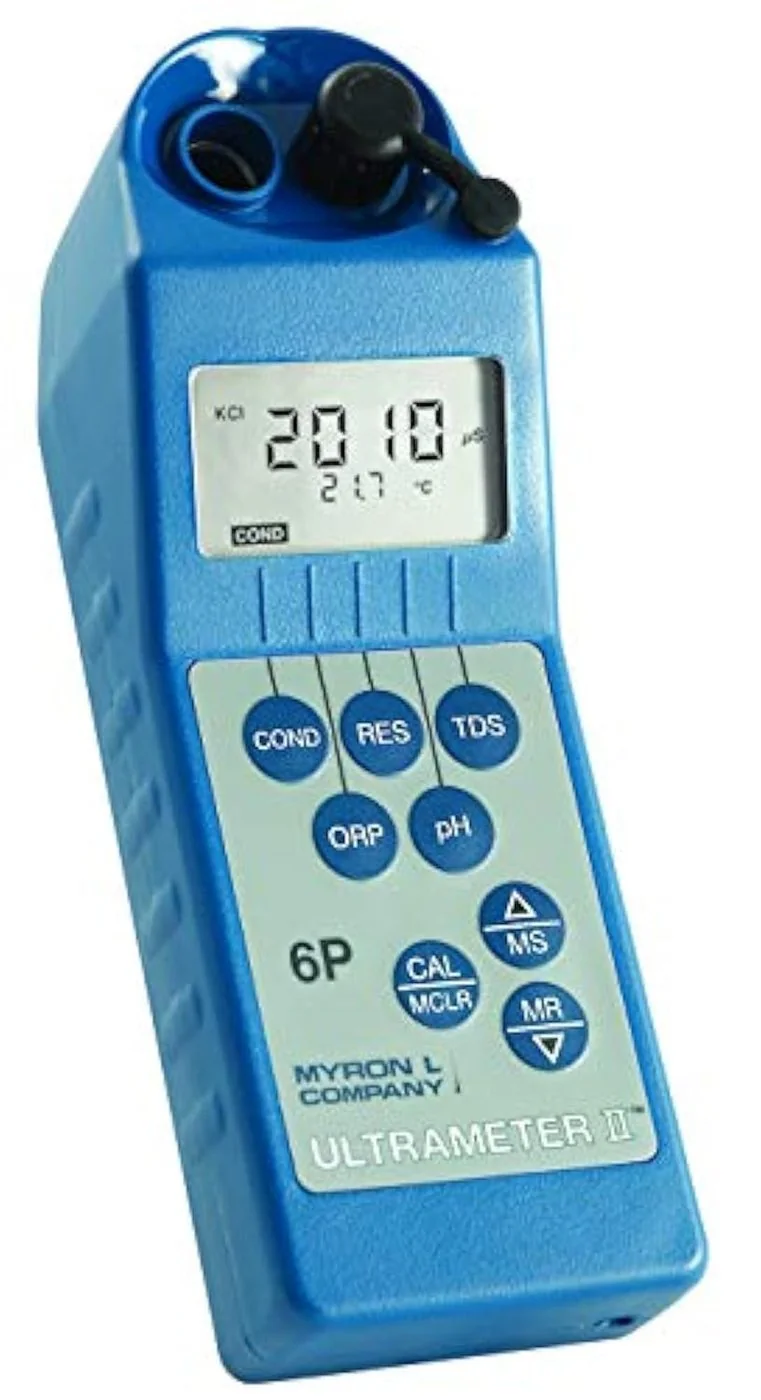
Best for: Water treatment operators, pool/spa professionals, industrial process engineers, RO system technicians, municipal water compliance, and any application requiring simultaneous multiparameter monitoring with traceable data records.
Made in Carlsbad, California. NIST-traceable calibration. IP67/NEMA 6. ±1% conductivity accuracy.
TDS, pH, ORP,
FCE™, Temp
±0.01 pH res.
1 m, 30 min
RTC timestamped
(Kelvin)
442™ · User
Carlsbad, CA
Contents
- 7 parameters explained
- Four-electrode conductivity cell
- FCE™ free chlorine — how it works
- The 442™ Natural Water standard
- Full specifications
- Solution selection and User mode
- Operating procedures — all parameters
- FCE measurement — flow and immersion methods
- Calibration protocols
- 100-point datalogger and real-time clock
- Cell Check and factory calibration restore
- Maintenance and troubleshooting
- Applications by sector
- FAQ
7 Parameters Explained
Four-Electrode Conductivity Cell
Most entry-level conductivity meters use a two-electrode design, where the same electrodes that drive current through the sample also measure the voltage response. This creates a systematic error: the electrode-solution interface has its own impedance (contact resistance), which is indistinguishable from the sample's resistance in a two-electrode measurement. The result is that fouled, aged, or partially blocked electrodes read incorrectly — and the operator may not know it.
The Ultrameter II uses a four-electrode (Kelvin) configuration. Two outer electrodes drive an AC current through the sample; two separate inner electrodes measure the resulting voltage. Because the inner measurement electrodes carry essentially no current, the electrode-solution contact impedance has negligible effect on the reading. The four-wire arrangement delivers ±1% accuracy regardless of electrode surface condition, fill level variations, or minor fouling — a design choice that directly explains why this instrument maintains calibration stability longer than two-electrode alternatives.
FCE™ Free Chlorine — How It Works
Standard DPD colorimetric testing adds a reagent to the sample that reacts with chlorine species to produce a pink color whose intensity is compared to a color chart or read by a photometer. The process chemically alters the sample, cannot be repeated on the same aliquot, requires reagent handling and disposal, and — critically — cannot distinguish between the sanitizing effectiveness of chlorine at different pH values.
The FCE approach exploits a physical chemistry relationship: in chlorinated water, ORP is a function of both the free available chlorine (FAC) concentration and the pH. Because FAC exists in two forms (hypochlorous acid, HOCl, and hypochlorite ion, OCl⁻) whose ratio is governed by pH, and because HOCl is approximately 80–100 times more effective as a disinfectant than OCl⁻, a measurement that captures both ORP and pH captures actual sanitizing power — not just total chlorine concentration.
The FCE conversion table was derived from controlled laboratory experiments with precisely calibrated chlorine levels and excluded interferants. The conversion applies to free available chlorine (hypochlorous acid and hypochlorite ion) specifically and is not valid for combined chlorine (chloramines) or other oxidants.
The 442™ Natural Water Standard
Conductivity measurements are calibrated against reference solutions of known conductivity. The choice of reference solution matters because different ionic species contribute differently to conductivity per unit mass — meaning a 1,000 µS reading in KCl solution represents a different TDS than the same 1,000 µS in a natural freshwater sample.
Myron L's 442™ Natural Water standard — 40% sodium sulfate, 40% sodium bicarbonate, 20% sodium chloride — was formulated to replicate the ionic balance of typical fresh natural water. When the Ultrameter II is calibrated with the 442 standard and the 442 solution type is selected for TDS conversion, the resulting ppm reading correlates closely with gravimetric TDS (evaporated weight measurement) used in regulatory reporting. For water treatment, drinking water, and environmental monitoring applications, this is a meaningful accuracy advantage over KCl-calibrated instruments.
Full Specifications
| Parameter | Range | Resolution | Accuracy |
|---|---|---|---|
| Conductivity (COND) | 0–199.9 µS / 200–1999 µS / 2.00–19.99 mS / 20.0–199.9 mS | 0.1 µS / 1 µS / 0.01 mS / 0.1 mS | ±1% of reading |
| Resistivity (RES) | 10 KΩ–30 MΩ·cm | Auto-ranging | ±1% of reading |
| TDS | Derived from COND (solution-type dependent) | Depends on range | ±1% of reading (conductivity basis) |
| pH | 0–14 pH | 0.01 pH | ±0.01 pH (buffer calibrated) |
| ORP | ±1999 mV | 1 mV | Platinum electrode |
| FCE™ Free Chlorine | 0.01–5.00 ppm Cl₂ | 0.01 ppm | Derived from ORP + pH |
| Temperature | 0–100°C | 0.1°C | Compensated reference for COND/TDS/RES |
| Source: Myron L Company Ultrameter II Operation Manual (UMIIFCEOM 18FE16, 2016). Conductivity accuracy ±1% of reading — not ±% of full scale. Factory calibration NIST-traceable. | |||
| Physical / Environmental | Specification |
|---|---|
| IP rating | IP67 / NEMA 6 — dust-tight, submersible to 1 meter for 30 minutes |
| Battery | 9V alkaline |
| Auto-off | 15 seconds default (adjustable to 75 sec); 60 sec in calibration mode |
| Memory | 100 readings — EEPROM non-volatile; real-time clock date/time stamp on each record |
| Calibration storage | Non-volatile; factory calibration (FAC) permanently stored and restorable |
| Solution types | KCl, NaCl, 442™ Natural Water, User (custom Tempco and TDS ratio) |
| EMC compliance | CE certified; IEC 61000-4-2, IEC 61000-4-3, CISPR 11, EN61326-1 |
| Origin | Made in USA — Carlsbad, California |
Solution Selection and User Mode
The solution type selection controls two linked calculations simultaneously: the temperature compensation model applied to the raw conductivity reading, and the conversion ratio used to derive TDS from that compensated conductivity. The Ultrameter II maintains separate calibration data for each solution type — changing the selection does not affect calibrations performed for other types.
| Solution Type | Best Used For | TDS Basis |
|---|---|---|
| KCl | Laboratory standard reference; conductivity calibration verification | KCl ionic weight |
| NaCl | Seawater, brine, desalination applications; cooling tower blowdown; food-grade salt solutions | NaCl ionic weight |
| 442™ Natural Water | Drinking water, freshwater, municipal water treatment, RO permeate, environmental monitoring — correlates with gravimetric TDS | 40% Na₂SO₄ / 40% NaHCO₃ / 20% NaCl |
| User | Any solution with known TDS but unique ionic composition — hydroponic nutrient solutions, specialty chemical processes, industrial process streams | Custom ratio (operator-programmed) |
| Factory defaults: KCl for conductivity, NaCl for resistivity, 442 for TDS. The 40% TDS error example (NaCl vs. 442 at the same µS reading) illustrates why correct solution selection is not optional for accurate TDS reporting. | ||
Setting a Custom User Mode TDS Ratio
To program a custom conductivity-to-TDS conversion ratio: measure the solution at 25°C in COND mode and record the µS reading. Divide the solution's known TDS (ppm) by the measured µS. For example: 75 ppm TDS at 100 µS = ratio of 0.75. Enter this ratio (0.20–7.99) in User mode via the CAL key sequence. The custom Tempco (%/°C, range 0.00–9.99) should also be entered for the specific solution. Setting Tempco to 0.00 disables temperature compensation.
Operating Procedures — All Parameters
Conductivity and TDS
Verify solution type
Check the left side of the LCD for the current solution type (KCl, NaCl, 442, or User). To change: press COND or TDS, hold CAL for 3 seconds until "SEL" appears, use ▲▼ to select, press CAL to confirm.
Rinse the cell cup three times
Rinse the conductivity cell cup three times with the test sample — not distilled water, not rinse water. This conditions the temperature compensation network and removes contamination from previous measurements. Three rinses, not one.
Fill and measure
Refill the cell cup with the test sample. Verify no air bubbles are clinging to the cell walls or electrodes — bubbles cause falsely low readings. Press COND or TDS. Allow reading to stabilize.
Store and rinse
Press ▲ MS to store the reading with timestamp. After measurement, rinse the cell with clean water to prevent crystal formation on the electrodes.
Resistivity (High-Purity Water)
Pure water absorbs CO₂ from the atmosphere within seconds of contact, driving resistivity readings artificially downward. Static sample measurement is not reliable for high-purity water. Follow the flowing sample method:
- Confirm the pH protective cap is secured on the pH/ORP sensor well.
- Hold the instrument at a 30° angle with the cell cup sloping downward.
- Allow sample to flow continuously into and out of the cell without aeration.
- Press RES and observe the stabilizing reading — use the most stable value observed.
pH Measurement
Remove the pH/ORP protective cap
Rotate while grasping and pulling upward to remove. The cap contains pH sensor storage solution — avoid spilling.
Rinse both sensor well AND cell cup — three times
Rinse both the pH/ORP sensor well and the conductivity cell cup three times with the test sample. Shake out each rinse completely before the next. Both must be rinsed — contamination in either chamber affects the reference junction.
Fill and measure
Refill both sensor well and cell cup with test sample. Press pH and allow reading to stabilize.
CRITICAL — Store the pH sensor after every use
After use, fill the pH/ORP sensor well with Myron L pH Sensor Storage Solution and replace the protective cap securely. Storing the sensor dry causes the reference junction KCl to crystallize, blocking the junction and producing drift or unresponsive pH readings. This is the most common cause of pH sensor failure on this instrument.
ORP Measurement
Confirm ORP mode is active (not FCE mode): press ORP/Fr Chl, hold CAL 3 seconds, verify display shows "mV" not "ppm". Use ▲▼ to toggle if needed, then press any parameter key to save. Procedure: remove cap → rinse sensor well and cell cup three times → fill both → press ORP/Fr Chl → read stable mV value → press MS to store → fill sensor well with storage solution, replace cap.
FCE Measurement — Flow and Immersion Methods
Flow Method — Recommended for Discrete Samples
Set FCE mode
Press ORP/Fr Chl → hold CAL 3 seconds → use ▲▼ to select "Chl" ppm (not "ORP" mV) → press any parameter key to save.
Empty sensor well of storage solution
Remove cap and empty the storage solution from the pH/ORP sensor well before flushing. Storage solution residue dilutes the sample and produces falsely low FCE readings.
Flush for 10+ seconds
Hold at 30° angle (cell cup sloping down). Flush sensor well and cell cup with a steady sample stream for at least 10 seconds. Allow sample to flow continuously — do not aerate.
Press ORP/Fr Chl and wait for stabilization
Display alternates between predicted ORP (mV) and FCE ppm. Wait until both readings are unchanged for 5 consecutive readings — typically 1–2 minutes. If it takes over 1 minute, press ORP/Fr Chl again to reset the auto-off timer.
Record and repeat
Press MS to store the stable FCE ppm reading. Repeat the full procedure twice more. Average all three readings for the reported value.
Immersion Method — Pools, Spas, and Large Bodies
- Hold the instrument beneath the water surface — surface chemistry differs from bulk water.
- Swirl the instrument for at least 10 seconds to flush cell cup and sensor well.
- Continue holding under the surface throughout measurement.
- Press ORP/Fr Chl. Wait for mV and ppm to stabilize (5 consecutive unchanged readings; 1–2 minutes typical).
- Press MS to store. Repeat twice and average the three readings.
Calibration Protocols
The Ultrameter II is factory-calibrated with NIST-traceable Myron L standard solutions before shipment. The microprocessor architecture eliminates mechanical drift, extending calibration intervals significantly versus older designs. Factory calibration values are stored permanently in non-volatile EEPROM and can be restored at any time.
Conductivity / TDS Calibration
- Rinse the conductivity cell cup three times with the appropriate standard solution (KCl, NaCl, or 442).
- Refill the cell cup with the same standard.
- Press COND or TDS to begin measuring.
- Press CAL — the CAL annunciator appears on the LCD.
- Use ▲▼ keys to adjust the displayed value to match the standard solution's labeled value.
- Press CAL to accept and complete calibration for this solution type.
- To calibrate additional solution types, change the solution type and repeat from step 1.
pH Calibration — Three-Point Procedure
- Rinse sensor well and cell cup three times with pH 7 buffer. Fill with pH 7 buffer.
- Press pH. When stable, press CAL. Adjust to 7.00. Press CAL to save. This also calibrates the ORP zero point electronically.
- Rinse three times with pH 4 buffer (acid gain). Fill with pH 4 buffer. Press pH. When stable, press CAL. Adjust to 4.00. Press CAL.
- Optionally: rinse three times with pH 10 buffer (base gain). Fill with pH 10. Press pH. When stable, press CAL. Adjust to 10.00. Press CAL.
100-Point Datalogger and Real-Time Clock
Every stored record includes: measured value and parameter, measurement units, solution type in use, temperature at time of measurement, and a real-time clock time and date stamp. Memory is non-volatile — stored data and all calibration settings survive battery replacement provided the battery is removed for fewer than 3 minutes.
| Operation | Procedure |
|---|---|
| Save reading | While desired measurement is displayed, press ▲ MS. MEMORY annunciator flashes; temperature display momentarily shows the memory location number (1–100). |
| Recall readings | Press ▼ MR in any measurement mode. Scroll through records with ▲▼. Press CAL while viewing a record to display its full time and date stamp. |
| Delete individual record | While the record is displayed in Recall mode, press and hold CAL/MCLR. |
| Delete all records | Scroll past location 100 to "CLr ALL" → press CAL to confirm. All 100 records erased. |
| Configure real-time clock | Access via Memory Recall scroll menu. Time in 24-hour format. Date format: US (MM/DD/YY) or International (DD/MM/YY) — selectable independently. |
| Memory fills locations 1–100 sequentially. Once full, new records overwrite the lowest-numbered empty or cleared location. Non-volatile EEPROM — battery changes do not erase stored data if battery is replaced within 3 minutes. | |
Cell Check and Factory Calibration Restore
Cell Check Function
Cell Check electronically verifies the conductivity cell's cleanliness without requiring standard solution. It is the first step in any conductivity troubleshooting sequence.
Access: press ▼ MR → scroll past FAC SEL → "CELL ch" appears → press CAL to run the test.
Result "Good": cell is clean — proceed with measurement or calibration.
Result "CELL cLn": cell requires cleaning before accurate measurements are possible. Clean with isopropyl alcohol or foaming non-abrasive household cleaner. Do not scrub cell interior. Rinse, recheck.
Factory Calibration Restore (FAC)
If field calibration is suspected to be incorrect and no standard solution is available, the original factory calibration can be restored from permanent EEPROM storage.
Access: press ▼ MR → scroll past CLr ALL → "FAC SEL" appears → press CAL to execute.
Maintenance and Troubleshooting
Conductivity Cell Cleaning
Rinse the cell with clean water after every use. Discoloration of the stainless steel electrodes from chemically active samples does not impair accuracy — do not clean purely for appearance. When visible oil, scale, or fouling films are present, clean with isopropyl alcohol or a foaming non-abrasive cleaner (not abrasive scrubbers). Run Cell Check after cleaning to verify the cell is restored to "Good" status before taking measurements.
pH/ORP Sensor Rejuvenation
A sensor stored without the cap, or exposed to extreme heat, may develop a blocked reference junction from crystallized KCl. Two rejuvenation methods:
- Hot salt solution (preferred): clean sensor well with isopropyl alcohol, rinse. Fill with hot (~60°C) KCl solution or Myron L pH/ORP Sensor Storage Solution. Allow to cool. Retest.
- DI water soak (up to 4 hours maximum): fill sensor well with DI water and allow to stand for no more than 4 hours. Longer soaking depletes the reference solution and can damage the glass bulb. Retest.
Battery Replacement
Applications by Sector
| Application | Primary Parameters | Key Capability |
|---|---|---|
| Municipal drinking water | TDS (442 mode), FCE ppm, pH | FCE verifies FAC residuals without DPD reagent handling. 442 mode TDS correlates with regulatory evaporated-weight measurements. |
| Pool and spa | FCE ppm, ORP, pH | Immersion method provides bulk water readings. Three simultaneous parameters — FAC, ORP, and pH — in one measurement cycle. No reagent disposal. |
| RO and water purification | TDS (feed and permeate), Resistivity | Memory logging with timestamps enables membrane performance trending. User mode for custom feed water ionic profile. |
| Industrial boiler / high-purity | Resistivity (10 KΩ–30 MΩ·cm) | Flowing sample method for high-purity water prevents CO₂ interference. Resistivity range covers semiconductor and pharmaceutical process water. |
| Cooling towers | COND, TDS (NaCl mode), ORP | NaCl mode appropriate for cooling tower blowdown chemistry. ORP monitors biocide effectiveness. |
| Agriculture / hydroponics | EC (µS/mS), TDS (User mode) | User mode custom TDS ratio matches specific nutrient solution chemistry. EC as nutrient concentration proxy. |
FAQ
What parameters does the Ultrameter II 6PIIFCE measure?
Seven: conductivity, resistivity, TDS, pH, ORP, FCE™ free chlorine (ppm), and temperature. All displayed simultaneously — temperature always appears on the secondary display. The Model 4P variant measures conductivity, resistivity, TDS, and temperature only (no pH, ORP, or FCE).
What is FCE and how does it differ from DPD?
FCE (Free Chlorine Equivalent) is Myron L's reagent-free free chlorine measurement. The instrument simultaneously measures ORP and pH, then applies a proprietary laboratory-derived conversion to calculate effective free chlorine ppm. Unlike DPD, FCE doesn't alter the sample, doesn't require reagents, and accounts for pH when calculating sanitizing effectiveness. A full explanation is in the FCE section above.
What is the 442 Natural Water standard?
40% sodium sulfate, 40% sodium bicarbonate, 20% sodium chloride — a blend formulated by Myron L to replicate the ionic profile of fresh natural water. Using 442 mode produces TDS readings that correlate with gravimetric TDS measurements used in regulatory reporting. More accurate than NaCl or KCl mode for drinking water and freshwater applications.
How do I run the Cell Check function?
Press ▼ MR → scroll past FAC SEL → "CELL ch" appears → press CAL. "Good" = cell is clean. "CELL cLn" = clean the cell before measuring. No standard solution required.
Can the factory calibration be restored?
Yes — permanently stored FAC values in EEPROM can be restored any time: press ▼ MR → scroll past CLr ALL → "FAC SEL" → press CAL. This is a recovery option when field calibration is suspected to be wrong. It is not a substitute for calibration against NIST-traceable standard solutions.
How does User mode work?
User mode allows programming a custom temperature compensation coefficient (Tempco, 0.00–9.99 %/°C) and custom conductivity-to-TDS conversion ratio (0.20–7.99) for solutions that don't match KCl, NaCl, or 442. To determine the ratio: measure the solution's conductivity in µS at 25°C, then divide the known TDS (ppm) by that µS value. See the solution selection section above for the full procedure.
- Turbidity Meter Comparison: Sper 860040 vs VEVOR TN1000 — low-range accuracy and the EPA 180.1 compliance gap
- pH Meters for Commercial Water Use — EPA 150.1/150.2 methods, the 15-minute rule, and compliance records
- Measuring TDS in Water — What Your Meter Actually Measures
- Apera PC60 — 5-in-1 multiparameter (pH/EC/TDS/Salinity/Temp)
- Hach Pocket Pro pH Meter
- VEVOR 9011B Dissolved Oxygen Bluetooth Meter
- VEVOR TN1000 Turbidity Meter
- Hach DR900 Multiparameter Colorimeter
- Guide: pH Testing in Commercial Water Applications
- Hydroponics EC, TDS & pH Guide — crop targets, ppm conversion, calibration protocols
- Guide: Deionized Water — Production and Quality Verification