Hach Pocket Pro pH Tester Review (2026): Pocket Pro vs. Pocket Pro+
Disclosure: This page contains affiliate links. If you purchase through our links, we may earn a commission at no extra cost to you. See our affiliate disclosure.
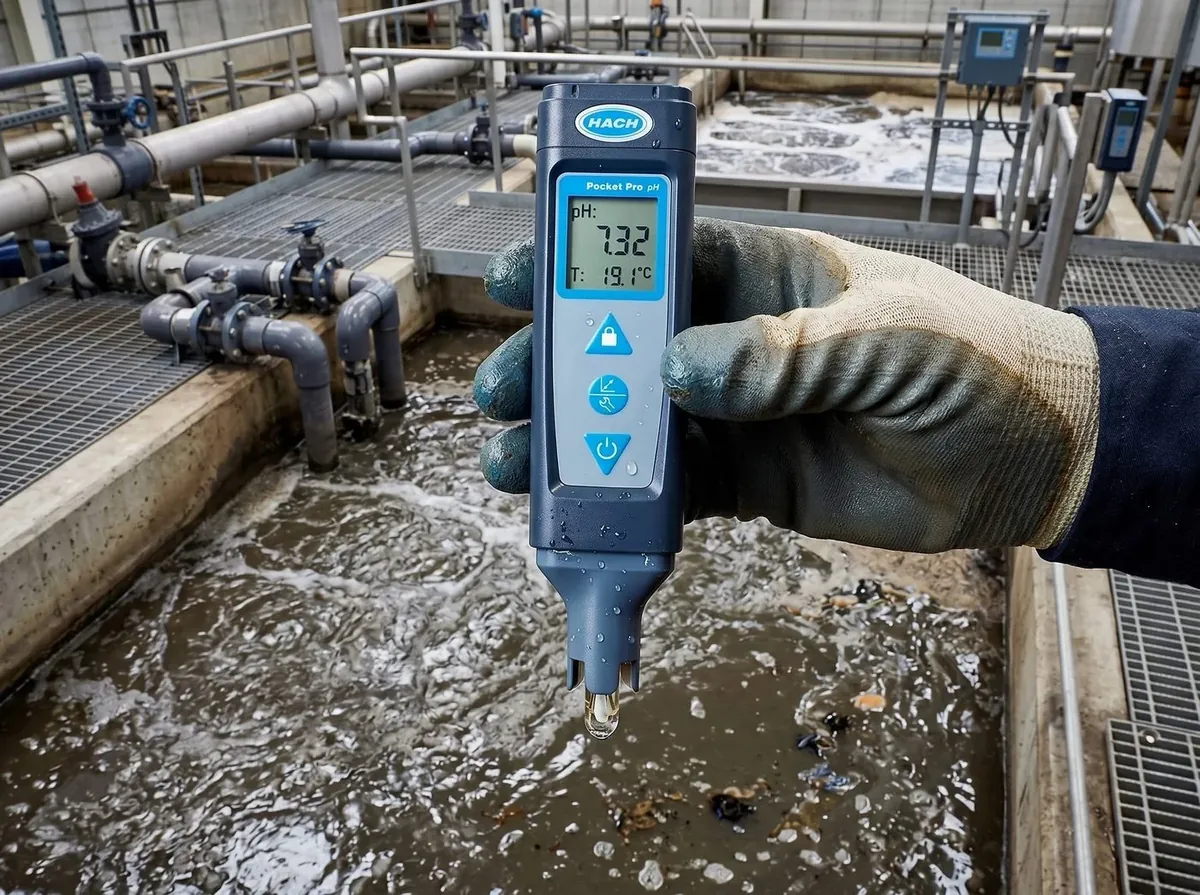
In this review
Pocket Pro vs. Pocket Pro+ — Which Model
Both models share identical IP67 housing, battery platform, pH range, and auto-calibration. The differences are specific and consequential for certain applications:
| Feature | Pocket Pro (9531000E) | Pocket Pro+ (9531001) |
|---|---|---|
| pH resolution | 0.1 pH | 0.01 pH |
| pH accuracy | ±0.1 pH | ±0.02 pH |
| Auto calibration | 3-point auto | 3-point auto |
| Custom calibration | Not available | 2-point custom (any known pH) |
| Replaceable sensor | No — replace whole instrument | Yes — Item No. 9532001 |
| Backlight | No | Yes — 1-minute auto-off |
| Battery life (backlight off) | 450 hours | 450 hours |
| Battery life (backlight on) | N/A | 200 hours |
| Instrument warranty | 6 months | 1 year |
| Best for | Routine field screening where 0.1 pH resolution is sufficient; single-user instruments; budget-conscious procurement | Precision monitoring; dim-light environments; non-standard buffer calibration; applications where long-term sensor replacement reduces TCO |
Full Specifications
Floats
4× AAA alkaline
0.1 resolution
0.01 resolution
(32–122°F)
135 g with batteries
(configurable)
| Specification | Detail |
|---|---|
| Models | Pocket Pro™ pH (Item 9531000E) • Pocket Pro™+ pH (Item 9531001) |
| Manufacturer | Hach Company, Loveland, Colorado • hach.com |
| Dimensions | 37 × 30 × 170 mm (1.45 × 1.18 × 6.69 in.) |
| Weight | 135 g (0.297 lb) with batteries installed |
| Enclosure rating | IP67 — dustproof; submersion to 1 m for 30 min; floats |
| Power source | 4 × AAA alkaline batteries (included) |
| Battery life | Pocket Pro: 450 hours • Pocket Pro+: 450 hrs (backlight off) / 200 hrs (backlight on) |
| Operating temperature | 0 to 50 °C (32 to 122 °F) |
| Storage temperature | −20 to 60 °C (−4 to 140 °F) |
| Maximum humidity | 80%, non-condensing |
| Maximum altitude | 2,000 m (6,562 ft) |
| pH measurement range | 0.0 to 14.0 pH (both models) |
| Resolution — Pocket Pro | 0.1 pH |
| Resolution — Pocket Pro+ | 0.01 pH |
| Accuracy — Pocket Pro | ±0.1 pH (3-point calibration at same temperature as sample) |
| Accuracy — Pocket Pro+ | ±0.02 pH (3-point calibration at same temperature as sample) |
| Calibration — Pocket Pro | 3-point auto-recognition (USA: 4.01, 7.00, 10.01 • NIST: 4.01, 6.86, 9.18) |
| Calibration — Pocket Pro+ | 3-point auto OR 2-point custom (any user-defined pH values) |
| Auto-off | 8 minutes of inactivity (default On; configurable in Settings) |
| Backlight | Pocket Pro+: Yes, 1-minute auto-off • Pocket Pro: No |
| Replaceable sensor | Pocket Pro+: Yes (Item No. 9532001) • Pocket Pro: No |
| Certifications | CE, FCC Part 15 Class B, Industry Canada ICES-003 Class B, KC, RCM, China RoHS |
| Warranty | Pocket Pro: 6 months (instrument) • Pocket Pro+: 1 year (instrument), 6 months (replacement sensor) |
| Manual | DOC022.53.80394, Edition 4, November 2025 |
Physical Design and IP67 Rating
The Pocket Pro is 170 mm tall — about the length of a standard pen — with a 37 mm width that fits comfortably in a shirt pocket or vest. The spring clip on the back and the lanyard attachment loop at the top are both functional rather than decorative: field instruments dropped into streams, tanks, and sample vessels benefit from both. The instrument floats, which is the first and most important safety net against instrument loss in open water sampling.
IP67 means fully dustproof and submersion-resistant to 1 meter for 30 minutes. The rating applies to the sealed instrument body with the battery compartment cover and sensor cap properly installed. Users who remove the battery cover in the field for battery replacement need to ensure it is reseated before the instrument enters water again. This is a practical constraint worth noting — the IP67 rating is not unconditional.
The three-key interface (Power, Calibration/Settings, Lock) runs all functions through press duration and context: a short press does one thing, a hold does another. The keypad layout means the instrument can be operated one-handed, which matters in field sampling where the other hand is managing a sample container, safety line, or field notebook.
Sensor cap measurement method
The measurement method differs from conventional dip-style pH meters. Rather than submerging the electrode tip in a large sample volume, the Pocket Pro uses a sensor cap: pour the sample or calibration standard into the cap to a marked FILL line, insert the sensor into the filled cap, read. This approach minimizes sample volume requirements and protects the sensor between uses. It also means the sensor is never in contact with sample water except during measurement, which reduces contamination risk between samples.
Calibration Guide
Calibrate before initial use, after any period of dry storage, when the SENSOR? icon appears, or when readings seem inaccurate. For routine use, daily calibration before field deployment is best practice; for lower-frequency use, calibrate at each session start.
Auto calibration (both models)
The auto-recognition calibration identifies which buffer standard is in the cap without manual pH entry. This eliminates the most common field calibration error — entering the wrong pH value for the buffer — and speeds the calibration process significantly.
Buffer options: USA set (4.01, 7.00, 10.01) or NIST set (4.01, 6.86, 9.18), selectable in Settings. Use 1, 2, or 3 points. A 3-point calibration covering the full pH range provides the best accuracy across the 0.0–14.0 range; a 1-point calibration at pH 7.00 is valid for the 5.5–8.5 range only.
| Calibration points | Accuracy valid range | Use case |
|---|---|---|
| 1-point (pH 7 only) | 5.5–8.5 pH at ±0.02 pH | Drinking water, environmental sampling within neutral range |
| 2-point (pH 7 + pH 4) | 0.0–8.5 pH at ±0.02 pH | Acid samples, wastewater, RO permeate (typically pH 5.5–7.5) |
| 2-point (pH 7 + pH 10) | 5.5–14.0 pH at ±0.02 pH | Alkaline samples, softener effluent, cooling tower water |
| 3-point (pH 4 + 7 + 10) | Full 0.0–14.0 range at rated accuracy | General use; unknown sample pH; best practice for routine monitoring |
Custom calibration (Pocket Pro+ only)
The Pocket Pro+ adds 2-point custom calibration using any user-defined pH values — not limited to the standard auto-recognition buffer set. Set the bUFr option to Cus in Settings, then use Up/Down keys to match the displayed pH to the known value of the calibration solution. Use cases include calibration against process matrices (nutrient solutions, fermentation broths), validation against reference materials with non-standard pH values, and applications where NIST or USA buffer sets don't bracket the sample range well.
Taking Measurements
If returning from dry storage: soak the sensor for several minutes in sample or tap water before measuring. Dry storage causes the pH glass membrane to dehydrate, which produces slow stabilization and potentially inaccurate readings until the membrane is re-hydrated.
Rinse the sensor and cap with deionized water, blot dry (do not rub — rubbing generates static charge on the glass that affects readings). Pour sample to the FILL line in the cap. Insert sensor fully. Wait for the reading to stabilize — the lock icon appears when stabilization is detected. Press the Lock key to freeze the reading if needed for recording.
After measurements: rinse sensor and cap thoroughly with DI water, reinstall the cap, power off. Optional: add a few drops of tap or DI water to the cap before installation to keep the sensor conditioned for the next use.
Maintenance and Sensor Cleaning
Clean the sensor when the SENSOR? icon appears (calibration slope ±10–15%), when stabilization is slow, when results drift, or when ECAL (calibration failure) occurs after a calibration attempt.
| Contaminant type | Cleaning agent | Soak time |
|---|---|---|
| Grease, oils, fats | Hach Electrode Cleaning Solution (Item No. 2965249) | Maximum 2 hours |
| Mineral buildup / scale | 10% hydrochloric acid (HCl) solution (Item No. 13406 or 13449) | Maximum 5 minutes — do not exceed; longer exposure damages sensor membrane |
| After cleaning, rinse or soak sensor in DI water for 1 minute, then recalibrate before taking measurements. | ||
Battery replacement: replace all four AAA batteries simultaneously when the battery icon flashes (<10% remaining). Never mix old and new batteries — mismatched batteries reduce performance and create uneven discharge that can damage the compartment contacts.
Troubleshooting Display Messages
| Display | Cause | Fix |
|---|---|---|
| SENSOR? | Calibration slope is ±10–15% — sensor contaminated or degraded | Clean sensor (see Section above). Recalibrate. If icon persists after cleaning and calibration, replace sensor (Pocket Pro+) or instrument (Pocket Pro). |
| ECAL | Calibration failure — slope exceeded ±15% | Clean sensor. Recalibrate. If ECAL persists after cleaning, replace sensor (Pocket Pro+) or instrument (Pocket Pro). |
| ———— (top line) | Sample pH outside 0.0–14.0 range | Verify sample pH is within range. Clean sensor and recalibrate. |
| ———— (bottom line) | Temperature outside 0–50°C, or temperature sensor failure | Verify sample temperature within range. If temperature sensor has failed, pH measurement continues without ATC; contact Hach support. |
| Battery icon flashing | Battery below 10% | Replace all four AAA batteries immediately. |
| ? next to calibration icon | Last calibration failed, OR calibration reminder due (ACAL=Yes) | Run calibration procedure. If calibration failed, clean sensor first. |
| C1 appears in calibration mode unexpectedly | bUFr set to Cus (custom) when auto calibration was intended | Exit calibration. Go to Settings, change bUFr to USA or NIST. Restart calibration. |
| Slow stabilization | Air bubble under probe tip; sensor not hydrated; contaminated sensor | Remove sensor, shake side-to-side to dislodge bubbles, reinsert. If returning from dry storage, soak sensor in sample or tap water for several minutes. Clean sensor if contamination suspected. |
Replacement Parts and Accessories
| Item | Item No. | Notes |
|---|---|---|
| pH Sensor Replacement (Pocket Pro+ only) | 9532001 | Key long-term cost advantage of the Pocket Pro+ over the base Pocket Pro |
| pH 4.01 SINGLET Buffer (20/pkg) | 2770020 | Low-point calibration standard; auto-recognized by instrument |
| pH 7.00 SINGLET Buffer (20/pkg) | 2770120 | Mid-point calibration standard; primary single-point calibration buffer |
| pH 10.01 SINGLET Buffer (20/pkg) | 2770220 | High-point calibration standard; auto-recognized by instrument |
| Electrode Cleaning Solution (500 mL) | 2965249 | For grease/oil/fat fouling; maximum 2-hour soak |
| Hydrochloric Acid (HCl) 500 mL | 13449 | For mineral scale cleaning; maximum 5-minute soak; corrosive — wear PPE |
| Hydrochloric Acid (HCl) 2.5 L | 13406 | Bulk option for high-frequency cleaning requirements |
| AAA Alkaline Batteries (4/pkg) | 4674300 | Hach-supplied replacement batteries |
| Lanyard | 201305 | Replacement for lanyard attached to instrument — essential for field use over water |
Best Applications by Use Case
| Application | Model | Why |
|---|---|---|
| Environmental field sampling (streams, groundwater, stormwater) | Pocket Pro | IP67 + floating + 450-hr battery are the primary value; 0.1 pH resolution sufficient for screening; the float feature is not a gimmick in open water work |
| Water treatment plant operations | Pocket Pro+ | ±0.02 pH accuracy supports treatment-level precision; replaceable sensor reduces long-term cost in continuous-use environments |
| Brewery water and process pH | Pocket Pro+ | Brewing water pH targets (mash, sparge, CIP) require 0.01 resolution and ±0.02 accuracy; backlight useful in dim brewhouse environments |
| Agricultural irrigation water | Pocket Pro | Simple operation, field durable, 450-hr battery suits seasonal field use; 0.1 pH resolution adequate for irrigation quality monitoring |
| Pool and cooling tower monitoring | Pocket Pro | Pool pH target range (7.2–7.8) well within 0.1 pH resolution; IP67 obvious advantage in pool deck environments |
| Food and beverage production | Pocket Pro+ | Process pH control benefits from 0.01 resolution; custom calibration allows matrix-matched calibration against production streams |
| Laboratory QC screening | Pocket Pro+ | Custom calibration for non-standard matrices; 0.01 resolution; replaceable sensor for high-throughput use |
| Educational / field labs | Pocket Pro | Simple 3-key interface; auto-calibration removes setup errors; durable; economical |
Who Should Buy It
Related guides and reviews
- pH Meters for Commercial Water Use — EPA 150.1/150.2 methods, the 15-minute rule, and compliance records
- pH testing in commercial water — complete guide
- How to calibrate a pH meter — step-by-step protocol
- Apera pH700 Benchtop pH Meter review — lab bench option with data logging for applications requiring logged records
- Apera pH60 Field pH Meter review — alternative field pH option with replaceable electrode
- Apera PC60 Multi-Parameter Tester review — pH plus EC, TDS, salinity, and temperature in one field instrument
- YSI EcoSense pH10A review — pen-style alternative with 50-reading timestamped memory; compare if data logging in the field matters
- Hach DR300 Pocket Colorimeter review — paired field instrument for chlorine, iron, nitrate, ammonia, and other colorimetric parameters
- Hach DR1900 Portable Spectrophotometer review
- Colorimeter vs. spectrophotometer — which to choose