VEVOR TN1000 Turbidity Meter Review (2026)
Disclosure: This page contains affiliate links. If you purchase through our links, we may earn a commission at no extra cost to you. See our affiliate disclosure.
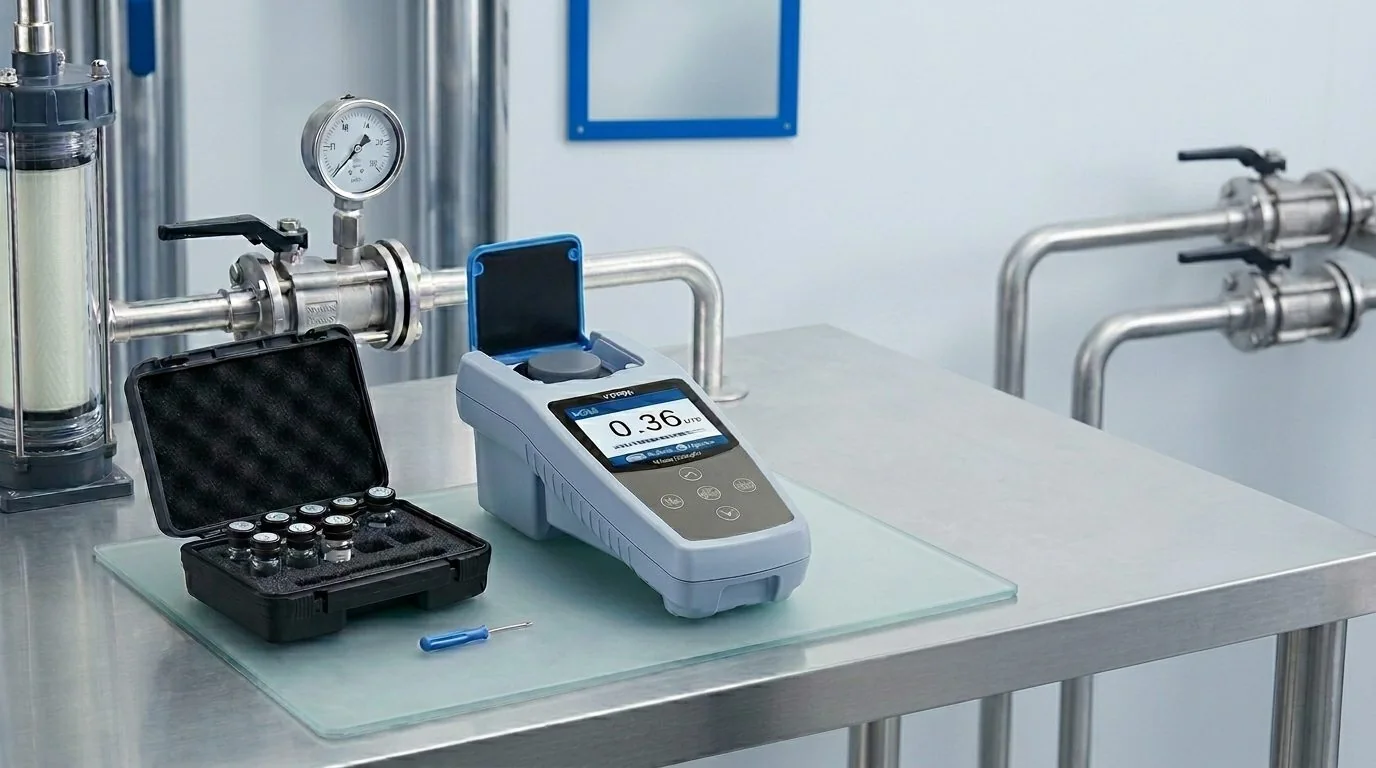
Based on the Apera Instruments TN1000 platform and sold under the VEVOR brand at a lower price point.
Best for: Drinking water monitoring near the EPA 1 NTU limit, filter and RO performance verification, brewing QC, and environmental sampling where ±0.5 NTU is insufficient.
Contents
- Platform note: Apera TN1000
- Full technical specifications
- Accuracy: why ±2% matters at low turbidity
- 5-point calibration system explained
- Silicone oil protocol — what it is and how to use it
- Measurement modes: normal, average, and bubble control
- Calibration standard management
- Commercial application matrix
- TN1000 vs. Sper 860040: which to choose
- Troubleshooting
- FAQ
Platform Note: Apera TN1000
The VEVOR TN1000 is manufactured on the Apera Instruments TN1000 platform — the same instrument, sold under the VEVOR brand at a different price point. The instruction manual is published by VEVOR (Sanven Technology Ltd., Rancho Cucamonga, CA) and explicitly identifies the underlying instrument as the Apera TN1000. All specifications, calibration procedures, and operational guidance in this review are drawn from the official VEVOR/Apera TN1000 instruction manual.
Full Technical Specifications
| Parameter | Specification |
|---|---|
| Measurement | |
| Measuring range | 0–1000 NTU |
| Resolution | 0.01 NTU (0–9.99), 0.1 NTU (10.0–99.9), 1 NTU (100–1000) |
| Accuracy | ≤±2% of reading + stray light (≤0.02 NTU) |
| Repeatability | ≤±1% or 0.02 NTU (whichever is greater) |
| Stray light | ≤0.02 NTU |
| Measurement method | 90° nephelometric scattering; ISO 7027 / DIN EN 27027 |
| Light source | Infrared LED, 860±30 nm |
| Detector | Silicon photovoltaic cell |
| Calibration standards | Polymer (EPA-certified) or Formazin at 0, 20, 100, 400, 800 NTU |
| Calibration points | 5-point (all five, or selectable subset of 2+) |
| Measurement modes | Normal (single reading), Average (10 readings auto-averaged) |
| Display | Color TFT, on-screen instructions |
| Environmental and Power | |
| Operating temperature | 0–50°C |
| Operating humidity | Per specification table (varies by temperature) |
| Storage temperature (instrument) | -40 to 60°C |
| Storage temperature (calibration solutions) | 5–30°C — significantly narrower than instrument |
| Power | 4× AA alkaline batteries (included) |
| Display unit | NTU or FTU (switchable) |
| Warranty | 2 years from delivery date |
| What's Included | |
| Calibration solutions | 5 vials: 0, 20, 100, 400, 800 NTU |
| Sample vials | 6 vials (numbered #1–6; #1 and #2 designated for <2 NTU measurements only) |
| Silicone oil | 10 mL bottle |
| Microfiber cloth | For silicone oil application |
| Screwdriver | For battery cover |
| Batteries | 4× AA included |
| Case | Hard carrying case |
Accuracy: Why ±2% Matters at Low Turbidity
The TN1000's accuracy specification — ±2% of reading plus stray light — behaves very differently from the flat-floor specifications of basic turbidimeters. Because the accuracy is proportional to the reading, it gets better at low turbidity levels where measurement precision matters most for drinking water applications.
| Reading (NTU) | ±2% Calculation | + Stray Light | Effective Accuracy | vs. Sper 860040 |
|---|---|---|---|---|
| 0.5 NTU | ±0.010 NTU | +0.02 NTU | ≈±0.03 NTU | Sper: ±0.5 NTU — 17× worse |
| 1.0 NTU (EPA limit) | ±0.020 NTU | +0.02 NTU | ≈±0.04 NTU | Sper: ±0.5 NTU — 12× worse |
| 5.0 NTU | ±0.10 NTU | +0.02 NTU | ≈±0.12 NTU | Sper: ±0.5 NTU — 4× worse |
| 10.0 NTU | ±0.20 NTU | +0.02 NTU | ≈±0.22 NTU | Sper: ±0.5 NTU — 2× worse |
| 100.0 NTU | ±2.0 NTU | +0.02 NTU | ≈±2.02 NTU | Sper: ±5.0 NTU — 2.5× worse |
| 500.0 NTU | ±10.0 NTU | +0.02 NTU | ≈±10.02 NTU | Sper: ±25.0 NTU — 2.5× worse |
| Sper 860040 accuracy for comparison only — see full Sper 860040 review for that instrument's specifications. | ||||
5-Point Calibration System Explained
The TN1000's 5-point calibration (0, 20, 100, 400, 800 NTU) characterizes the instrument's response curve at five specific points across its range rather than interpolating between just two. This matters because turbidimeter response is not perfectly linear — more calibration points produce a more accurate correction curve, particularly across the full 0–1000 NTU span.
Calibration Point Selection
You don't need to use all five points for every session. The rule: the sample's expected turbidity range must fall between the two lowest and highest calibration points selected. Minimum: 2 points. For most applications, the points that bracket your sample range are sufficient.
| Application | Expected Range | Recommended Cal Points |
|---|---|---|
| Drinking water / RO permeate | 0–5 NTU | 0 + 20 NTU (minimum); add 100 NTU if samples occasionally spike |
| Filter performance verification | 0–50 NTU | 0 + 20 + 100 NTU |
| Wastewater effluent | 5–200 NTU | 20 + 100 + 400 NTU |
| Environmental / stormwater | 0–500 NTU | 0 + 20 + 100 + 400 NTU |
| Full range (brewing, industrial) | 0–1000 NTU | All 5 points |
Calibration Procedure (Full 5-Point)
Prepare vials — apply silicone oil
Apply a small drop of silicone oil to the outside of the 0 NTU calibration vial. Wipe evenly with the microfiber cloth. Remove excess with filter paper. Apply to all calibration vials being used this session, and to sample vials, with the same consistent technique.
Enter calibration mode
Press the Power/Mode key once. The calibration menu appears, cursor at 0 NTU.
0 NTU calibration
Place the 0 NTU vial in the holder. Align the arrow on the vial cap with the arrow on the holder. Close the flip cover. Press Measure/Confirm to start. When complete, press Measure/Confirm to confirm — "OK" appears next to 0 NTU, cursor moves to 20 NTU.
20 NTU calibration
Replace with the 20 NTU vial. Align arrow. Close cover. Press Measure/Confirm. Confirm with Measure/Confirm. "OK" appears next to 20 NTU.
Continue through selected points
Repeat step 4 for 100, 400, and 800 NTU vials as needed for your application range.
Exit calibration
Press the Power/Mode key to exit. The instrument returns to Measurement Mode. Calibration is stored.
Silicone Oil Protocol — What It Is and How to Use It
The silicone oil protocol is unique to professional-grade portable turbidimeters and is one of the reasons the TN1000 can achieve significantly better measurement accuracy than basic instruments using the same optical principle. Here's what it's actually doing and why it matters.
Why Silicone Oil Is Used
Turbidimeters measure light scattered at 90° from a light beam passing through the sample vial. Any surface imperfection on the glass vial — microscopic scratches from cleaning, fingerprint residue, manufacturing variations — scatters light in the same way as actual turbidity particles. At high turbidity (hundreds of NTU), this surface contribution is negligible. At low turbidity (below 5 NTU), vial surface scatter can represent a significant fraction of the total detected signal, introducing systematic measurement error and vial-to-vial variability.
Silicone oil fills micro-scratches and surface imperfections on the glass, presenting a more optically uniform surface to the light beam. The result is reduced surface scatter, better measurement-to-measurement repeatability, and lower vial-to-vial variation — all of which matter more at low turbidity.
Silicone Oil Application Procedure
- Apply a single small drop of silicone oil to the outer surface of the vial
- Use the included microfiber cloth to spread evenly across the entire vial surface
- Use filter paper or high-quality tissue paper to wipe off all excess silicone oil
- Apply to calibration vials and sample vials in the same session, using the same technique on all vials — consistency of surface treatment is as important as the treatment itself
Measurement Modes: Normal, Average, and Bubble Control
Normal Measurement Mode
Place the prepared vial in the holder (align arrow), close the flip cover, press Measure/Confirm once. A progress bar appears; the turbidity value displays after approximately 10 seconds. Press Measure/Confirm again for the next reading.
Average Measurement Mode — The Key Feature
Average mode automatically takes 10 consecutive readings every 20 seconds over approximately 3.5 minutes and displays the mean. This directly addresses two of the most common causes of turbidity measurement error:
- Rapidly settling particles: in samples with settleable solids, a single reading captures only a snapshot of the suspended fraction at one moment. Averaging across 3.5 minutes captures the full settling profile and produces a more representative result.
- Micro-bubble disturbance: placing a vial in the holder causes minor vibration that introduces micro-bubbles into the sample. A single immediate reading may capture anomalously high scatter from these bubbles. Averaging across 10 readings over several minutes reduces the contribution of any single bubble event.
To activate: long press the Measure/Confirm key until a beep sounds, then release. The instrument runs all 10 readings automatically and displays the average on completion.
Air Bubble Control — Critical for Accurate Results
After filling the vial (to 4/5 capacity, ≈18 mL), slowly flip it a few times (do not shake), then let it stand 2–5 minutes before inserting into the holder. After inserting the vial, wait an additional 1–2 minutes before pressing Measure to allow micro-bubbles from vial movement to dissipate.
Calibration Standard Management
| Standard | Openable? | Shelf Life | Storage | Handling |
|---|---|---|---|---|
| 0 NTU | Yes — refillable with distilled water (valid only 2–3 days once opened) | 6–12 months | 5–30°C | Never shake or flip — bubbles |
| 20 NTU | No — permanently sealed | Per expiry date | 5–30°C | If long unused: flip slowly 2×, stand 2 min |
| 100 NTU | No — permanently sealed | Per expiry date | 5–30°C | Same as 20 NTU |
| 400 NTU | No — permanently sealed | Per expiry date | 5–30°C | Same as 20 NTU |
| 800 NTU | No — permanently sealed | Per expiry date | 5–30°C | Same as 20 NTU |
| Store calibration standards at 5–30°C — significantly narrower than instrument storage range. Do not store in vehicles, unheated sheds, or spaces subject to temperature extremes. | ||||
Commercial Application Matrix
| Application | Key Advantage of TN1000 | Notes |
|---|---|---|
| Drinking water — near EPA 1 NTU limit | ≈±0.04 NTU accuracy at 1 NTU vs. ±0.5 NTU in basic meters | Field screening and filter verification; not for compliance reporting |
| RO permeate monitoring | High precision at low turbidity; average mode for variable readings | Confirm permeate stays below SDI/turbidity thresholds for downstream equipment |
| Filter performance verification | Reliable low-turbidity readings; 5-point cal brackets filter output range precisely | Before/after filter comparison; alert to media breakthrough |
| Brewing and beverage QC | Full 0–1000 NTU covers all brewing stages; average mode for variable wort samples | Wort clarity, filtration, bright beer confirmation |
| Wastewater effluent monitoring | Better accuracy than basic meters at mid-range; 5-point cal brackets typical 10–200 NTU effluent | Field check; not for NPDES permit compliance reporting |
| Environmental / stormwater sampling | Average mode compensates for settling during sample handling | Compare against MSGP 50 NTU benchmark; portable for field use |
| Pharmaceutical process water | High accuracy and repeatability at low turbidity; ISO 7027 and DIN EN 27027 dual standard | Validate against pharmacopoeia method requirements before use in regulated production |
TN1000 vs. Sper Scientific 860040: Which to Choose
| Feature | VEVOR TN1000 | Sper Scientific 860040 |
|---|---|---|
| Accuracy at 1 NTU | ≈±0.04 NTU | ±0.5 NTU (floor) |
| Calibration points | 5-point (0/20/100/400/800 NTU) | 2-point (0/100 NTU) |
| Averaging mode | Yes — 10 readings auto-averaged | No — single reading only |
| Light source | Infrared LED 860nm (ISO 7027) | Visible light (ISO 7027) |
| Standards compliance | ISO 7027 + DIN EN 27027 | ISO 7027 |
| Display | Color TFT with on-screen guidance | Monochrome LCD |
| Vial surface treatment | Silicone oil protocol included | Standard cleaning only |
| Vials for <2 NTU | Dedicated vials #1 and #2 | Standard vials |
| Battery | 4× AA | 6× AAA, 250-hour life |
| Warranty | 2 years | 1 year |
| Price tier | Higher | Lower |
Choose the Sper 860040 when: budget is the primary constraint, samples are consistently above 5 NTU where the ±0.5 NTU floor doesn't limit useful resolution, or the application is simple field screening where ±0.5 NTU is adequate.
Choose the TN1000 when: accuracy near 1 NTU matters (drinking water, RO permeate, filter effluent verification), samples are variable enough to benefit from averaged readings, or you need 5-point calibration across a wide turbidity range in the same session.
Troubleshooting
| Problem | Most Likely Cause | Resolution |
|---|---|---|
| Reading much higher than expected | Air bubbles in sample | Do not shake vial. Fill to 4/5 capacity, slowly flip a few times, stand 2–5 min. After inserting in holder, wait 1–2 more minutes before pressing Measure. |
| Wrong vial placed at calibration step | No automatic recognition | Recalibrate from the beginning with the correct vial sequence. Verify each standard before pressing Measure/Confirm. |
| Variable readings on same sample | Inconsistent vial surface treatment or settling particles | Apply silicone oil to all vials with the same technique. Use average measurement mode for samples with settleable solids. |
| Readings elevated at low turbidity | Silicone oil not applied, or vial exterior dirty | Apply silicone oil as described. Handle vials by cap. Clean exterior with filter paper before inserting. |
| 0 NTU calibration gives elevated reading | Bubbles in 0 NTU standard from shaking | Never shake the 0 NTU standard. Set it down gently and allow to stand 5+ minutes before calibrating. Replace 0 NTU solution if consistently elevated. |
| Low battery warning | Batteries depleted | Replace all 4× AA batteries. Do not mix old and new batteries or different brands. |
| Readings systematically offset from known values | Expired or contaminated calibration standards | Replace calibration standards. Verify storage conditions were within 5–30°C. |
FAQ
How accurate is the VEVOR TN1000?
±2% of reading plus stray light (≤0.02 NTU). At 1 NTU, that's approximately ±0.04 NTU — roughly 12 times better than the ±0.5 NTU floor of basic 2-point turbidimeters at the same reading. See the accuracy table above for specific values across the range.
What is the silicone oil for?
It fills microscopic scratches and imperfections on the vial glass surface, reducing surface light scatter that would otherwise add to the turbidity reading — particularly important below 5 NTU. Apply every several days or weekly, not before every measurement. Apply consistently to both calibration vials and sample vials in the same session.
What is average measurement mode?
Ten consecutive readings taken every 20 seconds, automatically averaged, over approximately 3.5 minutes. Activate with a long press on Measure/Confirm. Best for samples with settling particles or any application where a single reading may not represent the true turbidity. Long-press Measure/Confirm to activate.
Is the VEVOR TN1000 the same as the Apera TN1000?
Yes — the VEVOR TN1000 is manufactured on the Apera Instruments TN1000 platform. The instruction manual is co-branded and explicitly identifies the Apera TN1000 as the underlying instrument. Specifications and procedures are identical.
Can the TN1000 be used for regulatory compliance reporting?
For field screening and process monitoring, yes. For regulatory compliance reporting — drinking water NPDWR or wastewater NPDES permit compliance — the TN1000 is not a substitute for NIST-traceable laboratory nephelometers. Use it to screen, verify, and monitor; send boundary-condition samples to a certified laboratory for compliance reporting.
- Turbidity Meter Comparison: Sper 860040 vs VEVOR TN1000 — low-range accuracy and the EPA 180.1 compliance gap
- Sper Scientific 860040 Turbidity Meter — Entry-Level Alternative
- Hach 2100Q Turbidimeter — EPA Method 180.1 Compliance-Grade
- Hach Water Test Kits — Hardness, Chlorine, and Field Testing
- Industrial Wastewater — MSGP Turbidity Benchmarks
- All Water Quality Instrument Reviews