Home › Reviews › Pulsar Max Plus UV
US Water Systems Pulsar Max Plus UV Review (2026): Dose, Flow, and the Commercial Warranty Gap
Disclosure: This page contains affiliate links. If you purchase through our links, we may earn a commission at no extra cost to you. See our affiliate disclosure.
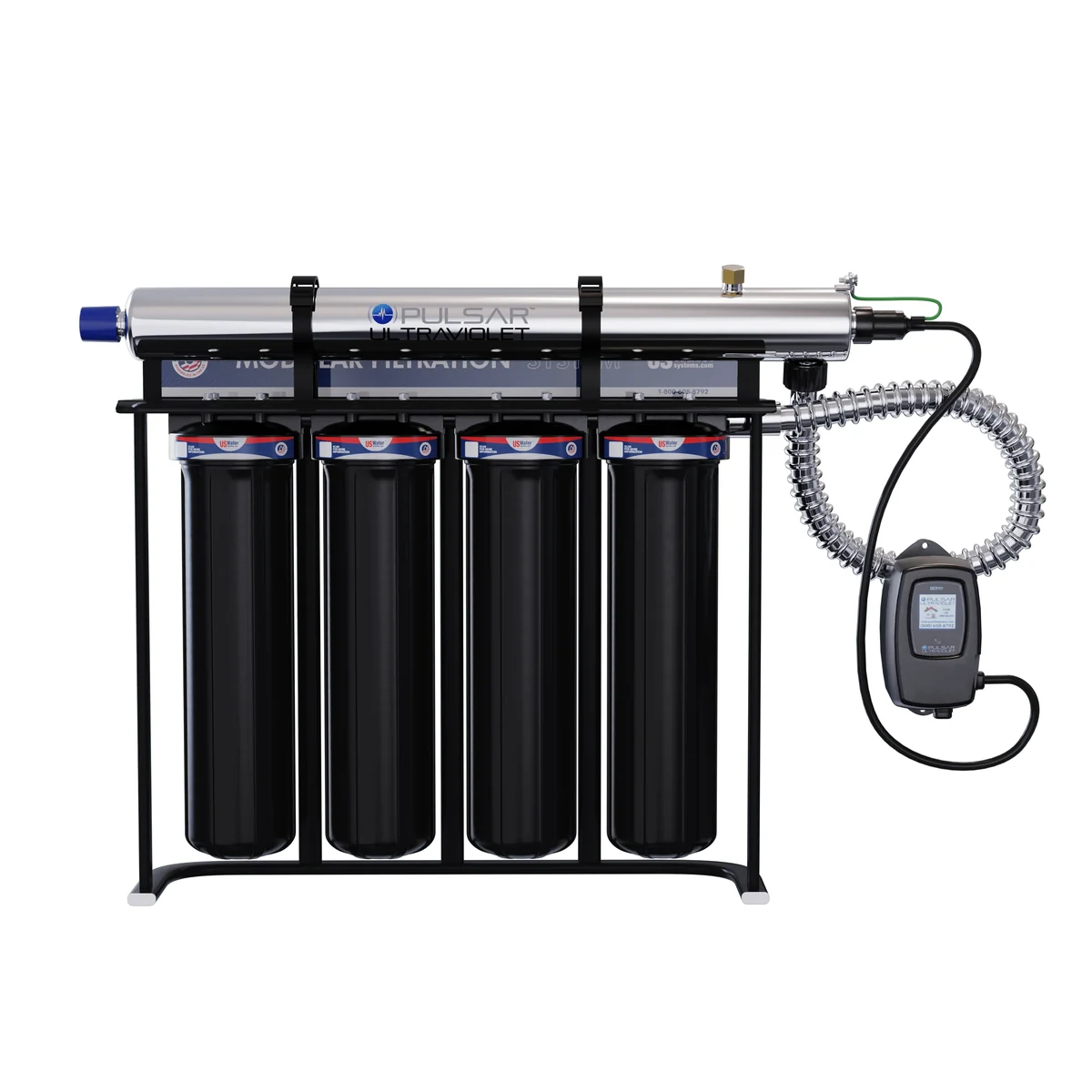
The Pulsar Max Plus (SKU 320-PUV-MAX-PLUS) is a five-stage whole-house treatment system built around a 304 stainless UV reactor, aimed primarily at private wells and rainwater harvesting. The filtration train is well sequenced, the build quality is legitimately good, and the warranty is unusually generous. But three things in the published specifications deserve more attention than the product page gives them, and all three come from US Water Systems' own numbers: the 20 GPM flow rating and the disinfection-grade UV dose are mutually exclusive, the pathogen table has the virus claim backwards relative to EPA guidance, and the warranty excludes exactly the installations this site's readers operate.
Contents
Verdict at a glance
What's genuinely good
- Correctly sequenced filtration train — sediment, carbon, fine sediment, charged sub-micron, then UV. The order is right and it matters.
- 304 stainless ASME-standard reaction chamber rather than plastic.
- Lifetime warranty on chamber and filter housings; 4 years on electronics — strong terms for residential buyers.
- Universal 90–265V input and a controller that tracks lamp hours with audible and visual alerts.
- Lamp replaceable without interrupting water flow.
- Published dose-vs-flow curve at three points, which many competitors don't disclose at all.
What buyers need to know
- 20 GPM and 40 mJ/cm² cannot both be achieved — 40 mJ/cm² requires derating to 16 GPM.
- No NSF/ANSI 55 Class A listing claimed; CSA and CE compliance only.
- Vendor pathogen table overstates UV performance against viruses relative to EPA guidance.
- Warranty expressly excludes commercial and industrial installations.
- Controller tracks elapsed lamp hours, not delivered dose — sleeve fouling is a silent failure mode.
- "100% destruction" language isn't how disinfection performance is expressed.
The dose vs. flow tradeoff
UV dose is intensity multiplied by exposure time. Push water through a fixed-length reactor faster and each organism spends less time under the lamp, so dose falls. That's physics, not a product flaw, and every UV system has this curve. What matters is where a given unit sits on it, and to its credit US Water Systems publishes three points rather than a single marketing number.
| Flow rate | Delivered dose | What that dose covers |
|---|---|---|
| 39 GPM | 16 mJ/cm² | Equivalent to the NSF/ANSI 55 Class B threshold — supplemental treatment of water already deemed safe. Class B systems cannot make cyst claims or health-effects claims. |
| 21 GPM | 30 mJ/cm² | The rating corresponding to the advertised 20 GPM. Comfortably above the ~22 mJ/cm² EPA associates with 4-log Giardia and Cryptosporidium inactivation. Below the Class A threshold. |
| 16 GPM | 40 mJ/cm² | Meets the NSF/ANSI 55 Class A dose figure — the level generally accepted as adequate for essentially all waterborne pathogens. |
| Dose figures published by US Water Systems for the PUV-200-20 chamber. Class thresholds from NSF/ANSI 55. All doses assume UV transmittance above 85% and a clean quartz sleeve. | ||
Read the table and the headline claim reorganizes itself. NSF/ANSI 55 Class A systems must deliver 40 mJ/cm² at 254 nm to inactivate pathogenic microorganisms, while Class B systems deliver 16 mJ/cm², a level sufficient for nonpathogenic organisms. The Pulsar spans both thresholds depending on how hard you run it. At its advertised 20 GPM it sits between them.
NSF/ANSI 55 Class A comparison
US Water Systems lists the Pulsar as CSA and CE compliant. It does not claim NSF/ANSI 55 certification, and that distinction is worth understanding rather than glossing over.
Class A certification is more than a dose number. Systems certified to NSF/ANSI 55 Class A must provide a dose in excess of 40 mJ/cm² across the entire life of the UV lamp, incorporate a UV dose monitoring system, and include a flow restrictor ensuring the rated flow capacity is not exceeded. Class A systems must include a UV sensor — a visible indicator is explicitly not sufficient — connected to an alarm that gives visual and audible warning that the system is not performing, or terminates discharge of treated water.
The Pulsar has audible and visual alerts, but they're driven by the lamp-hour countdown, not by a sensor measuring actual UV output reaching the water. That's the meaningful gap, and it interacts directly with the maintenance section below: a scaled or iron-stained quartz sleeve can cut transmission substantially while the controller continues to report healthy lamp life, because elapsed hours and delivered dose are different quantities.
The virus claim, corrected
The product literature's pathogen table states that UV is more effective against most viruses than chlorination, and rates viruses alongside bacteria at 99.99%+ inactivation at standard doses. EPA guidance says close to the opposite.
So the honest performance picture for any residential UV system in the 30–40 mJ/cm² range, the Pulsar included, is this: excellent against bacteria, excellent against the chlorine-resistant protozoa that make UV worth installing in the first place, and partial against the most UV-resistant viruses. That's still a strong result — Cryptosporidium and Giardia are precisely the organisms chlorination struggles with, which is the entire reason UV earned its place in drinking water treatment. But "99.99% on viruses at standard doses" isn't supportable at 30 mJ/cm².
Two related pieces of language in the source material are worth flagging for anyone comparing UV products. "100% destruction of bacteria, parasites, virus and cysts" is not how disinfection performance is expressed — inactivation is logarithmic and reported as log reduction, and no system achieves 100%. And the Interceptor stage's zeta potential mechanism is electrokinetic, not magnetic; contaminants aren't "magnetically" drawn to it. The underlying technology is real and the stage does useful work. The description just overstates it.
The commercial warranty exclusion
This is the most consequential fact on this page for most readers of this site, and it appears well down the manual rather than on the product page.
| Component | Term | Coverage notes |
|---|---|---|
| Filter housings (black and gray) | Lifetime | Original residential purchaser, original address. Excludes environmental damage and improper installation. |
| UV reactor chamber (304 stainless) | Lifetime | Same conditions. |
| Frame | Lifetime | Per product page listing. |
| UV electronics / controller | 4 years | Replacement at no charge except transportation and standard labor. |
| UV lamp (406-PUV-LM-20) | Consumable | Annual replacement expected. Not a warranty item. |
| Quartz sleeve (406-PUV-QS-20) | Consumable | Replace when cracked or fouled beyond cleaning. |
| Commercial and industrial installations — excluded entirely. Transfer to a subsequent owner is possible with written approval and a standard transfer fee. | ||
For residential buyers these are genuinely excellent terms — lifetime coverage on the two most expensive components is better than most of the market offers. The point isn't that the warranty is bad. It's that it's precisely scoped, and commercial buyers evaluating this unit on price against a commercial-rated alternative are not comparing like with like.
The five-stage train
The sequencing here is correct, and that's not a given in packaged systems. Each stage protects the next, and the whole arrangement exists to deliver water to the UV chamber clean enough for the lamp to do its job — because particles physically shield organisms from UV, and anything that fouls the quartz sleeve reduces delivered dose.
Water quality prerequisites
These limits are the difference between a UV system that works and one that quietly doesn't. Every parameter below either fouls the quartz sleeve or absorbs UV in the water itself, and both reduce delivered dose without triggering any alarm.
| Parameter | Limit | Failure mechanism | Upstream fix |
|---|---|---|---|
| Iron | < 0.3 ppm | Plates onto the sleeve as brown stain, opaque to UV | Oxidation and filtration — see the iron in well water guide |
| Manganese | < 0.05 ppm | Black staining on the sleeve, blocks UV | Greensand or catalytic media filter |
| Hardness | < 7 gpg (120 mg/L) | Scale deposits on sleeve reduce transmission | Softener upstream, or increased cleaning frequency — see the hard water guide |
| Turbidity | < 1 NTU | Suspended particles scatter UV and shield organisms | Handled by stages 1–4 on typical well or rainwater |
| Tannins | < 0.1 ppm | Absorb strongly at 254 nm — the disinfection wavelength itself | Dedicated tannin ion exchange upstream |
| UV transmittance | > 85% | Directly determines delivered dose; the master parameter | Below 80%, reduce flow and consult the manufacturer |
| Water temperature | < 105 °F | Affects lamp performance and components | Temperature relief valve; verify peak temperature first |
Full specifications
| Model / SKU | 320-PUV-MAX-PLUS (UV chamber: PUV-200-20) |
| Price | $2,295 (list $3,825) |
| Rated flow | 20 GPM with 1" inlet/outlet; housings flow to 25 GPM |
| UV dose curve | 16 mJ/cm² @ 39 GPM · 30 mJ/cm² @ 21 GPM · 40 mJ/cm² @ 16 GPM |
| Chamber | 36.1" H × 3.5" dia, polished 304 stainless, ASME pressure vessel standards |
| Max operating pressure | 150 PSI (10 bar) |
| Connections | 1" MNPT reactor inlet/outlet; full 1" filter housing ports |
| Electrical | 90–265V / 50–60 Hz universal; NEMA 5/15 3-prong; 51 W; GFCI outlet required |
| Lamp life | 9,000 hours (~375 days continuous), controller countdown with audible + visual alert |
| Compliance | CSA, CE. No NSF/ANSI 55 listing claimed. |
| Origin | Housings and filters made in USA; UV chamber made in Canada |
| Shipping weight | 17 lbs |
| Replacement parts | Lamp 406-PUV-LM-20 · Sleeve 406-PUV-QS-20 · Ballast 406-PUV-BL-200 · Sensor 406-PUV-S-2.5 |
Maintenance and running cost
UV systems fail quietly rather than dramatically, and the maintenance schedule is the whole defense against that. Three recurring items:
- Filter cartridges — annually. All four stages, more often on high-sediment or high-iron sources. The controller does not track filter life; that's a calendar item you own.
- Quartz sleeve cleaning — annually at minimum, more frequently with elevated hardness, iron, or manganese. Clean with a scale remover such as CLR or Lime-A-Way on a lint-free cloth, and keep all liquid out of the sleeve interior. Inspect for cracks and etching while it's out.
- Lamp — every 9,000 hours, roughly annually. Replace on schedule even if it still lights. UV output decays well before visible failure, so a glowing lamp is not evidence of adequate dose.
Annual consumables run to a replacement lamp plus four cartridges, with a quartz sleeve occasionally on top. Budget for that from day one — it's the real cost of ownership on any UV system, and it's the line item people underestimate when comparing UV against chemical disinfection.
What it doesn't treat
| Contaminant | Addressed? | Notes |
|---|---|---|
| Bacteria (E. coli, coliform, Legionella) | Yes — stages 4 + 5 | The primary reason to buy this system. UV is highly effective here. |
| Giardia, Cryptosporidium | Yes — stages 3 + 4 + 5 | Physical removal plus inactivation. UV's strongest use case, since both are chlorine-resistant. |
| Viruses | Partial | Effective against many; the most UV-resistant viruses need far higher doses than this class of system delivers. |
| Sediment, chlorine, VOCs, taste and odor | Yes — stages 1–3 | Conventional and well executed. |
| Lead, Chromium-6, tannins | Partial — stage 4 | Interceptor reduces these. Not a primary treatment claim; high levels need dedicated treatment. |
| PFAS | Partial | GAC has some capacity, but shallow beds and short contact time limit it. RO or activated alumina for meaningful reduction — see the NSF certification breakdown. |
| Iron, manganese | Trace only | Above the sleeve-fouling limits these must be removed upstream, or they disable the UV stage. |
| Hardness | No | No softening. Add a softener upstream above 7 gpg. |
| Nitrate / nitrite | No | Requires ion exchange or RO. Relevant on agricultural wells. |
| Arsenic | No | Requires activated alumina or RO. |
| TDS | No | Requires RO or distillation — see measuring TDS in water. |
The general principle: UV inactivates organisms, it doesn't remove anything. It's a biological barrier bolted onto a physical and chemical filtration train, and it provides zero protection against dissolved chemical contamination of any kind.
Who this is right for
Good fit
- Rainwater harvesting — the application US Water Systems positions it for, and the five-stage train suits the mixed biological and particulate load from roof catchment.
- Private wells with good baseline chemistry and peak demand at or below 16 GPM.
- Remote and rural residential properties with no municipal treatment.
- Seasonal and vacation properties where stagnant plumbing allows bacterial regrowth.
- Buyers who want one integrated unit rather than assembling a train from components.
Look elsewhere
- Any commercial or industrial installation — the warranty excludes you; specify a commercial-rated UV unit instead.
- Confirmed E. coli or coliform positives where an NSF 55 Class A validated dose is the appropriate standard of care.
- Peak demand meaningfully above 16 GPM without a flow restrictor or a larger reactor.
- Iron above 0.3 ppm or manganese above 0.05 ppm without upstream removal already in place.
- Water problems that are chemical rather than biological — nitrate, arsenic, TDS, hardness.
FAQ
What UV dose does the Pulsar Max Plus actually deliver?
It depends on flow. US Water Systems publishes 16 mJ/cm² at 39 GPM, 30 mJ/cm² at 21 GPM, and 40 mJ/cm² at 16 GPM. The advertised 20 GPM rating corresponds to about 30 mJ/cm². Reaching the 40 mJ/cm² NSF Class A dose figure requires derating to 16 GPM — the two headline numbers can't be had at the same time.
Is it NSF/ANSI 55 Class A certified?
No certification is claimed; the listed compliance is CSA and CE. Class A requires 40 mJ/cm² maintained across full lamp life, a UV sensor tied to an alarm, and a flow restrictor. The Pulsar's alerts are based on elapsed lamp hours rather than measured UV output, which is the substantive difference.
Does UV work better on viruses or protozoa?
Protozoa, decisively. EPA guidance places 4-log virus inactivation near 186 mJ/cm² versus roughly 22 mJ/cm² for 4-log Giardia and Cryptosporidium, and notes viruses are more UV-resistant than either protozoan even though they're more chlorine-sensitive. UV's real advantage is exactly the organisms chlorine handles badly.
Can I install this in my restaurant or hotel?
Physically yes, but the warranty won't cover it — coverage is limited to the original residential purchaser at a residential address, with commercial and industrial installations expressly excluded. US Water Systems offers separate commercial UV products. For a commercial application, specify one of those or a comparably rated unit and keep the warranty intact.
How often do I replace the lamp and filters?
Lamp every 9,000 hours, roughly annually, on schedule regardless of whether it still lights. All four filter cartridges annually, more often on high-sediment or high-iron water. Quartz sleeve cleaning at least annually, more frequently with hard or iron-bearing water. The controller tracks lamp hours only — filter changes are your calendar.
Do I need a softener before it?
Above 7 gpg, yes. Hardness scales the quartz sleeve, and a scaled sleeve blocks UV without any alarm indication. Below that threshold, periodic sleeve cleaning is generally adequate. Iron above 0.3 ppm and manganese above 0.05 ppm are more urgent than hardness — both stain the sleeve and are effectively opaque to UV.
Will it fix water that tastes or smells bad?
Probably, but through the carbon stage, not the UV. Stage 2 GAC handles chlorine, VOCs, and most taste and odor compounds. UV contributes nothing to taste. If the smell is sulfur, that's a different problem requiring oxidation — this system won't address it.
Related Reviews and Guides
- Well Water Test Kits — What to Test For and What Can't Be Mailed
- Sulfur Smell in Water — hydrogen sulfide diagnosis, SRB testing, and treatment by concentration
- Crystal Quest UV Water Sterilizer Review — 1–84 GPM inline UV in 304 stainless, the commercial-scale comparison point
- US Water Systems Defender HD Commercial RO Review
- US Water Systems Brand Review — company overview, product lines, and support
- Iron in Well Water — required upstream treatment when iron exceeds 0.3 ppm
- Budget Filters vs. Professional Systems — what NSF certifications actually certify
- Chloramine in Water — catalytic carbon EBCT requirements for stage 2 duty
- Hard Water Guide — testing and treating above the 7 gpg sleeve-scaling threshold
- Commercial RO Pre-Treatment Guide
Sources: US Water Systems, Inc., "Pulsar Max Plus Ultraviolet Disinfection System — Installation and Maintenance Manual," document 320-PUV-MAX-PLUS. · US Water Systems product page, SKU 320-PUV-MAX-PLUS, July 2026. · NSF/ANSI 55, Ultraviolet Microbiological Water Treatment Systems (Class A and Class B dose and monitoring requirements). · US EPA, "Disinfection Profiling and Benchmarking Technical Guidance Manual." · US EPA UV Disinfection Guidance Manual and LT2ESWTR UV dose tables. Specifications and pricing are as published by the manufacturer at the time of writing and are subject to change. Commercial Water Lab has not independently bench-tested this unit; this review is a technical analysis of published manufacturer specifications against recognized standards. Verify current specifications and warranty terms with the manufacturer before purchase.