Home › Reviews › Crystal Quest UV Sterilizer
Crystal Quest UV Water Sterilizer Review (2026): Full Lineup 1–84 GPM
Disclosure: This page contains affiliate links. If you purchase through our links, we may earn a commission at no extra cost to you. See our affiliate disclosure.
The Crystal Quest UltraViolet Disinfection System is a 304 stainless steel inline UV sterilizer available in ten flow rate configurations from 1 GPM to 84 GPM. It delivers >30,000 µW/cm² UV dose at rated flow, inactivating bacteria, viruses, and protozoa without chemicals, taste compounds, or disinfection byproducts. Made in the USA. The 6 GPM ($389) and 8 GPM ($499) models are the natural fit for craft brewery ingredient water, restaurant water systems, and light commercial applications following carbon filtration or RO.
In this review
How UV Sterilization Works
UV-C light at 254 nanometers penetrates the cell walls of microorganisms and disrupts their DNA at the thymine-thymine dimer bond. This damage prevents cell replication — the organism is inactivated and cannot reproduce or cause infection, even though it may remain physically present in the water. UV does not kill microorganisms in the conventional sense; it renders them biologically non-viable.
The critical metric is UV dose, measured in microwatt-seconds per square centimeter (µW·s/cm² or mJ/cm²). Crystal Quest’s entire lineup delivers >30,000 µW/cm² at rated flow — well above the NSF/ANSI 55 Class A minimum of 40,000 µW/cm² (which uses more conservative margin) and the EPA standard of 16 mJ/cm² for 99.99% Cryptosporidium inactivation. At rated flow rate, these systems provide effective inactivation of:
- Bacteria (E. coli, Salmonella, Legionella, Pseudomonas, coliform)
- Viruses (hepatitis, norovirus, adenovirus)
- Protozoa (Cryptosporidium, Giardia — highly resistant to chlorine but sensitive to UV)
- Yeasts and molds (including wild brewing yeasts)
What UV does not do: remove dissolved chemicals, TDS, hardness, iron, chlorine, chloramine, or any inorganic contaminant. UV is a biological disinfection technology only. Chemical treatment must precede it.
UV for Brewery Water — Why It’s Non-Negotiable
Breweries that treat their ingredient water with reverse osmosis or carbon filtration achieve the mineral profile control needed for recipe accuracy and chloramine removal needed for flavor quality. But in doing so, they also remove the residual chlorine or chloramine that municipal systems use to keep water biologically safe in distribution.
Dechlorinated water exiting a carbon filter or RO system has zero residual disinfection protection. From that point to the mash tun, the water is vulnerable to contamination from:
- Wild yeast strains that compete with pitched yeast and produce off-flavors
- Lactic acid bacteria (Lactobacillus, Pediococcus) that sour the wort before fermentation
- Biofilm formation in holding tanks and distribution lines
- Bacterial contamination from storage tanks, hoses, or treatment system surfaces
UV sterilization as the final stage after carbon or RO treatment eliminates this biological risk without adding any chemicals that would affect flavor. No chlorine. No chloramine. No taste compounds. No disinfection byproducts. The UV-treated water is biologically clean and chemically defined — the ideal starting point for brewing water.
Featured Models — 6 GPM and 8 GPM
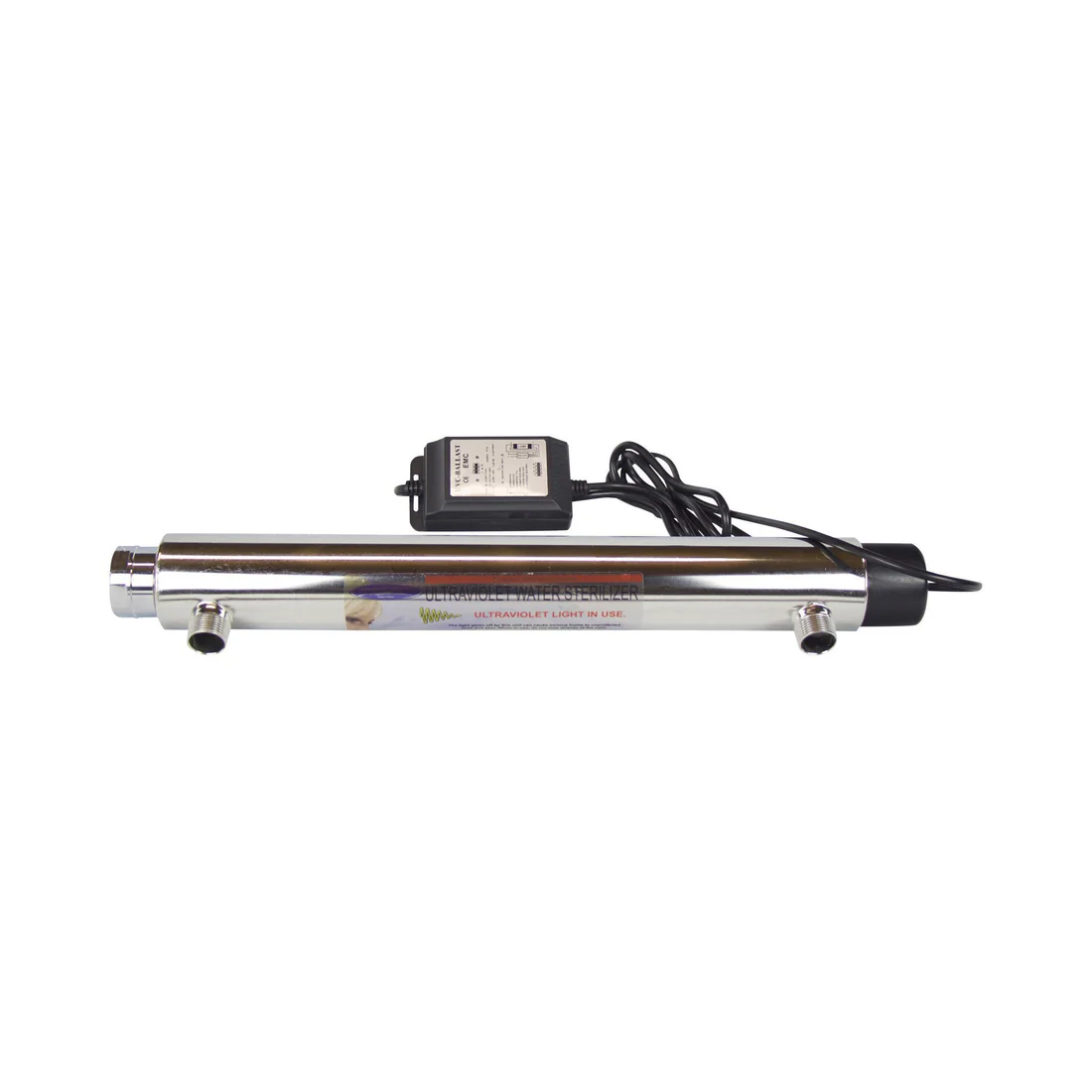
Wattage: 25W • Output: 113mA
Voltage: 110–240V • 50–60Hz
UV dose: >30,000 µW/cm²
Housing: 304 stainless steel
Port size: ½″ MNPT
Max pressure: 100 psi
Audible lamp failure alarm: Yes
Price: $389
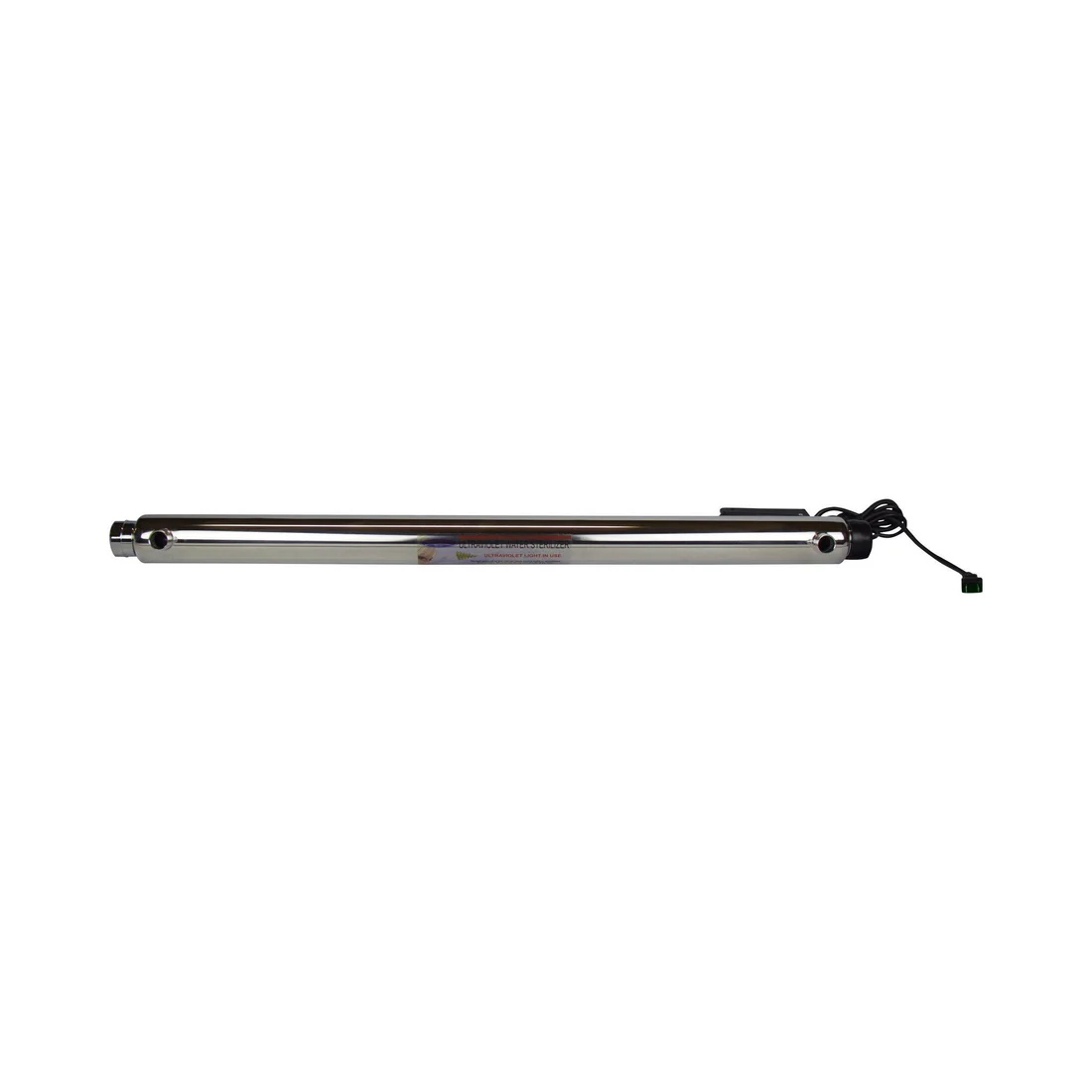
Wattage: 30W • Output: 136mA
Voltage: 110–240V • 50–60Hz
UV dose: >30,000 µW/cm²
Housing: 304 stainless steel
Port size: ½″ MNPT
Max pressure: 100 psi
Audible lamp failure alarm: Yes
Price: $499
Full Lineup — All 10 Models
| Model | Flow rate | Watts | Port size | UV dose | Max pressure | Price | Best application |
|---|---|---|---|---|---|---|---|
| CQE-UV-00101 | 1 GPM | 11W | ¼″ MNPT | >30,000 µW/cm² | 85 psi | $169 | Point-of-use, countertop RO, single fixture |
| CQE-UV-00102 | 6 GPM | 25W | ½″ MNPT | >30,000 µW/cm² | 100 psi | $389 | Craft brewery up to 10 BBL, restaurant, light commercial |
| CQE-UV-00103 | 8 GPM | 30W | ½″ MNPT | >30,000 µW/cm² | 100 psi | $499 | 10–20 BBL brewery, food service, well water whole-house |
| CQE-UV-00104 | 12 GPM | 55W | ¾″ MNPT | >30,000 µW/cm² | 100 psi | $569 | 20–30 BBL brewery, commercial kitchen, car wash |
| CQE-UV-00105 | 24 GPM | 110W | 1″ MNPT | >30,000 µW/cm² | 100 psi | $1,799 | Regional brewery, hotel/hospitality, light industrial |
| CQE-UV-00106 | 36 GPM | 165W | 1″ MNPT | >30,000 µW/cm² | 100 psi | $2,069 | Mid-scale production brewery, manufacturing, food processing |
| CQE-UV-00107 | 48 GPM | 220W | 1.5″ MNPT | >30,000 µW/cm² | 100 psi | $2,369 | High-volume food & beverage production |
| CQE-UV-00108 | 60 GPM | 275W | 2″ MNPT | >30,000 µW/cm² | 100 psi | $2,969 | Large commercial & light industrial |
| CQE-UV-00109 | 72 GPM | 330W | 2″ MNPT | >30,000 µW/cm² | 100 psi | $3,269 | Industrial water treatment, large facility |
| CQE-UV-00110 | 84 GPM | 440W | 2.5″ MNPT | >30,000 µW/cm² | 100 psi | $3,469 | High-volume industrial processing |
| All models: 110–240V, 50–60Hz, 304 stainless steel housing, audible lamp failure alarm. Source: Crystal Quest CQE-UV Installation and Operation Guide, Copyright 2024. | |||||||
How to Size a UV System
UV sizing is straightforward: the system must handle your peak instantaneous flow rate at or below rated GPM to maintain the specified UV dose. Exceeding the rated flow reduces contact time between water and the UV lamp, dropping the effective dose below the level needed for reliable disinfection.
Brewery sizing
| Batch size | Water needed (approx.) | Fill time target | Required flow rate | Recommended model |
|---|---|---|---|---|
| 3 BBL | ~93 gallons | 20 min | ~5 GPM | 6 GPM ($389) |
| 7 BBL | ~217 gallons | 30–40 min | ~5–7 GPM | 6 GPM ($389) |
| 10 BBL | ~310 gallons | 40–55 min | ~6–8 GPM | 8 GPM ($499) |
| 15 BBL | ~465 gallons | 60 min | ~8 GPM | 8 GPM ($499) |
| 20 BBL | ~620 gallons | 60 min | ~10 GPM | 12 GPM ($569) |
| 30 BBL | ~930 gallons | 60 min | ~15 GPM | 24 GPM ($1,799) |
| Water volume estimate: approximately 31 gallons per BBL including process water, CIP, and evaporation allowance. Size to peak simultaneous demand if multiple vessels fill at once. | ||||
Food service and commercial sizing
For restaurants, hotels, and food service operations, size to the peak simultaneous flow demand across all connected fixtures and equipment. The pre-filter ahead of the UV system (required 5-micron sediment) will have its own flow restriction; account for pressure drop across the pre-filter at peak flow to confirm you have adequate driving pressure at the UV inlet (minimum 30 psi, optimum 30–60 psi).
Water Quality Requirements
UV effectiveness depends entirely on the clarity and chemistry of the water passing through the chamber. Dissolved minerals, iron, tannins, and turbidity all reduce UV transmittance — the fraction of UV light that reaches the target microorganism. Crystal Quest specifies:
| Parameter | Limit | Why it matters |
|---|---|---|
| UV Transmittance (UVT) | >75% | Below 75% UVT, effective dose drops below disinfection threshold at rated flow; call for application-specific guidance |
| Turbidity | <1 NTU | Suspended particles shadow microorganisms from UV exposure; high turbidity is the most common cause of UV system failure |
| Iron | <0.3 ppm | Iron coats the quartz sleeve, blocking UV transmission; must be removed upstream |
| Hardness | <7 gpg (120 mg/L) | Scale deposits on quartz sleeve reduce UV output; above 7 gpg requires softening or more frequent sleeve cleaning |
| Manganese | <0.05 ppm | Similar fouling mechanism to iron; stains quartz sleeve |
| Tannins | <0.1 ppm | Organic color absorbs UV light, reducing effective dose |
| Temperature | 40–85°F | Above 85°F reduces lamp efficiency; below 40°F may freeze water in chamber |
| Pressure | 30–60 psi (100 psi max) | Below 30 psi: insufficient flow control; above 100 psi: risk of chamber damage |
Where UV Fits in the Treatment Train
UV must be last. Any treatment stage after UV — carbon filters, mineral addition systems, holding tanks — can introduce biological load and negate the UV disinfection. For breweries, this means UV is installed immediately before the mash tun fill line, not at the building entry point. For whole-house applications where UV is installed at point of entry, no additional treatment stages should follow it inside the distribution system.
The 5-micron sediment pre-filter is not optional. It is required by Crystal Quest and by the physics of UV disinfection. Without it, turbidity will shield organisms and quickly foul the quartz sleeve.
Annual Lamp Replacement
The UV lamp has a rated effective life of approximately 9,000 hours — about one year of continuous operation. Crystal Quest’s manual states explicitly: replace the UV lamp annually to ensure continuous high bacteria and virus kill rate.
This is not conservative engineering margin — it reflects the physical reality of UV-C lamp degradation. Low-pressure mercury lamps lose UV-C output steadily over their service life. A lamp at 12 months may still illuminate visibly while delivering only 60–70% of its original UV dose. The audible lamp failure alarm on all Crystal Quest models signals complete lamp failure, not gradual output decline. Annual replacement on schedule — not on alarm — is the correct maintenance protocol.
The lamp must remain ON continuously during operation. Repeatedly switching the UV lamp on and off severely shortens lamp life and creates startup windows during which bacteria pass through without being inactivated. Design the installation so the UV system runs whenever water flow is possible, controlled by a flow switch or by running continuously during operating hours.
Replacement lamps by model: CQE-UV-03101 (1 GPM), CQE-UV-03102 (6 GPM), CQE-UV-03103 (8 GPM), CQE-UV-03104 (12 GPM). The 24–84 GPM units use the same lamp part numbers as their system model numbers.
Also clean the quartz sleeve annually with a cloth soaked in vinegar or CLR when removing the lamp. Hard water scale on the quartz sleeve reduces UV transmission the same way that scale on a window reduces light — even a thin deposit measurably decreases effective dose. Where hardness exceeds 7 gpg, clean the sleeve every 3–6 months.
Installation Notes
- Licensed plumber required in AR, CA, GA, KS, MA, MI, MN, OK, RI, SC, SD, TX, VT, and WI
- GFCI outlet required — UV systems operate with water present near electrical equipment; ground fault protection is mandatory
- Do not use an extension cord — undersized cords reduce voltage, impair lamp performance, and present a fire hazard
- Ideal mounting: vertical with lamp connector on top — prevents water from pooling in lamp pins; horizontal mounting is acceptable but lamp failure risk is higher
- Ballast location: above or beside the chamber — prevents moisture intrusion into ballast enclosure
- 40″ clearance at lamp end required — for lamp and quartz sleeve removal during annual maintenance
- Allow 3–5 minutes warm-up before use; flush 2–3 minutes to clear air. For post-RO applications, 30–45 seconds flush is sufficient
- Indoor use only — direct sunlight causes algae growth; freezing damage voids warranty
- System sterilization at startup — flush entire downstream piping with chlorine bleach before first use to eliminate any residual contamination from installation
Who Should Buy It
Related reviews and guides
- US Water Systems Pulsar Max Plus UV Review — residential/rainwater 5-stage alternative; note the commercial warranty exclusion
- Brewery water treatment guide — complete treatment train for craft breweries: chloramine removal, RO sizing, glycol, and UV
- RO water for brewing — why RO is the starting point for brewery water chemistry control
- Matrixx DROP Bodyguard Plus Carbon Filter — catalytic carbon upstream of UV for chloramine removal
- Crystal Quest Thunder RO review — 200 and 300 GPD whole-house RO; pair with UV for complete treatment
- US Water Systems Defender HD Commercial RO
- NSF water filter certifications guide
- Water treatment for restaurants