Home › Guides › Well Water Test Kits
Well Water Test Kits: What to Actually Test For, and Why One Kit Can't Do It All
Disclosure: This page contains affiliate links. If you purchase through our links, we may earn a commission at no extra cost to you. See our affiliate disclosure.
If you draw water from a private well, no agency is testing it for you. The Safe Drinking Water Act regulates public water systems; private wells sit outside it entirely, which makes the homeowner both the operator and the regulator. The complication most buyers hit is that a single mailed kit cannot test everything that matters — several parameters expire before a package can reach a laboratory. This guide covers what to test in priority order, which measurements must happen at the wellhead, what testing realistically costs, how to take a sample that produces a valid number, and what each result actually means.
Contents
What to test for, in priority order
"Test everything" is expensive and mostly unnecessary. The useful framing is three tiers: what every well needs annually, what your specific situation adds, and what only matters if you have a reason to suspect it.
- Total coliform bacteria and E. coli — coliform indicates a pathway from the surface into your well. E. coli specifically indicates fecal contamination and is an immediate do-not-drink finding.
- Nitrate (and nitrite) — EPA MCL is 10 mg/L as nitrogen for nitrate, 1 mg/L for nitrite. Health-based, not aesthetic. Critical where infants are present.
- pH — governs corrosivity, whether metals leach from your plumbing, and whether most treatment options will work at all.
- Total dissolved solids — the general indicator of mineral load, and a baseline you compare future tests against. See measuring TDS.
- Iron and manganese — if you have orange, brown, or black staining, or metallic taste. Test if you plan to install any treatment, since both foul equipment. See iron in well water.
- Hardness — if you have scale, soap scum, or short water heater life. See hard water.
- Hydrogen sulfide and sulfate-reducing bacteria — if there is rotten-egg odor. Run the hot/cold test first; if only hot water smells, it is your water heater and not your well.
- Lead and copper — if plumbing, solder, or fixtures predate 1986, or if water is corrosive (low pH).
- Arsenic — geology-driven. Common in parts of New England, the Upper Midwest, and the Mountain West. Ask your county health department whether local wells show it.
- Tannins — if water is tea-colored but clear.
- PFAS — near airports, military installations, firefighting training sites, landfills, or industrial facilities. Expensive; test when there is a known regional source rather than routinely.
- Volatile organic compounds — near fuel storage, dry cleaners, or industrial sites.
- Pesticides and herbicides — near intensive agriculture, especially in shallow wells.
- Radon and uranium — geology-driven; your state health department maintains regional data.
- Fluoride — naturally occurring in some aquifers at levels worth knowing.
Why one kit can't do it all
This is the structural fact that shapes every purchase decision on this page, and almost no product listing explains it: some parameters have hold times too short for shipping.
| Parameter | Constraint | Where it must be measured |
|---|---|---|
| pH | 15-minute analysis window under EPA Method 150.1 | On site. A mailed pH result is not a valid measurement |
| Hydrogen sulfide | Dissolved gas — off-gasses and oxidizes in transit | On site. Mailed samples read falsely low or non-detect |
| Bacteria (coliform, E. coli) | Generally must reach the lab within 24–30 hours, held cold | Lab, but only with overnight shipping and a cold pack — or an on-site culture test |
| Iron-related and sulfate-reducing bacteria | Culture-based; read over 8–15 days | On site, incubated at room temperature |
| Metals, minerals, hardness, nitrate, TDS | Stable for days | Lab — mail with no issue |
| Volatile organics | Stable if the vial has zero headspace | Lab — fill the VOA vial until water bulges above the rim |
| This is why comprehensive kits arrive in two parts: bottles that ship to a laboratory, and tests you run yourself at the wellhead. A kit that mails everything is silently giving you invalid numbers on the short-hold-time parameters. | ||
Kit, lab, or health department
| Route | Best for | Limitations |
|---|---|---|
| County health department | Basic bacteria and nitrate testing, often subsidized or free. Check this first — many counties test private wells at low or no cost | Limited panel; may have seasonal availability or waiting periods |
| Comprehensive homeowner kit | A full baseline picture in one purchase — minerals, metals, hardness, plus on-site sulfide and bacteria tests | Chain of custody usually insufficient for real estate or lender requirements |
| State-certified laboratory, direct | Real estate transactions, lender requirements, legal disputes, or any result someone else must accept | More expensive; you arrange sampling and delivery within hold times |
| Test strips | Rough screening between real tests; watching a trend | Not quantitative enough for decisions. Adequate for "is something changing," useless for "is this safe" |
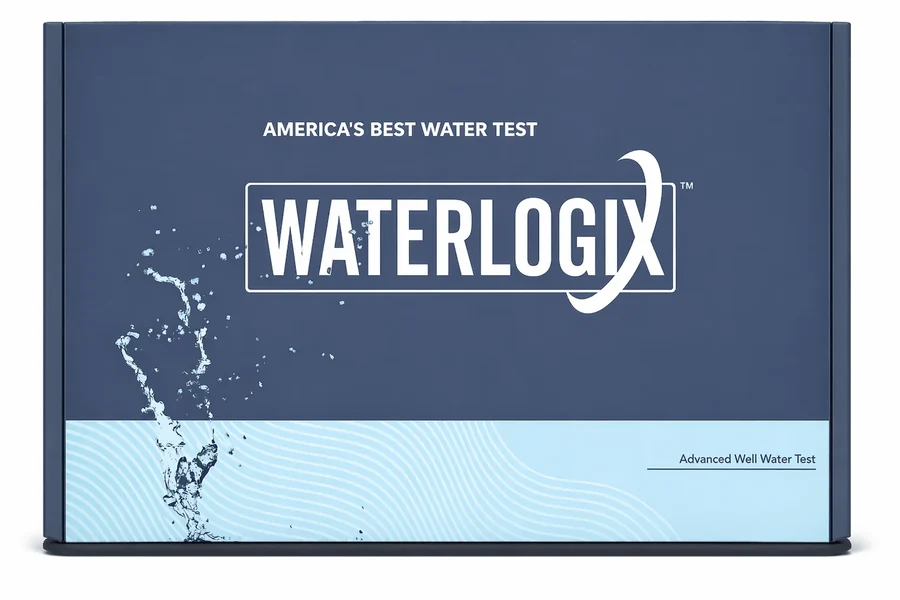
A comprehensive kit is generally the right first purchase for a homeowner establishing a baseline, because it covers the on-site parameters a mail-in lab cannot. The WaterLogix kit is built on this split — plastic bottles and a VOA glass vial ship to the laboratory for minerals, hardness, metals, and volatile organics, while an IRB-BART tube, an SRB-BART tube, and a Gastec sulfide detector tube stay with you.
What it actually costs
| Test | Typical cost | Notes |
|---|---|---|
| Bacteria + nitrate, certified lab | $20–75 | The essential annual minimum. Often subsidized by county health departments |
| Basic mineral panel | $50–150 | Hardness, iron, manganese, TDS, pH, sulfate, chloride |
| Comprehensive homeowner kit | $150–300 | Broad panel plus on-site sulfide and bacteria components |
| Arsenic, single analyte | $25–60 | Worth adding where local geology warrants |
| Lead, single analyte | $25–50 | First-draw and flushed samples answer different questions |
| PFAS | $300+ | Requires specialized instrumentation and clean sample handling. Test with cause, not routinely |
| VOC panel | $150–300 | Needs a zero-headspace VOA vial |
| Pesticide / herbicide panel | $200–400+ | Priced per compound group |
| Ranges are typical US pricing as of 2026 and vary substantially by region and laboratory. Costs are illustrative for planning, not quotes — get pricing from a state-certified laboratory in your area. | ||
How often to test
| Trigger | What to test |
|---|---|
| Annually, always | Coliform bacteria, E. coli, nitrate, pH, TDS |
| After flooding at or near the wellhead | Bacteria immediately. Floodwater carries surface contamination directly into a compromised well |
| Pregnancy, or an infant will drink the water | Nitrate and bacteria, before use. Nitrate above 10 mg/L is a documented infant health risk |
| After well repair, pump replacement, or plumbing work | Bacteria — the system was opened |
| Any change in taste, odor, color, or clarity | Bacteria plus whatever the symptom suggests |
| Buying or selling the property | Full panel through a certified laboratory |
| New land use nearby — feedlot, industry, drilling, landfill | Baseline before, and follow-up after |
| Recurring gastrointestinal illness in the household | Bacteria, promptly |
Taking a valid sample
A perfect laboratory produces a wrong answer from a bad sample. These rules cover most of the error:
- Decide what question you're asking. To evaluate the raw water, sample before any existing treatment — an outside spigot or the holding tank. To evaluate whether your current treatment is working, sample at the kitchen tap. Same kit, different answers, and choosing wrong invalidates the conclusion.
- Run the cold tap 3–5 minutes first to flush water standing in the pipes, unless you are specifically testing first-draw water for lead.
- Don't touch the inside of bottles or caps. For bacteria sampling this matters enormously — a fingerprint is a positive result waiting to happen.
- Fill VOA glass vials with zero headspace — until the water bulges above the rim, then cap. A trapped air bubble ruins the volatiles result.
- Draw all lab bottles from the same tap in one sitting so the results describe one water rather than several.
- Leave aerators on unless visibly fouled; removing them changes what you are sampling.
- Keep bacteria samples cold and ship overnight. Hold time is short and a warm sample in transit for two days is not a valid bacteria test.
- Record collection date and time on every bottle — the laboratory needs it to confirm hold times were met.
- Run on-site tests at the wellhead per their instructions, and read colorimetric tubes immediately.
Reading your results
| Parameter | Benchmark | What an exceedance means |
|---|---|---|
| E. coli | Absent | Do not drink. Fecal contamination. Use bottled water, disinfect the well, identify the pathway, retest |
| Total coliform | Absent | A surface pathway exists. Inspect the wellhead seal, casing, and cap; shock chlorinate; retest |
| Nitrate (as N) | 10 mg/L | Health-based MCL. Serious risk to infants under six months. Boiling concentrates it. Often signals a surface pathway too |
| Nitrite (as N) | 1 mg/L | Same mechanism, lower threshold |
| Arsenic | 0.010 mg/L | Health-based MCL. Chronic exposure risk. Requires RO or activated alumina |
| Lead | 0.015 mg/L action level | Usually from plumbing rather than the aquifer. Investigate the source before treating |
| pH | 6.5–8.5 (secondary) | Aesthetic standard, but low pH means corrosive water leaching metals from plumbing |
| Iron | 0.3 mg/L (secondary) | Staining and taste. Also fouls softeners, UV sleeves, and RO membranes |
| Manganese | 0.05 mg/L (secondary) | Black staining. Fouls treatment equipment |
| TDS | 500 mg/L (secondary) | Aesthetic. Also determines whether an RO system is within its feed specification |
| Hardness | No standard | Not a health parameter. Above ~7 gpg, scale and equipment life become the issue |
| Hydrogen sulfide | No federal standard | Odor and corrosion. Treatment selection depends on concentration |
| Primary (health-based) MCLs are enforceable for public water systems and are the appropriate benchmark for a private well. Secondary standards address taste, odor, and appearance and are not health-based. Private wells are not subject to either as a legal matter — these are reference points, not requirements. | ||
Testing for a home sale or VA loan
Transaction testing follows different rules from homeowner testing, and the difference catches people out.
VA loans require water testing on properties served by a private well, and many conventional lenders and state real estate regulations impose comparable requirements. The panel, the acceptable laboratory, and often who is permitted to collect the sample are set by the lender and local authority rather than by the buyer.
Requirements vary meaningfully by state and program, so treat the general guidance here as orientation and get the specific panel list from the lender or your state's well program before sampling.
From results to treatment
A test result identifies the problem. Selecting treatment usually requires one more layer of detail than a basic panel provides — which is why "test, then match treatment to the specific form of the contaminant" beats buying equipment off a headline number.
| Result | What still needs determining | Guide |
|---|---|---|
| Iron elevated | Ferrous, ferric, colloidal, or bacterial — a total iron number does not distinguish them, and each needs different treatment | Iron in well water |
| Rotten-egg odor | Hot water only (water heater anode) or both taps (source sulfide), plus concentration and SRB status | Sulfur smell in water |
| Hardness elevated | Compensated hardness including the iron load, and peak flow rate for sizing | Hard water |
| Bacteria present | Pathway of contamination; whether disinfection is one-time or continuous | UV disinfection |
| TDS elevated | Which ions dominate, and whether feed TDS is within an RO system's specification | Measuring TDS |
| Multiple problems | Treatment train order — sediment, then iron, then softening, then RO, and UV last | Pre-treatment order |
FAQ
What should I test my well water for?
Annually: coliform bacteria and E. coli, nitrate, pH, and TDS. Beyond that, test based on your situation — iron and manganese for staining, hardness for scale, sulfide for odor, lead if plumbing predates 1986, arsenic where geology warrants. Private wells aren't covered by the Safe Drinking Water Act, so nobody tests it for you.
How much does well water testing cost?
Bacteria and nitrate through a certified lab typically $20–75, often subsidized by county health departments. A comprehensive homeowner kit runs $150–300. PFAS is $300+ on its own because of the instrumentation required.
Can I mail everything to a lab?
No. pH has a 15-minute analysis window, hydrogen sulfide off-gasses in transit, and bacteria samples generally need to reach the lab within 24–30 hours held cold. That's why comprehensive kits split into mail-back bottles and on-site tests.
How often should I test?
Annually at minimum. Immediately after flooding at the wellhead, after well or plumbing work, when taste or appearance changes, when an infant will drink the water, and when buying or selling.
Do I need a water test to buy a house with a well?
Often, and VA loans specifically require it. The panel and the acceptable laboratory are set by the lender — and a DIY kit usually won't qualify, since transaction testing needs certified-lab chain of custody. Confirm requirements before sampling.
What's a safe nitrate level?
Below the EPA MCL of 10 mg/L as nitrogen. Above that is a documented risk to infants under six months. Boiling concentrates nitrate rather than removing it. Elevated nitrate also often signals a surface pathway worth investigating.
Are test strips good enough?
For watching a trend between real tests, yes. For deciding whether water is safe or what treatment to buy, no — they aren't quantitative enough, and the parameters that matter most for health need laboratory or culture methods.
Does the test tell me what system to buy?
It tells you the problem, which is the necessary first step. Treatment selection needs more detail — iron's chemical form, pH for sulfide treatment, compensated hardness for softener sizing. Test first, then match treatment to the specific form of the contaminant.
- Water Softener Sizing Calculator — compensated hardness, capacity, and peak flow check
- Iron in Well Water — Ferrous vs. Ferric, Iron Bacteria, and Treatment by Type
- Sulfur Smell in Water — The Hot/Cold Test That Finds It
- Hard Water: What It Is, How to Test It, How to Treat It
- Measuring TDS in Water — What Your Meter Actually Measures
- Water Softener Troubleshooting
- Pre-Treatment Order — Sediment, Iron, Softening, RO, UV
- Water Hardness Calculator
- Pulsar Max Plus UV — Well and Rainwater Disinfection
Sources: US EPA National Primary and Secondary Drinking Water Regulations (MCLs and secondary standards referenced as benchmarks). · US EPA private well guidance and CDC private well water testing recommendations. · 40 CFR Part 136 Table II (analytical hold times); EPA Method 150.1 (pH). · WaterLogix Complete Advanced Well Water Test instructions, US Water Systems — kit composition, sampling protocol, and on-site test methodology. · BART method documentation for iron-related and sulfate-reducing bacteria. · Gastec detector tube specifications for sulfide measurement. Cost ranges are typical US pricing for planning purposes and vary by region and laboratory. Private wells are not regulated under the Safe Drinking Water Act; MCLs are cited here as health benchmarks rather than legal requirements. This guide is informational and does not constitute engineering, medical, or legal advice. For transaction or lender testing, confirm requirements with the lender and use a state-certified laboratory.