US Water Systems Patriot XL Review (2026): 8,000–16,000 GPD Skid-Mounted Turnkey RO
Disclosure: This page contains affiliate links. If you purchase through our links, we may earn a commission at no extra cost to you. See our affiliate disclosure.
Source: US Water Systems Technical Manual 223-DFROS-XXXX (2023) • Made in USA • 2-year warranty
Integrated carbon backwash • Dual sediment filtration • Anti-scalant dosing • UV disinfection • 75% recycle • Re-pressurization pump • US100 controller
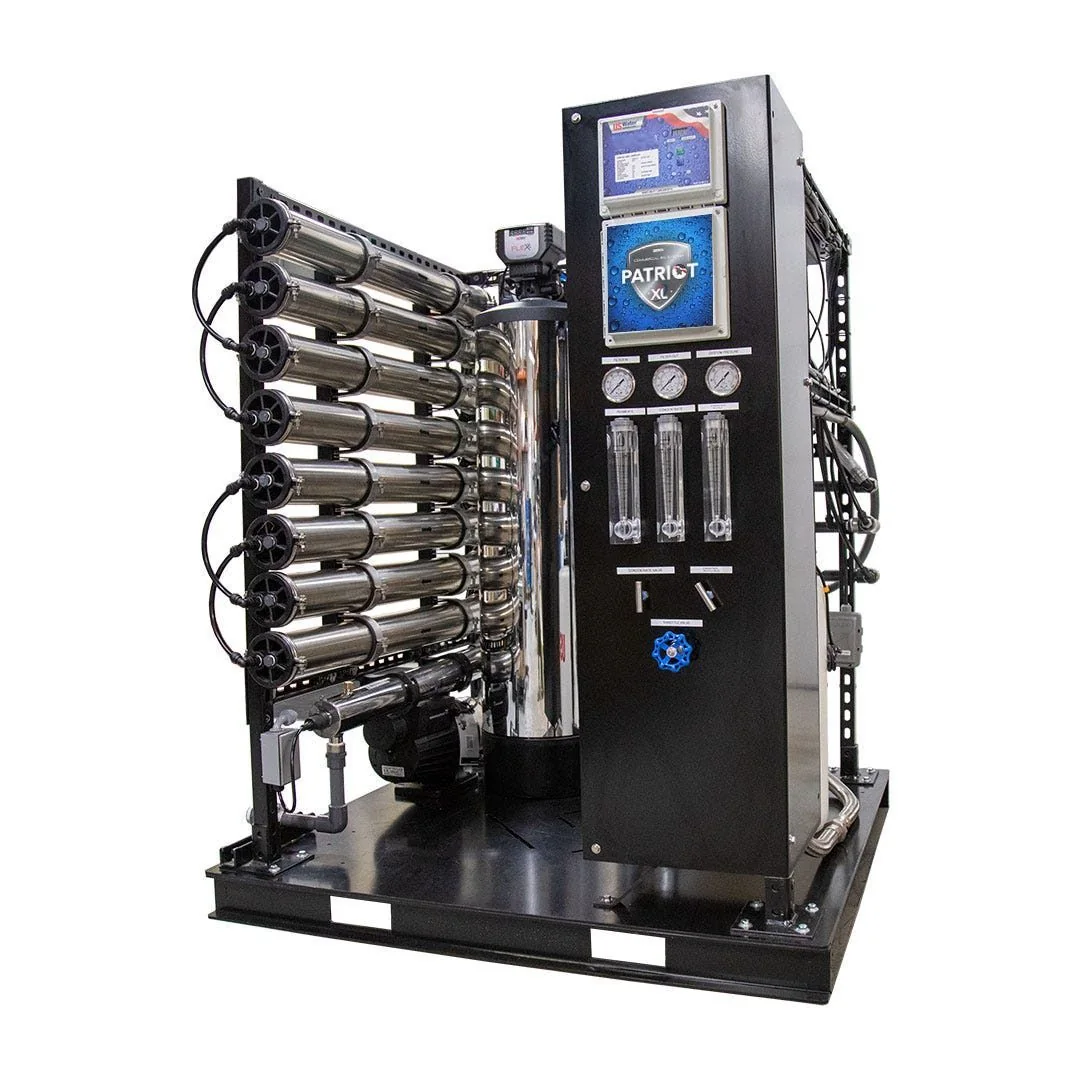
Patriot XL vs Defender HD — What the Skid Integration Buys You
Both systems use the same US100 controller and the same 4×40 TFC membrane elements. The difference is everything around the membranes.
| Component | Defender HD | Patriot XL |
|---|---|---|
| RO membrane array | ✓ | ✓ |
| US100 controller | ✓ (220V) | ✓ (240V) |
| 3 HP multi-stage pump | ✓ | ✓ |
| Carbon backwash filtration | Not included — separate purchase | ✓ Integrated onboard |
| Dual sediment pre-filtration (5μ + 1μ) | Not included | ✓ Integrated onboard |
| Anti-scalant dosing system | Anti-scalant only | ✓ Integrated onboard |
| Concentrate recycle circuit | No — standard 58–65% recovery | ✓ Up to 75% recovery |
| UV disinfection | Not included | ✓ Integrated post-RO |
| Atmospheric storage tank | Not included | ✓ Included on skid |
| Re-pressurization pump | Not included | ✓ Included (65 PSI distribution) |
| Legacy Control Valve (Bluetooth) | No | ✓ Carbon filter control |
| GPD capacity | 2,000–16,000 | 8,000–16,000 |
| Starting price | ~$7,195 | Higher — complete system |
Model Configurations & Output Capacity
| Model | GPD (Rated) | GPM (Rated) | Membranes | 75% Recovery: Permeate / Concentrate / Recycle |
|---|---|---|---|---|
| DFROS-8000 | 8,000 | 5.56 | 4×40 array | 5.56 / 1.85 / 1.15 GPM |
| DFROS-12000 | 12,000 | 8.33 | 4×40 array | 8.33 / 2.78 / 0.22 GPM |
| DFROS-16000 | 16,000 | 11.10 | 4×40 array | 11.10 / 3.70 / — GPM |
| Test conditions: 550 TDS, 5-micron filtered, dechlorinated, softened city feed water, 35 PSI feed, 150 PSI operating pressure, 77°F, pH 7.0, 30-min stabilization. All models: 52”×54”×70” footprint, same 3 HP pump. | ||||
75% Concentrate Recycle — How It Works and Why It Matters
Standard commercial RO systems operate at 58–65% recovery — meaning 35–42% of all feed water goes to drain as concentrate. At high flow rates this adds up to significant water and sewer costs. The Patriot XL adds a recycle valve and dedicated recycle flow meter that routes a controlled portion of concentrate back to the membrane inlet.
Permeate: 5.56 GPM ✓
Concentrate to drain: 3.00 GPM
Daily drain: 4,320 gallons
Permeate: 5.56 GPM ✓
Concentrate to drain: 1.85 GPM
Daily drain: 2,664 gallons — 38% less waste
Step 2: Total Feed GPM = Permeate GPM ÷ Target Recovery (0.75)
Step 3: Concentrate to Drain = Total Feed − Permeate
Step 4: Recycle GPM = Min Membrane Flux (3.0 GPM) − Concentrate to Drain
Integrated Pre-Treatment System
The Patriot XL’s pre-treatment train arrives factory-assembled. Understanding each stage is essential for commissioning sequencing — the carbon filters must be started before the RO membranes.
| Pre-Treatment Stage | What It Removes | Why Critical |
|---|---|---|
| Backwashing carbon filter (Legacy Control Valve, Bluetooth) | Chlorine, chloramines, VOCs, taste & odor | Chlorine and chloramines permanently destroy polyamide TFC membranes. Zero tolerance. Must be in service before any water reaches the RO array. |
| 5-micron sediment filter | Particulates, turbidity, suspended solids | Protects downstream 1-micron filter and membrane housings from particle fouling. Replace when pressure differential increases. |
| 1-micron sediment filter | Fine particulates, colloidal matter | Final mechanical barrier before membrane array. The 1-micron stage is the SDI (Silt Density Index) control stage — high SDI is a leading cause of membrane biofouling. |
| Anti-scalant injection (Hyper-Guard Plus 7000) | Calcium carbonate, silica, sulfate scale | Prevents mineral scale precipitation on membrane surface — the leading cause of irreversible membrane flux decline. Especially critical at 75% recovery where concentrate TDS is elevated. |
Anti-Scalant Dosing Reference — Hyper-Guard Plus 7000
| Model | GPD | Initial Fill (15-gal tank) | Refill Rate |
|---|---|---|---|
| DFROS-8000 | 8,000 | 58.2 oz | 3.9 oz per gallon of RO product water |
| DFROS-12000 | 12,000 | 96 oz | 6.4 oz per gallon of RO product water |
| DFROS-16000 | 16,000 | 113 oz | 7.5 oz per gallon of RO product water |
| Based on 3 GPD chemical injection pump and 15-gallon solution tank. Future refills can use RO product water from the Patriot XL itself. Dosing rate assumes typical municipal feed water hardness — adjust for site-specific water chemistry reports. | |||
Commissioning — Correct Start-Up Sequence
Step 1 — Carbon Filter Start-Up (Do First)
Place bypass handles in bypass position — open main water supply — initiate immediate regeneration
Use the Legacy Control Valve onboard button or Legacy View Bluetooth app to advance the valve to backwash position. Do not open bypass fully yet.
Slowly open bypass valve ~1/8 turn — water enters tank slowly
If a loud knocking sound occurs, reduce the opening rate. Rapid filling causes water hammer that can damage the valve.
Continue opening bypass fully once water flows from drain hose — allow full backwash to purge air
Air in the tank must exit completely through the drain line before proceeding.
Skip rest cycle — press Set/Change 3 seconds (or Legacy View: Go to Next Regen Step)
The 2-minute rest period can be skipped during startup commissioning.
Allow full Rapid Rinse cycle — drain water must run clear before cycle ends
Rinse removes carbon fines. If drain water is still dark at end of rinse, run another manual rinse before placing in service.
Valve advances to Service position — repeat entire sequence for second carbon filter unit
Both carbon filter units must complete the startup sequence before RO start-up begins.
Step 2 — UV Light Installation
Insert quartz sleeve fully — leave ~1/8” protruding above chamber top
Apply silicone grease to the quartz sleeve O-ring. Install retaining nut securely.
Install spring — then UV bulb — WEAR PLASTIC GLOVES
Do not touch the UV bulb with bare skin. Fingerprint oils cause premature bulb failure through localized heating at contaminated spots.
Connect UV controller (keyed connector) — push down on bulb and spring — turn to lock
Inspect for leaks around the quartz sleeve before energizing. Never look at an operating UV lamp.
Step 3 — RO System Start-Up
Verify all pre-treatment systems are commissioned and in service
Both carbon filters in service position, sediment pre-filters installed, anti-scalant solution mixed and dosing pump primed. Do not start RO until confirmed.
Open concentrate valve fully (CCW) — close recycle valve fully (CW)
Starting with concentrate fully open and recycle closed prevents pressure build-up during initial startup. Recycle is introduced only after flow rates are established.
Power on via US100 — run 5–10 minutes to purge air — cycling ON/OFF is normal
Air in pre-filters and membrane vessels causes system cycling during startup. Allow it to complete.
Verify 40–60 PSI inlet pressure (30 PSI minimum) — stop if below 30 PSI
Low inlet pressure is the leading cause of pump damage. Address feed supply before continuing if pressure is unstable.
Adjust throttle and concentrate valves to target flow rates — do not exceed 150 PSI
Make small incremental adjustments; wait 2–3 minutes between changes.
For 75% recovery: slowly open recycle valve — balance all three valves to target flow rates
Maintain 80–150 PSI operating pressure. Use the recycle flow meter to set the correct recycle GPM per the formula above.
Fill storage tank to ~50 gallons — drain twice — discard all first-hour permeate
Membranes ship in glycerin-based preservative. All product water from the first hour must be discarded. After 60+ minutes, verify ≥96% salt rejection on the US100 display before putting water into service.
Legacy Control Valve — Backwash Carbon Filter Programming
The onboard backwashing carbon filters are controlled by the Legacy Control Valve, which includes Bluetooth connectivity for programming via the free Legacy View app (iOS and Android). Default cycle times and key settings:
| Parameter | Default Setting | Notes |
|---|---|---|
| Backwash duration | 10 minutes | Fluidizes and classifies the carbon bed; removes accumulated fines |
| Rest cycle | 2 minutes | Carbon bed settles; can be skipped during initial commissioning |
| Rapid Rinse duration | 10 minutes | Compacts bed and removes remaining carbon fines before returning to service |
| Backwash frequency | Configurable — typically every 3–7 days | Set based on feed water chloramine load and carbon bed capacity |
| Regeneration time | Configurable in Legacy View | Schedule during low-use periods to avoid RO downtime during carbon backwash |
| Battery backup | Install battery BEFORE programming | If power is lost before battery is installed, programming resets to default — install 9V battery in valve head before any programming sessions |
Temperature Correction Factor (TCF) — Quick Reference
All GPD ratings are at 77°F (25°C). Divide nominal GPM by TCF at your actual feed water temperature to get expected output. Maximum operating pressure is 150 PSI — never exceed while compensating for cold water.
| Feed Temp (°F) | TCF | Output vs. Rated | DFROS-8000 | DFROS-12000 | DFROS-16000 |
|---|---|---|---|---|---|
| 77°F / 25°C (baseline) | 1.000 | 100% | 5.56 GPM | 8.33 GPM | 11.10 GPM |
| 68°F / 20°C | 1.189 | 84% | 4.68 GPM | 7.00 GPM | 9.34 GPM |
| 60°F / 15.6°C | 1.391 | 72% | 4.00 GPM | 5.99 GPM | 7.98 GPM |
| 55°F / 12.8°C | 1.541 | 65% | 3.61 GPM | 5.41 GPM | 7.20 GPM |
| 50°F / 10°C | 1.683 | 59% | 3.31 GPM | 4.95 GPM | 6.60 GPM |
| Well water and ground-source water in northern climates commonly runs 45–55°F year-round. Size for actual cold-water output, not rated output at 77°F. Source: DFROS manual pages 51–52. | |||||
Performance Formulas — Field Reference
Troubleshooting Reference
| Symptom | Likely Cause | Resolution |
|---|---|---|
| Salt rejection below 96% | Membranes not fully flushed; O-ring bypass; brine seal reversed; membrane failure | Continue flushing; inspect all O-rings and brine seals; pressure-test individual vessels; replace membranes if <96% after 2 hours |
| Low permeate flow | Cold feed water (TCF); membrane fouling; clogged pre-filters; concentrate valve too open | Apply TCF correction; replace sediment pre-filters; check inlet pressure; consider CIP membrane cleaning |
| Chlorine detected in permeate | Carbon filter bypassing; carbon bed exhausted; valve in wrong position | Test carbon filter effluent for free chlorine — if positive, carbon bed needs immediate attention. DO NOT operate RO until carbon filter is confirmed removing all chlorine. |
| System cycles ON/OFF rapidly | Storage tank float switch cycling; low inlet pressure; air still in system | Check storage tank level and float switch; verify inlet pressure stability; allow longer air purge on startup |
| Scale on membranes (CIP required) | Anti-scalant not dosing; softener bypassed; recovery too high for water chemistry | Verify anti-scalant pump operation and solution level; test feed water hardness; consider reducing recycle percentage temporarily |
| UV lamp alarm | Lamp end-of-life; quartz sleeve fouled; bulb not seated | Replace UV lamp (annual replacement recommended); clean quartz sleeve; verify bulb connector is locked |
| Re-pressurization pump not building pressure | Pump not primed; storage tank empty; pump check valve failed | Prime pump per manual; verify storage tank has water; inspect check valves |
Related US Water Systems Reviews
- US Water Systems Defender HD — 2,000–16,000 GPD Brackish Floor-Mount RO
- Raptor Lite Food Service RO — 3,290 GPD
- American Revolution 750 GPD Light Commercial RO
- US Water Systems Falcon — 500–2,000 GPD Light Commercial RO
- US Water Systems Maverick Lite — 200–750 GPD
- Brewery Water Treatment Guide
- Agricultural RO Systems Guide