Home › Reviews › ResinTech CLïR 3000
ResinTech CLïR 3000 Series Review (2026): Type I Ultrapure Lab Water System
Disclosure: This page contains affiliate links. If you purchase through our links, we may earn a commission at no extra cost to you. See our affiliate disclosure.
In this review
What the CLïR 3000 Is
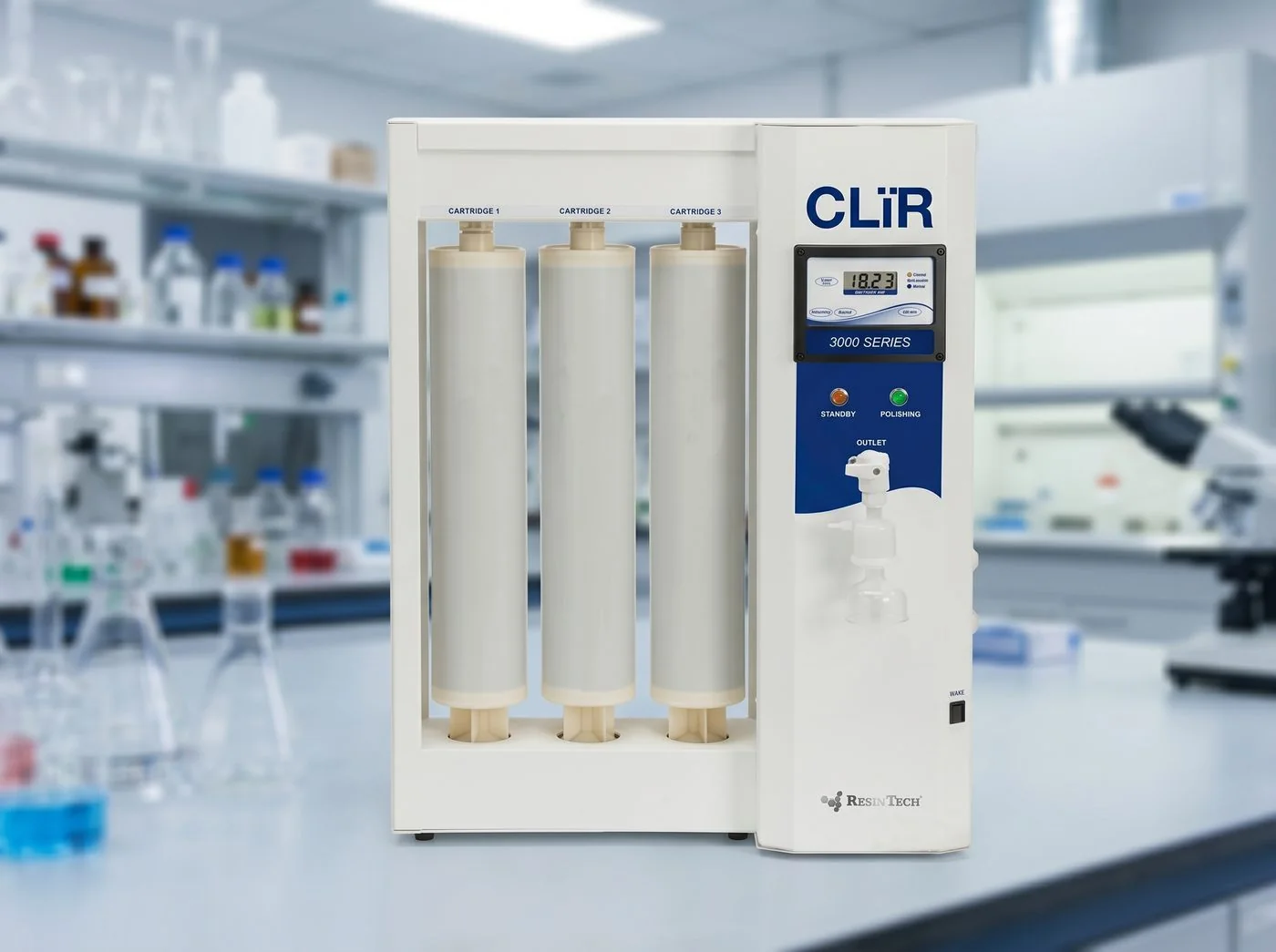
The ResinTech CLïR 3000 Series is a point-of-use ultrapure water polishing system designed for laboratory environments that require Type I water compliant with ASTM D1193, ISO 3696 Grade 1, and CLSI Clinical Laboratory Reagent Water (CLRW) standards. It produces water at >18 MΩ·cm resistivity — approaching the theoretical maximum for pure water at 25°C — for use in HPLC, LC-MS, cell culture, PCR, trace metal analysis, and clinical analyzers.
ResinTech is not primarily a water system manufacturer — it is a global ion exchange resin manufacturer. This distinction matters. Every high-purity water system on the market, including Milli-Q, Barnstead, and ELGA, relies on mixed-bed ion exchange resins as the core purification technology. ResinTech manufactures those resins. The CLïR 3000 is unusual in that the same company makes both the cartridge media and the system — a closed quality chain with lot-controlled, documented media performance that third-party media cannot match for traceability.
US Water Systems distributes the CLïR 3000 Series as an authorized dealer. All four models and associated consumables are available through their catalog.
Four-Model Lineup — CLS-3100 Through CLS-3400
All four CLïR 3000 models share identical physical hardware, the same 25″ × 23″ × 8.5″ footprint, the same cartridge mechanism, and the same core mixed-bed ion exchange polishing that achieves >18 MΩ·cm resistivity. They differ only in the post-polishing treatment stages added for TOC and biological contamination control.
<10 CFU/mL bacteria
0.2 µm final filter
No UV • No UF
Na♠/Cl♠ <1 ppb each
<10 CFU/mL bacteria
TOC <5–10 ppb (UV)
0.2 µm final filter
UV oxidation added
<1 CFU/mL bacteria (UF)
Endotoxin <0.03 EU/mL
0.05 µm hollow fiber UF
No UV
<1 CFU/mL bacteria
Endotoxin <0.03 EU/mL
TOC <5–10 ppb
UV + 0.05 µm UF
Full Specifications
4.0 LPM direct feed port
(CLS-3200, CLS-3400)
(CLS-3300, CLS-3400)
(64 × 59 × 22 cm)
220V converter available
(built-in regulator)
(registration required)
ISO 3696 Grade 1 • CLSI CLRW
| Parameter | CLS-3100 | CLS-3200 | CLS-3300 | CLS-3400 |
|---|---|---|---|---|
| Resistivity | >18 MΩ·cm | >18 MΩ·cm | >18 MΩ·cm | >18 MΩ·cm |
| UV oxidation | — | Yes | — | Yes |
| Ultrafiltration | — | — | 0.05 µm UF | 0.05 µm UF |
| Final filter | 0.2 µm | 0.2 µm | 0.05 µm UF | 0.05 µm UF |
| TOC | Not specified | <5–10 ppb | Not specified | <5–10 ppb |
| Bacteria | <10 CFU/mL | <10 CFU/mL | <1 CFU/mL | <1 CFU/mL |
| Endotoxin | Not specified | Not specified | <0.03 EU/mL | <0.03 EU/mL |
| Na♠ / Cl♠ | <1 ppb each | <1 ppb each | <1 ppb each | <1 ppb each |
| Source: ResinTech CLS-3X00 Product Data Sheet Rev.1.3; CLïR 3000 Installation & Operation Manual M-0530201701 Rev.10. | ||||
Feed Water Requirements
The CLïR 3000 is a polishing system, not a standalone purification system. It requires pre-treated feed water to achieve rated output quality and maintain cartridge service life. This is the most important operational consideration for anyone evaluating the system.
| Parameter | Requirement | Notes |
|---|---|---|
| Preferred feed source | RO permeate, service DI, or distilled water | Maximizes cartridge life; enables VPK-4010 kit (three mixed-bed cartridges) |
| Conductivity | <20 µS/cm for RO/DI feed | Higher conductivity exhausts resin faster; direct correlation to cartridge service life |
| TOC | <50 ppb for RO/DI feed; <200 ppb for SDI feed | Elevated TOC requires organics pretreatment cartridge (VPK-3805 kit) |
| Free chlorine | <0.05 ppm | Chlorine irreversibly damages ion exchange resin; chlorinated water must be de-chlorinated upstream |
| Temperature | 5°C to 38°C (41–100°F) | Resin capacity and UV efficiency both degrade at elevated temperatures |
| Pressure | 30–90 psig | Built-in regulator handles supply variation; gravity feed requires external pump (Part 1200109) |
| Silt Density Index (SDI) | <3 | SDI >3 will rapidly clog the 0.05 µm ultrafilter on CLS-3300/3400; additional pre-filtration required |
| Silica | <2 ppm | High silica can foul UF membranes and reduce mixed-bed resin capacity |
Cartridges — Selection and Replacement
Cartridges are not included with the base system and must be ordered separately. This is a common point of confusion during procurement — the system unit price does not include the consumables required to operate it.
| Cartridge kit | Contents | Feed water |
|---|---|---|
| VPK-4010 — RO/DI Feed Kit | 3 × High-Purity Mixed-Bed Cartridges | RO permeate or pre-treated water <20 µS/cm |
| VPK-3805 — Tap / SDI Feed Kit | 1 × Organics Pretreatment + 2 × Mixed-Bed | Tap water or higher-TDS SDI feed |
Cartridge replacement is recommended every six months, or when the inline resistivity display shows water quality has dropped below the application minimum — whichever comes first. All three cartridges should be replaced as a set; replacing only exhausted cartridges and leaving partially loaded ones in place leads to inconsistent output quality and shorter overall service intervals.
The tool-free cartridge swap mechanism is one of the CLïR 3000's strongest practical advantages. Push down, tilt forward, remove — no tools, no service technician required. New cartridges condition to full >18 MΩ·cm resistivity within 24 hours; flush a minimum of 4 liters through new cartridges before collecting water for analytical use.
Replace the final filter (0.2 µm CLF-XX-6402 for CLS-3100/3200, or 0.05 µm UF CLF-3000-005-HN for CLS-3300/3400) at every cartridge change without exception. The final filter is the last barrier between the purification train and the dispensed water; leaving it beyond the cartridge replacement interval compromises the bacteria and endotoxin specifications the system is rated to meet.
System Design and the Recirculation Advantage
The CLïR 3000's most operationally significant design feature is the automatic recirculation cycle. An internal timer controller runs the recirculation pump and all active purification components (UV lamp if equipped, solenoid valve, resistivity monitor) for 30 minutes every 2 hours, regardless of whether water is being dispensed.
This matters because static water in an ion exchange system degrades: resin slowly leaches trace organics, atmospheric CO&sub2; dissolves into standing water to form carbonic acid (reducing pH and lowering resistivity), and bacteria find stagnant warm water hospitable. A system without active recirculation delivers its highest-quality water immediately after dispensing, then quality drifts during idle periods. The CLïR 3000's continuous recirculation cycle prevents that drift.
The WAKE button overrides the standby timer and triggers an immediate 30-minute polishing cycle on demand. It must be held for more than 3 seconds — a brief press does nothing, which prevents accidental activation but catches users who don’t know the hold requirement.
The built-in resistivity monitor provides continuous inline temperature-compensated measurement. ASTM D1193 requires resistivity to be measured inline at the point of dispense rather than in a collected sample, because ultrapure water absorbs CO&sub2; from air within seconds of exposure, immediately dropping resistivity. The CLïR 3000’s inline cell satisfies this requirement. Programmable Hi/Lo set-point alerts trigger a relay output when resistivity drops below the application minimum — useful for alarming before water quality degrades far enough to affect results.
Installation Requirements
The CLïR 3000 can be installed by laboratory personnel — it does not require a plumber. Key site requirements to verify before ordering:
- Pre-treated feed water source (RO permeate preferred) available at the installation location
- Feed water pressure between 30–90 psig; gravity feed requires the external pump (Part 1200109)
- Dedicated GFCI-protected 120 VAC outlet within 6 feet of the unit
- Bench space: 23″ wide × 8.5″ deep, or wall structure capable of supporting 50+ lbs for wall mounting (bracket CLA-3000-WB required)
- An isolation valve upstream of the CLïR for service shut-off
For UV-equipped models (CLS-3200, CLS-3400): the UV bulb requires annual replacement regardless of apparent lamp condition. UV-C output from low-pressure mercury lamps degrades significantly over 12 months before the lamp visibly fails — a lamp that appears illuminated may be producing a fraction of its rated UV dose. Always replace on schedule, not on failure.
CLïR 3000 vs. Milli-Q, Barnstead, ELGA
| System | Key differentiators | Best fit |
|---|---|---|
| CLïR 3000 (ResinTech) | In-house ion exchange media manufacturing; vertically integrated quality chain; 4-model lineup; tool-free cartridge swap; recirculation pump; Made in USA; lower consumable cost | Labs prioritizing media quality traceability and operating cost; mid-tier initial investment |
| Milli-Q (MilliporeSigma) | Industry reference standard; IoT connectivity on newer models; certified for most regulatory submissions; largest global support network; highest consumable cost | Premium segment; regulatory submissions where Milli-Q is specified by name; highest initial and ongoing cost |
| Barnstead (Thermo Scientific) | Wide model range; strong integration with Thermo instrument ecosystem; established service network; proprietary consumables | Labs already committed to Thermo Scientific ecosystem; consumable lock-in is a consideration |
| PURELAB / MEDICA (ELGA) | European reference standard; strong clinical and pharmaceutical positioning; competitive consumable pricing; CAP accreditation documentation available | Clinical laboratories with CAP accreditation requirements; European-standard compliance contexts |
The CLïR 3000’s central advantage over all three premium competitors is the vertical integration of resin manufacturing. Ion exchange media is not a commodity; resin cross-linking density, bead size uniformity, and organic leachable content vary between manufacturers and lots. ResinTech sells its media to water system manufacturers globally — the CLïR 3000 puts the same media manufacturer in control of the whole system, with documented lot traceability that third-party resin cannot provide.
The main reason to choose Milli-Q over the CLïR 3000 is regulatory or institutional: when a method validation was performed on Milli-Q water, or when a regulatory submission specifically calls for Milli-Q, the switching cost is real. For labs without that constraint, the CLïR 3000 delivers equivalent ASTM Type I water at meaningfully lower consumable cost.
Who Should Buy It
Related reviews and guides
- What is deionized water? — how ion exchange works, ASTM Types I–IV, uses across labs, healthcare, and manufacturing, and materials compatibility
- Water treatment for healthcare & laboratory facilities — ASTM water types, ASHRAE 188 Legionella compliance, and application matrix for hospital and lab buildings
- Hach DR900 Multiparameter Colorimeter review
- Hach DR1900 Portable Spectrophotometer review
- Apera pH700 Benchtop pH Meter review