Home › Reviews › iSpring RCB3P
iSpring RCB3P Review (2026): The 750 ppm Ceiling Nobody Mentions
Disclosure: This page contains affiliate links. If you purchase through our links, we may earn a commission at no extra cost to you. See our affiliate disclosure.
The RCB3P is a competent piece of equipment at a fair price, and for the right application it is a sensible buy. But three numbers from iSpring's own specification sheet decide whether it fits your site, and none of them appear in the marketing: the 300 GPD rating assumes 77 °F feed water, the system is capped at 750 ppm feed TDS, and "tankless" describes what ships in the box rather than how most installations should run. Get those three right and this is a good light-commercial RO. Get them wrong and you will be diagnosing a system that is performing exactly as specified while failing to do the job you bought it for.
Contents
- Verdict at a glance
- The 300 GPD rating and temperature
- The 750 ppm TDS ceiling
- The hardness claim, corrected
- What "tankless" actually means here
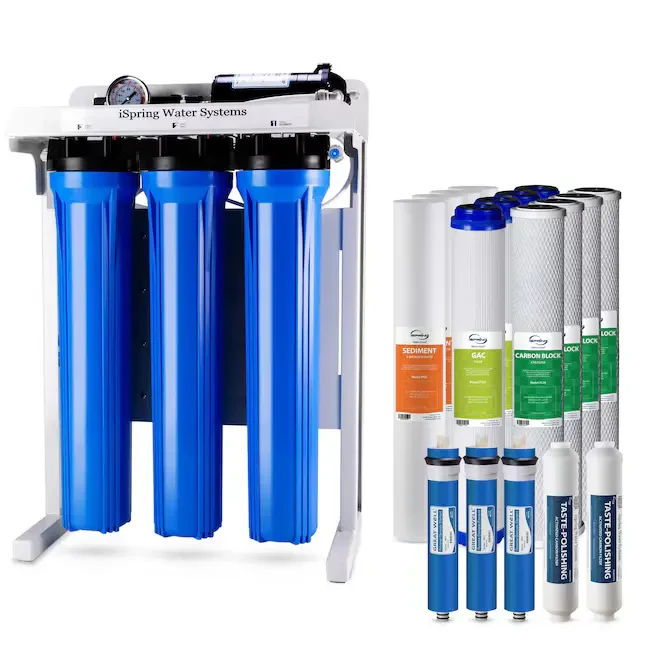
- The five-stage configuration
- Certification: what CE and RoHS are not
- Monitoring membrane rejection
- Full specifications
- Running cost and maintenance
- Who this fits
- FAQ
Verdict at a glance
What's genuinely good
- 1.5:1 pure-to-drain is well above typical residential RO, which commonly runs 3:1 or 4:1. Real water-cost advantage.
- Three 100 GPD membranes in parallel rather than one strained element — lower flux per membrane at rated output.
- 20″ × 2.5″ pre-filters hold roughly twice the media of standard 10″ cartridges, so service intervals stretch.
- Booster pump and pressure gauge included, not upsold.
- Freestanding stainless frame; parts and filter sets are cheap and easy to source.
- Wide feed pH tolerance of 3.0–11.0.
What buyers need to know
- 300 GPD assumes 77 °F feed. Winter municipal water can cut that by 35–45%.
- 750 ppm feed TDS ceiling rules out a lot of well water — and it isn't in the marketing.
- "Removes hardness" invites skipping a softener, which is how RO membranes get scaled.
- No system-level NSF certification; CE and RoHS are not drinking-water standards.
- Effectively needs a storage tank for most real duty, adding roughly $230.
- 1-year warranty excluding filters and membranes.
The 300 GPD rating and temperature
Every RO membrane is rated at a standard reference temperature, almost always 77 °F (25 °C). That is a laboratory condition, not a plumbing condition. As water cools its viscosity rises, it diffuses through the membrane more slowly, and permeate flow falls. The membrane is not degrading — this is reversible physics, and production returns when the water warms.
The practical consequence is that a system sized on its nameplate will underproduce for much of the year. Using standard membrane temperature correction factors:
| Feed water temperature | Correction factor | Actual output | Shortfall vs. nameplate |
|---|---|---|---|
| 77 °F (25 °C) | 1.00 | 300 GPD | — |
| 70 °F | 0.87 | 261 GPD | 13% |
| 65 °F | 0.79 | 237 GPD | 21% |
| 60 °F | 0.71 | 213 GPD | 29% |
| 55 °F | 0.64 | 192 GPD | 36% |
| 50 °F | 0.57 | 171 GPD | 43% |
| 45 °F | 0.50 | 150 GPD | 50% |
| 40 °F | 0.44 | 132 GPD | 56% |
| Correction factors are standard industry approximations for thin-film composite RO membranes relative to 77 °F. Exact values vary slightly by membrane. Municipal cold water in winter commonly runs 45–55 °F across much of the US; well water is typically nearer the local mean annual air temperature year-round. | |||
The 750 ppm TDS ceiling
This is the specification that should decide the purchase for anyone on well water, and it is buried in the manual rather than stated on the product page.
750 ppm is not a high ceiling. To put it in context against the interpretation bands in our TDS measurement guide: 300–600 mg/L is "good" water spanning the EPA secondary standard of 500, and 600–900 is "acceptable, monitor." So this system tops out in the middle of ordinary. Wells across the Southwest, the Great Plains, and coastal aquifers routinely exceed 750 ppm, and municipal supplies in parts of the arid West do too.
The hardness claim, corrected
"Removes up to 99% of over 1,000 contaminants and hardness, including PFAS, lead, chlorine, fluoride, arsenic, asbestos, calcium, sodium, and more."
The membrane does reject calcium and magnesium, so permeate is soft. But hardness rejected is hardness concentrated on the feed side, and calcium carbonate scale on the membrane surface is the single most common RO failure mode. On hard water a softener belongs upstream of the RO. iSpring's own manual concedes the point indirectly, noting membrane life depends on the hardness of incoming water. Reading that bullet as "I don't need a softener" is how a $856 system becomes a membrane replacement inside a year.
This is not unique to iSpring — it is close to universal in consumer RO marketing, and it is technically defensible in the narrow sense that the permeate really is soft. The problem is what a buyer infers. Correct pre-treatment order for hard or high-iron feed is sediment, then softening or iron removal, then carbon, then RO. The commercial RO pre-treatment guide covers the full train, and the softener troubleshooting guide covers why a failed softener upstream shows up as an RO problem downstream.
What "tankless" actually means here
Do the arithmetic on the rated output: 300 GPD is 12.5 gallons per hour, or 0.21 GPM. That is the maximum instantaneous rate the system can deliver, and it is a trickle by any commercial standard — a standard kitchen faucet runs about 1.5–2.2 GPM.
Tankless RO works when production rate meets or exceeds demand rate. At 0.21 GPM this system meets demand only where demand is slow and steady. Any burst — a rush of drink orders, filling a stockpot, a coffee batch brewer drawing several gallons in a few minutes — outruns it immediately. iSpring effectively acknowledges this by stating compatibility with 11- and 20-gallon storage tanks and selling them separately, with the 20-gallon tank appearing as the frequently-bought-together item at roughly $230.
The five-stage configuration
| Stage | Component | Function |
|---|---|---|
| 1 | 5-micron sediment filter (20″ × 2.5″) | Particulate removal. Protects carbon and membranes from physical fouling. Oversized format roughly doubles capacity versus standard 10″ cartridges. |
| 2 | GAC carbon filter | Chlorine, taste, odor, and organics. Loose granular bed for adsorption capacity. |
| 3 | CTO carbon block | The critical stage for membrane protection. Free chlorine oxidizes thin-film composite membranes irreversibly. A carbon block gives finer filtration and more reliable chlorine removal than GAC alone. |
| 4 | 3 × 100 GPD RO membranes | The actual separation. Three elements in parallel rather than one working element, which means lower flux per membrane at rated output — generally good for membrane life. |
| 5 | Inline post-carbon filter | Polishing for taste. Removes any residual off-flavor from storage. |
| The two carbon stages ahead of the membranes are the right design decision for chlorinated municipal feed. Note there is no remineralization stage — RO permeate is aggressive toward metals and flat-tasting, which matters for coffee and espresso applications in particular. | ||
Certification: what CE and RoHS are not
The manual lists safety approvals as CE, UCS18000, and RoHS. None of those is a drinking water contaminant reduction standard:
- CE — European conformity marking covering electrical safety and EMC. Relevant to the booster pump, silent on water quality.
- RoHS — restriction of hazardous substances in electronics. Concerns what the product is made of, not what it removes.
- UCS18000 — a general product safety standard, again not a performance standard for contaminant reduction.
The relevant standard for an RO system is NSF/ANSI 58, and the system does not carry it. Individual components can be certified separately — iSpring's FT15 inline post-carbon filter is listed as NSF/ANSI 58 certified — but a certified component inside an uncertified system does not make the system certified. That distinction matters because it determines whether "removes up to 99% of over 1,000 contaminants" is third-party verified or manufacturer testing. Here it is the latter. Our NSF certifications guide covers what each standard actually tests, and the budget filters comparison covers how to verify a certification claim in the NSF database.
Monitoring membrane rejection
iSpring gets this exactly right in the manual, and it is worth amplifying because most owners ignore it: replace the membranes when TDS rejection falls to 80%, tested every 6 to 12 months. Not by taste, not by calendar. Membranes can last up to five years depending on feed water quality, hardness, and filter change discipline.
Example: feed at 400 ppm, permeate at 40 ppm gives 90% rejection — healthy. The same feed with permeate at 80 ppm gives 80% rejection, which is the replacement threshold.
One cost note: because the RCB3P uses three 100 GPD membranes in parallel, a membrane replacement means three elements, not one. Budget accordingly.
Full specifications
| Model | RCB3P (bundle SKU RCB3PF17 includes F17RCB3P 2-year filter set) |
| Rated production | 300 GPD at 77 °F feed (12.5 GPH / 0.21 GPM) |
| Membranes | 3 × 100 GPD thin-film composite, parallel |
| Recovery | 1.5:1 pure to drain |
| Max feed TDS | 750 ppm |
| Feed pressure | 25–90 PSI |
| Feed temperature | 40–100 °F (4–38 °C) |
| Feed pH | 3.0–11.0 |
| Booster pump | 110V AC (some models 110–240V) |
| Safety approvals | CE, UCS18000, RoHS. No NSF/ANSI 58 system certification. |
| Dimensions / weight | 19.5″L × 11″W × 28″H; 52 lb |
| Storage tank | Not included. Compatible with 11- or 20-gallon tanks |
| Warranty | 1 year on parts, excluding replaceable filters and membranes. Voided by freezing, misuse, or installation contrary to instructions |
| Specifications from the iSpring RCB3P user manual and published product listings, August 2026. Verify current specifications with the manufacturer before purchase. | |
Running cost and maintenance
| Item | Interval | Notes |
|---|---|---|
| Sediment, GAC, and carbon block pre-filters | 6–12 months | More often on high-turbidity feed. The 20″ format buys longer intervals than 10″ cartridges. Failing to change these is the fastest route to premature membrane failure. |
| RO membranes (×3) | When rejection falls to 80% | Test every 6–12 months. Up to 5 years achievable with good pre-treatment and disciplined filter changes. |
| Inline post-carbon filter | 12 months | Manual is explicit: change on schedule, don't wait for taste to degrade. |
| Storage tank air charge | At every filter change | Specified in the manual and almost universally skipped. Wrong air pressure reduces usable draw and stresses the pump. |
| Post-membrane flush | At membrane replacement | Flushes the storage preservative from new membranes and carbon fines from the post filter. Do not skip. |
Filter economics are one of this system's genuine strengths: a 6-month supply runs around $79, a 1-year set around $101, and the 2-year set around $262, with individual cartridges in the $34–42 range. Compared with proprietary-cartridge systems that lock you into a single supplier at a premium, this is refreshingly ordinary — and the 20″ × 2.5″ format is an industry-standard size available from many manufacturers.
Who this fits
Good fit
- Offices, salons, and small labs needing drinking or process water at modest volume.
- Coffee service and small cafés, where daily volume is real but rate demand is low — paired with a storage tank.
- Feeding a single ice machine (a 300 lb/day machine uses roughly 35–40 gal/day).
- Municipal supply under 750 ppm TDS with reasonable hardness, or hard water with a softener already upstream.
- Operations wanting standard-size replacement cartridges rather than proprietary lock-in.
Look elsewhere
- Feed water above 750 ppm TDS — specify a brackish-rated system instead.
- Commercial dish machines or high-volume beverage service; 0.21 GPM is not close.
- Cold-climate installations needing full rated output year-round on 45–55 °F feed.
- Applications requiring NSF/ANSI 58 system certification for compliance or procurement.
- Hard or iron-bearing well water with no pre-treatment planned — fix that first, then revisit.
- Anyone needing true commercial capacity — see the Defender HD review for that tier.
FAQ
Does the RCB3P really make 300 gallons per day?
At 77 °F feed water, yes. At 60 °F expect around 213 GPD, at 55 °F around 192, and at 50 °F around 171. Winter municipal water in much of the US runs 45–55 °F, so plan from your coldest expected feed temperature rather than the nameplate.
What is the maximum TDS it can handle?
750 ppm, per the manufacturer's specification. Above that the system is out of spec — production drops, rejection degrades, and fouling accelerates. Test your feed before buying; it is a binary go/no-go.
Do I still need a water softener?
On hard water, yes, and it goes upstream. RO rejects hardness into the concentrate stream, which is precisely where calcium carbonate scale forms on the membrane. The permeate being soft is not the same as the system solving a hardness problem.
Is it NSF certified?
The system is not. CE, UCS18000, and RoHS are electrical safety, general safety, and hazardous-substance standards, not contaminant reduction standards. The FT15 post-carbon replacement filter carries NSF/ANSI 58 separately, but that does not certify the system.
Do I need the storage tank?
For most commercial duty, yes. 300 GPD is 0.21 GPM, so anything bursty outruns production immediately. The tank is sold separately at roughly $230, which makes the realistic installed price about $1,085.
How do I know when to replace the membranes?
Measure TDS on the feed and on the permeate with the same meter and compute rejection. Replace at 80%. Because rejection is a ratio, meter conversion-factor error cancels out — even a cheap pen gives a valid percentage as long as you use it for both readings.
How does it compare to the US Water Defender HD?
Different tiers entirely. The RCB3P is light commercial — offices, salons, small labs, coffee service. The Defender HD is a true commercial RO for higher volume and duty. If you are weighing them against each other, the deciding factor is usually daily volume and whether you need the system to keep up with rate as well as total.
- RO System Performance Calculator — temperature derating, rejection rate, recovery and GPD/GPM
- US Water Systems Defender HD Commercial RO Review — the true commercial tier above this one
- Commercial RO Pre-Treatment Guide — correct train order and why it matters
- Measuring TDS in Water — verifying feed TDS and monitoring rejection
- Water Softener Troubleshooting — when the softener upstream is the real problem
- NSF Water Filter Certifications Explained
- Budget Filters vs. Professional Systems
- Chloramine in Water — why standard carbon may not protect the membranes
- Commercial RO & Ultrafiltration Systems
Sources: iSpring RCB3P User's Manual (Model #RCB3P) — specifications, maintenance schedule, membrane rejection threshold, warranty terms. · iSpring published product listings and specifications, August 2026. · Standard thin-film composite RO membrane temperature correction factors relative to 77 °F reference. · NSF/ANSI 58, Reverse Osmosis Drinking Water Treatment Systems. Temperature-derated output figures in this review are calculated from published correction factors and are approximate; exact performance varies by membrane and feed chemistry. Commercial Water Lab has not bench-tested this unit; this review is a technical analysis of published manufacturer specifications. Verify current specifications, pricing, and warranty terms with the manufacturer before purchase.