Harmsco HUR-40-HP Hurricane Filter Housing Review (2026)
Disclosure: This page contains affiliate links. If you purchase through our links, we may earn a commission at no extra cost to you. See our affiliate disclosure.
Source: Harmsco Installation & Operation Manual Pub. No. 003 4/07 • HP Hurricane Product Data Sheet Pub. No. 07D 45 7/11
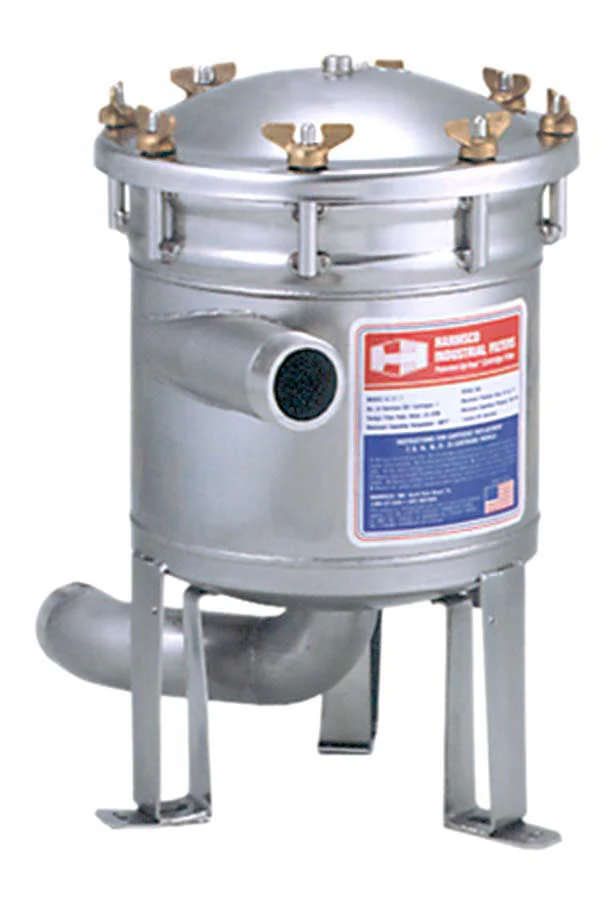
Dual-Technology: Centrifugal Separation + Pleated Cartridge • 40 Sq Ft • 50 GPM Max • 150 PSI • NSF 61 • Made in USA
Why Two-Stage Filtration Matters — The Core Design Argument
Most commercial filter housings are single-stage: liquid enters, passes through the cartridge, exits. When the incoming water carries heavy sediment — sand from a well, rust from aging iron pipe, grit from a municipal main break — all of that material hits the filter media directly. Dense abrasive particles are the fastest way to blind a cartridge, and they contribute nothing to the cartridge's rated efficiency calculation. They just load the surface and shorten service life.
Harmsco's approach is to remove those particles before they reach the cartridge using centrifugal force — a passive, energy-free separation mechanism driven entirely by system pressure. Dense particles that would have loaded the cartridge in minutes instead accumulate in the outer chamber and are flushed out through the drain valve on a scheduled purge cycle. The cartridge then only needs to handle the lighter, finer particles that centrifugal force can't capture — which is what it was designed for.
HP Hurricane Series — All Three Models
All three HP Hurricane models share the same 13-inch diameter stainless steel housing and 2” NPT inlet/outlet connections. Selection is based on required flow rate and filter area:
| Model | Filter Area | Max Flow | Recommended Flow | Notes |
|---|---|---|---|---|
| HUR-40-HP | 40 sq ft | 50 GPM | 35 GPM | Smallest model; fits most commercial applications on 2” connection |
| HUR-90-HP | 90 sq ft | 75 GPM | 50 GPM | Same 13” housing; larger cartridge for higher flows |
| HUR-170-HP | 170 sq ft | 150 GPM | 100 GPM | Largest single unit; Poly-Mesh cartridges available for this model only |
| For flows above 150 GPM: install multiple HUR-170-HP units in parallel with individual isolating valves, allowing one unit to be serviced without interrupting system flow. | ||||
Full Technical Specifications — HUR-40-HP
Physical & Hydraulic
| Specification | Value |
|---|---|
| Filter area | 40 square feet |
| Maximum flow rate | 50 GPM |
| Recommended flow rate | 35 GPM (70% of maximum) |
| Carbon Block cartridge max flow | 5 GPM |
| Maximum operating pressure (standard) | 150 PSI |
| Maximum operating temperature (standard) | 140°F (60°C) |
| Maximum temperature (HT cartridges) | 200°F (93°C) |
| Maximum temperature (HTM metal end cap cartridges) | 250°F (121°C) |
| Inlet/outlet connections | 2” NPT (BSPT available by special order) |
| Drain connection | 1” NPT |
| Lid port | 1/4” FPT (petcock, gauge, sensor, or thermocouple) |
| Housing diameter | 13 inches |
| Mounting | Leg-mount standard; wall-mount available |
Materials & Certifications
| Component | Standard Material | Options |
|---|---|---|
| Housing body & lid | 304 stainless steel | 316L SS (corrosion applications) |
| Lid wing-nuts | Brass | — |
| Rim gasket | EPDM | Buna-N, Viton |
| Standpipe | Stainless steel (standard) | Required for HT/HTM cartridges |
| Flanged connections | NPT standard | 2” SS flanged fittings (Part No. 327, special order) |
| NSF 61 listing | Yes — drinking water system components | — |
| NSF 42 listing | SureSafe Antimicrobial cartridges | — |
| Origin | Made in USA (North Palm Beach, FL) | — |
Pressure Drop Reference — HUR-40-HP
Pressure drop data developed by NSF International using clean water. These values represent clean-filter startup conditions — differential pressure increases as the cartridge loads with particulate. Use inlet-minus-outlet gauge readings to track cartridge condition during service.
| Flow Rate (GPM) | Pressure Drop — 1 Micron Cartridge (PSI) | Notes |
|---|---|---|
| 10 | <1 | Very low differential at partial flow |
| 20 | ≈2 | Typical light-duty service point |
| 35 | ≈4–5 | Recommended operating rate — optimum performance |
| 50 | ≈8–10 | Maximum rated flow — reduced contact time, higher pressure drop |
| Source: NSF International clean-water test, 1-micron Polyester-Plus cartridge. Actual values vary with cartridge type and particulate load. | ||
Complete Cartridge Selection Matrix
The HUR-40-HP accepts the full Harmsco cartridge family. Cartridge selection determines micron rating, temperature capability, chemical compatibility, and whether the cartridge can be cleaned and reused. All standard cartridges are NSF 61 listed for drinking water contact unless noted.
Polyester-Plus™ — Standard Series (Cleanable)
| Part No. | Micron Rating | Max Temp | Cleanable | Notes |
|---|---|---|---|---|
| HC40PP0.35 | 0.35 micron | 140°F | No | Sub-micron; do not clean |
| HC40PP1 | 1 micron | 140°F | No | Sub-5-micron; do not clean |
| HC40PP3 | 3 micron | 140°F | No | Sub-5-micron; do not clean |
| HC40PP5 | 5 micron | 140°F | Yes | Finest cleanable rating — most popular for general commercial use |
| HC40PP10 | 10 micron | 140°F | Yes | Standard pre-filter for well and municipal supply |
| HC40PP20 | 20 micron | 140°F | Yes | High-sediment pre-filtration; longest service interval |
| HC40PP50 | 50 micron | 140°F | Yes (NR) | Coarse pre-filter; nominal rating only |
| HC40PP100 | 100 micron | 140°F | Yes | Very coarse; sand and large debris protection |
| HC40PP150 | 150 micron | 140°F | Yes | Coarsest rating available |
| NR = Not rated to specific capture efficiency standard at nominal 50-micron value. Do not clean cartridges rated below 5 micron — cleaning drives particles deeper into media and degrades performance. | ||||
High-Temperature Cartridges
| Series | Suffix | Max Temp | End Caps | Standpipe Required |
|---|---|---|---|---|
| HT Standard | -HT | 200°F (93°C) | Plastic | Stainless steel standpipe |
| HT Metal | -HTM | 250°F (121°C) | Metal | Stainless steel standpipe (mandatory) |
| NSF 61 listing excludes high-temperature ratings. For steam condensate, hot process water, and high-temp industrial applications. | ||||
Specialty & High-Performance Cartridges
| Cartridge Type | Key Specs | Primary Use | Cleanable | Special Notes |
|---|---|---|---|---|
| Harmsco-Free Carbon Block | NSF 42 & 61; 5 GPM max | Chlorine, taste, odor removal | No | Max 5 GPM — exceeding this dramatically reduces chlorine removal |
| Poly-Pleat | 1–50 micron; polypropylene | Aggressive chemical environments; acid/caustic applications | Limited | Polypropylene resists broad chemical range; use where polyester is incompatible |
| All-Poly Fine Pleat | 0.2 micron | Sub-micron removal; bacteria-size particle capture | No | Highest efficiency available; highest pressure drop |
| SureSafe Antimicrobial | NSF 42; antimicrobial treated | Applications where bacterial growth in cartridge is a concern | No | Verify current NSF listing for specific potable application before use |
| EZ Clean | Polyester; heavy-duty cleaning | High-sediment industrial; frequent cleaning cycles | Yes — engineered for it | Designed specifically for aggressive cleaning protocols |
| Poly-Mesh | Available HUR-170-HP only | Very coarse pre-filtration; high-flow industrial | Yes | Not available for HUR-40-HP or HUR-90-HP |
Application → Cartridge Selection Guide
| Application | Recommended Cartridge | Micron Rating | Notes |
|---|---|---|---|
| Well water — high sediment | Polyester-Plus | 20–50 micron | Centrifugal stage handles bulk sand; cartridge polishes fines |
| Well water — iron/rust | Polyester-Plus | 5–10 micron | Pair with upstream iron oxidation treatment |
| Municipal supply — pre-treatment | Polyester-Plus | 5–10 micron | General commercial water quality improvement |
| RO pre-filtration | Polyester-Plus | 1–5 micron | Protects RO membrane; 1 micron preferred for SDI-sensitive membranes |
| Chlorine/taste/odor removal | Harmsco-Free Carbon Block | — | 5 GPM maximum — size system accordingly |
| Process water — chemical | Poly-Pleat | Per process spec | Polypropylene chemical resistance; check specific compatibility |
| Hot process water (to 200°F) | Polyester-Plus -HT | Per process spec | Requires stainless steel standpipe |
| Steam condensate (to 250°F) | Polyester-Plus -HTM | Per process spec | Metal end caps; SS standpipe mandatory |
| Food & beverage process water | Polyester-Plus or Poly-Pleat | 1–10 micron | Verify NSF 61 listing; confirm media compatibility with product |
| Sub-micron / bacteria-size particles | All-Poly Fine Pleat | 0.2 micron | Highest pressure drop; adequate system pressure required |
Installation Requirements
Piping & Valve Requirements
Install 2” couplers on inlet and outlet
Standard NPT. BSPT connections available by special order at time of purchase — specify at ordering. For flanged connections, 2” SS flanged fittings (Part No. 327) are available.
Install 1” coupler on drain pipe
The drain connection purges accumulated dense particles from the centrifugal outer chamber. Size drain piping to accommodate the full 50 GPM flow if the drain valve is opened with the system under pressure.
Install shut-off valves on all three connections
Inlet shut-off (isolates from upstream supply), outlet shut-off (isolates from downstream system), drain shut-off (controls purge cycle and housing drainage). All three are required. No exceptions for compliant installation.
Install pressure gauges on both inlet and outlet gauge ports
Differential pressure (inlet minus outlet) is the primary service indicator. Without gauges on both sides, there is no reliable way to determine cartridge condition. Strongly recommended by Harmsco and essential for any scheduled maintenance program.
Install petcock or pressure relief on lid 1/4” FPT port
A petcock valve on the lid allows the operator to confirm zero pressure before removing the lid for cartridge service. Without this confirmation, opening a pressurized housing can be dangerous. Alternatively, use the lid port for a pressure gauge or sensor.
Cartridge Sub-Assembly (Pre-Installation)
Place the top plate on the cartridge with clip facing upward
The secure top plate is the anti-bypass barrier separating filtered and unfiltered chambers. It must be assembled onto the cartridge before the sub-assembly is lowered into the housing.
Thread the retainer nut firmly onto the standpipe
The retainer nut seals the top plate against the housing, preventing bypass. Verify the sub-assembly is firmly seated and the top plate is correctly positioned before installation. An improperly seated top plate allows unfiltered liquid to bypass the cartridge.
Lower sub-assembly into the housing; seat the lid; fit wing-nuts
Inspect the EPDM rim gasket in the lid before every installation. Lower lid and fit brass wing-nuts to all studs. Tighten systematically rotating around the lid — not in a straight line across. Finger-tight for standard service; 75 inch-lbs maximum for extreme duty. Do not exceed 75 inch-lbs.
Operation — Commissioning & Ongoing
First Start-Up Sequence
Close drain valve; slowly open inlet valve
Pressurize the housing slowly — rapid pressurization can damage the cartridge. Do not slam open the inlet valve.
Slowly open outlet valve to establish flow
Check all connections and the lid for leaks under pressure before considering the installation complete.
Record startup differential pressure
Inlet gauge reading minus outlet gauge reading = startup ΔP. Record this value — it is the baseline for all future maintenance decisions. Cartridge service is triggered when ΔP reaches 15 PSI above this baseline.
Open drain valve briefly to purge outer chamber
Purge any air and loose particulate from the centrifugal outer chamber at startup. Repeat on the regular purge schedule thereafter.
Drain Valve Purge Schedule
The centrifugal outer chamber continuously accumulates dense particles. Periodic drain valve opening discharges these solids and maintains separation efficiency. Purge frequency depends on incoming particulate load:
| Incoming Water Quality | Recommended Purge Frequency | Purge Indication |
|---|---|---|
| High sediment (well water, construction sites) | Daily or more frequently | Discharge shows significant turbid flow during purge |
| Moderate sediment (municipal with occasional surges) | Weekly | Discharge clears within 5–10 seconds |
| Low sediment (clean municipal supply) | Monthly | Discharge nearly clear from start |
| A purge cycle that discharges clear water from the start indicates the outer chamber is clean — purge frequency can be reduced. A purge that remains turbid for an extended period indicates very high particle loading — increase frequency or check upstream conditions. | ||
Cartridge Maintenance — Cleaning Procedures
General Cleaning (All Cleanable Cartridges)
Use a pressure nozzle with a standard garden hose. Direct spray at an angle to the pleats — never perpendicular to the pleat face. Perpendicular spray drives particles into the media rather than dislodging them.
Oil Contamination Cleaning
Prepare TSP solution: 2 lbs tri-sodium phosphate per 10 gallons water
Use a container large enough to fully submerge the cartridge.
Soak cartridge up to 12 hours
Longer soak time produces better oil removal. A 12-hour overnight soak is recommended for heavily oil-contaminated cartridges.
Rinse thoroughly with clean water
All TSP residue must be removed before the cartridge is returned to service in potable or process applications.
Biological / Algae / Organic Contamination Cleaning
Prepare TSP solution + 1 pint liquid chlorine bleach
The bleach component addresses biological matter that TSP alone cannot remove.
Soak minimum 1 hour — until surface is no longer slippery
The slippery surface feel is biological (biofilm) contamination. Continue soaking until the cartridge surface is no longer slippery to the touch, regardless of whether the 1-hour minimum has passed.
Rinse thoroughly with clean water
Rinse until all bleach odor is eliminated before returning to service.
Calcium Scale / Mineral Deposit Cleaning
Complete the TSP (oil) soak FIRST
Acid treatment on oil-contaminated cartridges can fix oil in the media. Always remove oil and organics with TSP before acid treatment.
Prepare acid bath: 1 part muriatic acid to 20 parts water
Always add acid to water — never water to acid. Wear acid-resistant PPE: gloves, eye protection, apron. Work in a ventilated area.
Soak approximately 10 minutes
Do not over-soak — extended acid contact can degrade polyester media. Rinse extremely thoroughly with clean water after treatment.
Troubleshooting Guide
| Symptom | Likely Cause | Resolution |
|---|---|---|
| High differential pressure at startup | Cartridge micron rating too fine for flow rate; damaged cartridge installed | Verify correct cartridge for application; inspect cartridge; reduce flow to recommended 35 GPM |
| Rapidly increasing differential pressure | Extremely high particle load; purge cycle insufficient; upstream particle event | Increase drain purge frequency; check upstream for corrosion event or construction activity |
| Leak at lid | EPDM rim gasket damaged, deformed, or seated incorrectly; wing-nuts not uniformly tightened | Remove lid; inspect and replace gasket if damaged; re-seat gasket; re-tighten wing-nuts rotating around lid |
| Leak at connections | Thread sealant insufficient; connection not fully threaded | Depressurize; remove connection; apply thread sealant; re-thread |
| Turbid filtered effluent | Top plate not seated; top plate clip not engaged; bypass around cartridge | Shut down; remove cartridge sub-assembly; verify top plate assembly and seating; reinstall |
| Low downstream flow despite low ΔP | Downstream restriction; partially closed outlet valve | Check outlet valve position; inspect downstream piping; verify system demand hasn't changed |
| Drain will not purge | Drain valve fouled with compacted sediment; drain line restricted | Depressurize; inspect and clean drain valve; verify drain line is clear |
Warranty Summary
Harmsco warrants the HUR-40-HP housing against defects in materials and workmanship for the standard warranty period from date of purchase. The warranty covers the stainless steel housing body and standard components under normal use conditions.
Warranty does not cover: damage from improper installation; operation outside rated pressure, temperature, or flow limits; use of non-Harmsco cartridges; chemical incompatibility damage; physical damage from freezing, water hammer, or improper handling; unauthorized modification.