Home › Guides › Nitrate Removal Water Filters
Nitrate Removal Water Filter Guide (2026): What Works, What Doesn’t, and the Crystal Quest Commercial System
Disclosure: This page contains affiliate links. If you purchase through our links, we may earn a commission at no extra cost to you. See our affiliate disclosure.
Nitrate is the most widespread groundwater contaminant in the United States, found in well water across every agricultural region of the country. Most conventional water filters — carbon, sediment, and UV — do not remove it. This guide covers what causes nitrates in water, what actually removes them, and the Crystal Quest commercial nitrate removal system for well water and commercial facility applications at 15 to 390 GPM.
In this guide
- What nitrates are and why they matter
- What causes nitrates in well water
- EPA limits and health effects
- What actually removes nitrates
- What does NOT remove nitrates
- How nitrate ion exchange works
- Crystal Quest commercial nitrate removal system
- Full model specifications
- Control head options
- Test your water first
What Nitrates Are and Why They Matter
Nitrate (NO&sub3;♠) is the fully oxidized form of nitrogen — a colorless, odorless, tasteless dissolved ion that is invisible to standard sensory evaluation of water quality. You cannot detect elevated nitrate by looking at, smelling, or tasting the water. Testing is the only way to know.
Nitrate is also chemically stable in cold, oxygenated groundwater. Unlike iron (which oxidizes and precipitates visibly) or hydrogen sulfide (which produces a detectable odor), nitrate remains in solution indefinitely. A well with elevated nitrate will continue to deliver clear, odorless water that looks completely normal while exceeding safe drinking water limits.
What Causes Nitrates in Well Water
Nitrate contamination of groundwater follows a predictable pattern: organic nitrogen compounds at the surface oxidize to nitrate, which is highly water-soluble and mobile in soil, and migrate downward through the soil profile into the aquifer. The four primary sources:
Agricultural fertilizer runoff is the dominant cause in rural and farming areas. Nitrogen-based fertilizers (ammonium nitrate, urea, anhydrous ammonia) applied to crops in excess of plant uptake leach nitrate through the soil column. Shallow wells and wells in heavily farmed regions are at highest risk. USGS surveys consistently find the highest groundwater nitrate concentrations beneath irrigated cropland in the Central Valley, Midwest corn belt, and High Plains aquifer regions.
Livestock and poultry operations generate high-nitrogen waste from manure and urine. Nitrogen in animal waste oxidizes to nitrate in soil, particularly near lagoons, feedlots, and land application areas. Wells within a quarter mile of a concentrated animal feeding operation (CAFO) have elevated contamination risk.
Septic system effluent contains urea and proteins from human waste that break down to ammonia and then nitrate in the soil absorption field. Older or failing septic systems, high-density septic installations, and shallow wells in the same property all increase risk. This is the primary source of nitrate contamination in suburban and exurban well water.
Naturally occurring minerals in some aquifer formations contain nitrogen compounds that dissolve into groundwater. This is less common than anthropogenic sources but occurs in certain geological formations in the Southwest and parts of the Southeast.
EPA Limits and Health Effects
The EPA Maximum Contaminant Level (MCL) for nitrate is 10 mg/L measured as nitrogen (NO&sub3;-N), which is equivalent to 44.3 mg/L measured as nitrate ion (NO&sub3;♠). This limit applies to public water systems — private wells are not regulated under federal law, and their owners bear responsibility for testing and treatment.
The primary health concern is methemoglobinemia (blue baby syndrome) in infants under 6 months. Infants have gut bacteria that convert nitrate to nitrite (NO&sub2;♠) more readily than adults, and nitrite oxidizes hemoglobin to methemoglobin, which cannot carry oxygen. Above 10 mg/L NO&sub3;-N, infant formula mixed with the water poses a documented risk. The condition can be fatal if untreated.
For adults and older children, the risk from nitrate in drinking water at levels moderately above the MCL (10–50 mg/L NO&sub3;-N) is less acute but epidemiological research has identified associations with colorectal cancer, thyroid dysfunction, and adverse reproductive outcomes at chronic exposure levels. WHO guidance is consistent with the EPA MCL.
What Actually Removes Nitrates
| Method | Nitrate removal | Best application | Limitations |
|---|---|---|---|
| Ion exchange (nitrate-selective resin) | 95–99%+ | Whole-house and commercial — the standard commercial approach | Requires salt brine regeneration; generates nitrate-concentrated waste brine; sulfate in feed water affects selectivity |
| Reverse osmosis | 85–95% | Point-of-use drinking water; lab water | Wastes 3–5 gallons per gallon produced at residential scale; does not produce enough flow for whole-house or commercial use without large systems |
| Distillation | >99% | Small-scale, countertop | Very low production rate; high energy use; impractical above 1–2 gallons/hour |
| Carbon filter (GAC or block) | None | — | Nitrate is not adsorbed by activated carbon; false sense of security if carbon-only treatment is installed |
| Sediment filter | None | — | Nitrate is dissolved, not particulate |
| Water softener (standard) | Minimal | — | Standard softener resin prefers sulfate over nitrate; will not reliably reduce nitrate to safe levels and may worsen the problem at high sulfate concentrations |
| UV sterilization | None | — | UV addresses biological contaminants, not dissolved ions |
| Boiling | Concentrates nitrate | — | Actively worsens the problem by evaporating water |
Why Standard Water Softeners Don’t Work for Nitrate
This is the most important misconception to address. Standard water softener resin (styrene-divinylbenzene ion exchange resin in the sodium form) does exchange ions from water — but its selectivity order places sulfate (SO&sub4;²♠) well above nitrate (NO&sub3;♠). In water with even moderate sulfate content, the resin preferentially captures sulfate ions and ignores nitrate.
The result: a standard softener treating water with both sulfate and nitrate will primarily remove hardness (calcium, magnesium) and sulfate while allowing most of the nitrate to pass through. Worse, as the resin exhausts during a service cycle, nitrate captured early in the cycle can be displaced back into the treated water in a process called nitrate dumping — producing treated water with higher nitrate than the incoming feed water at the end of a cycle.
Nitrate-selective resin, such as Crystal Quest’s Eaglesorb media, is engineered with a reversed selectivity order that specifically favors nitrate over sulfate. This makes it effective even in high-sulfate source water, which is common in the same agricultural areas where nitrate contamination is worst.
How Nitrate Ion Exchange Works
Nitrate-selective ion exchange resin contains quaternary ammonium functional groups that carry a fixed positive charge. As nitrate-contaminated water flows through the resin bed, the negatively charged nitrate ions (NO&sub3;♠) are electrostatically attracted to these sites and held there, while chloride ions (Cl♠) from the resin are released into the treated water as the exchange partner.
The regeneration cycle reverses this process. When the resin becomes saturated with nitrate, a concentrated sodium chloride (salt) brine solution is flushed through the bed. The high chloride concentration displaces the captured nitrate from the resin back into the brine waste stream, restoring the resin to its chloride form and readying it for another service cycle. The waste brine — containing concentrated nitrate — must be disposed of to drain. It is not returned to the water supply.
Salt consumption for regeneration is the primary ongoing operating cost. A system treating 15 GPM of moderately nitrate-contaminated water will consume salt on a cycle schedule determined by the incoming nitrate concentration, flow volume, and resin capacity. Automatic control head systems meter water usage and initiate regeneration based on actual throughput rather than a fixed timer, which optimizes salt use and extends resin service.
Crystal Quest Commercial Nitrate Removal System
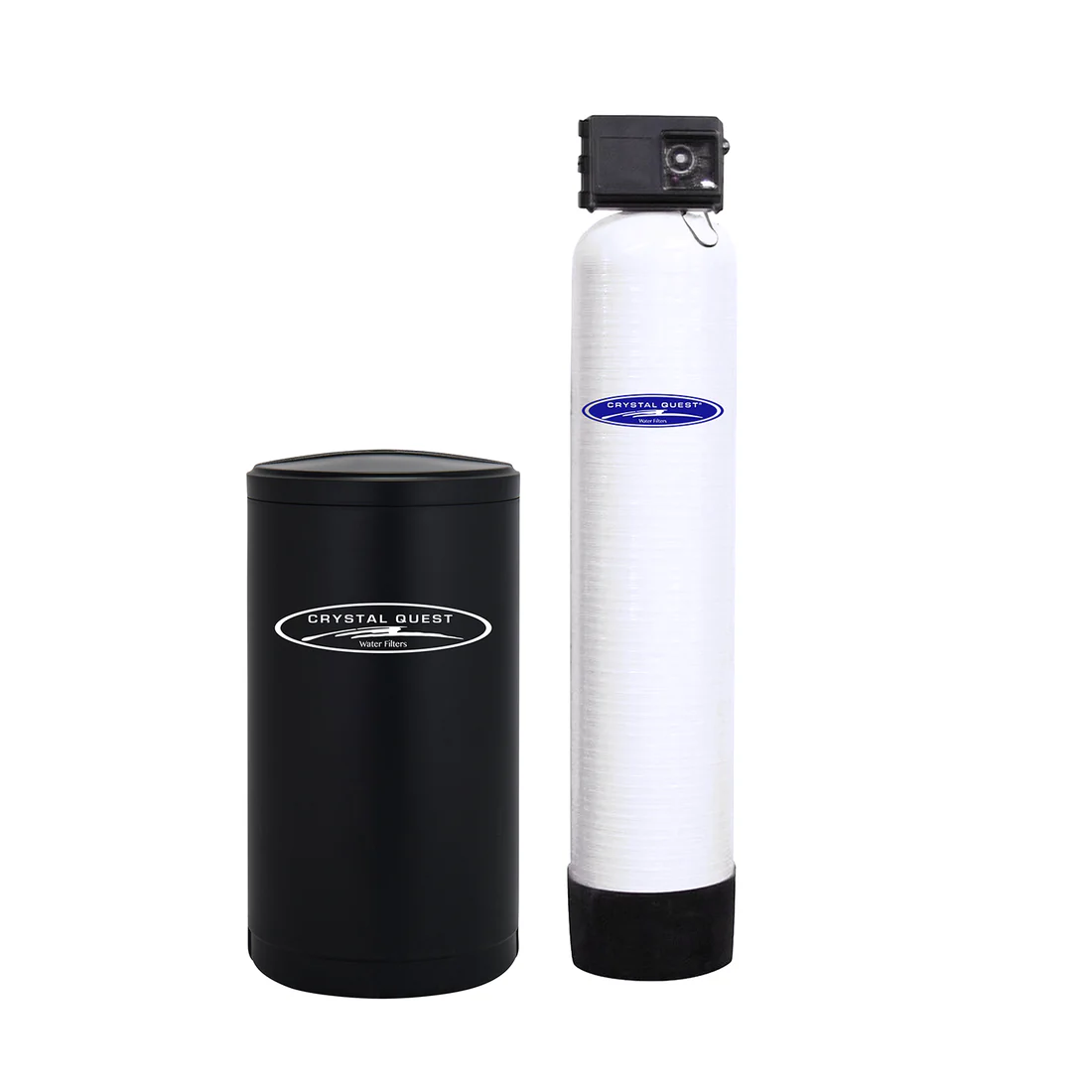
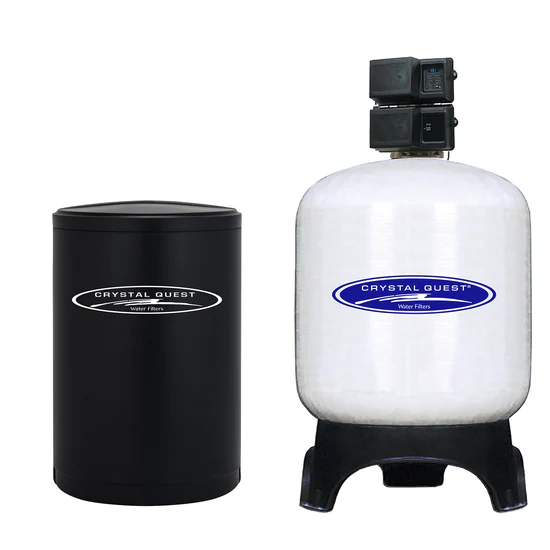
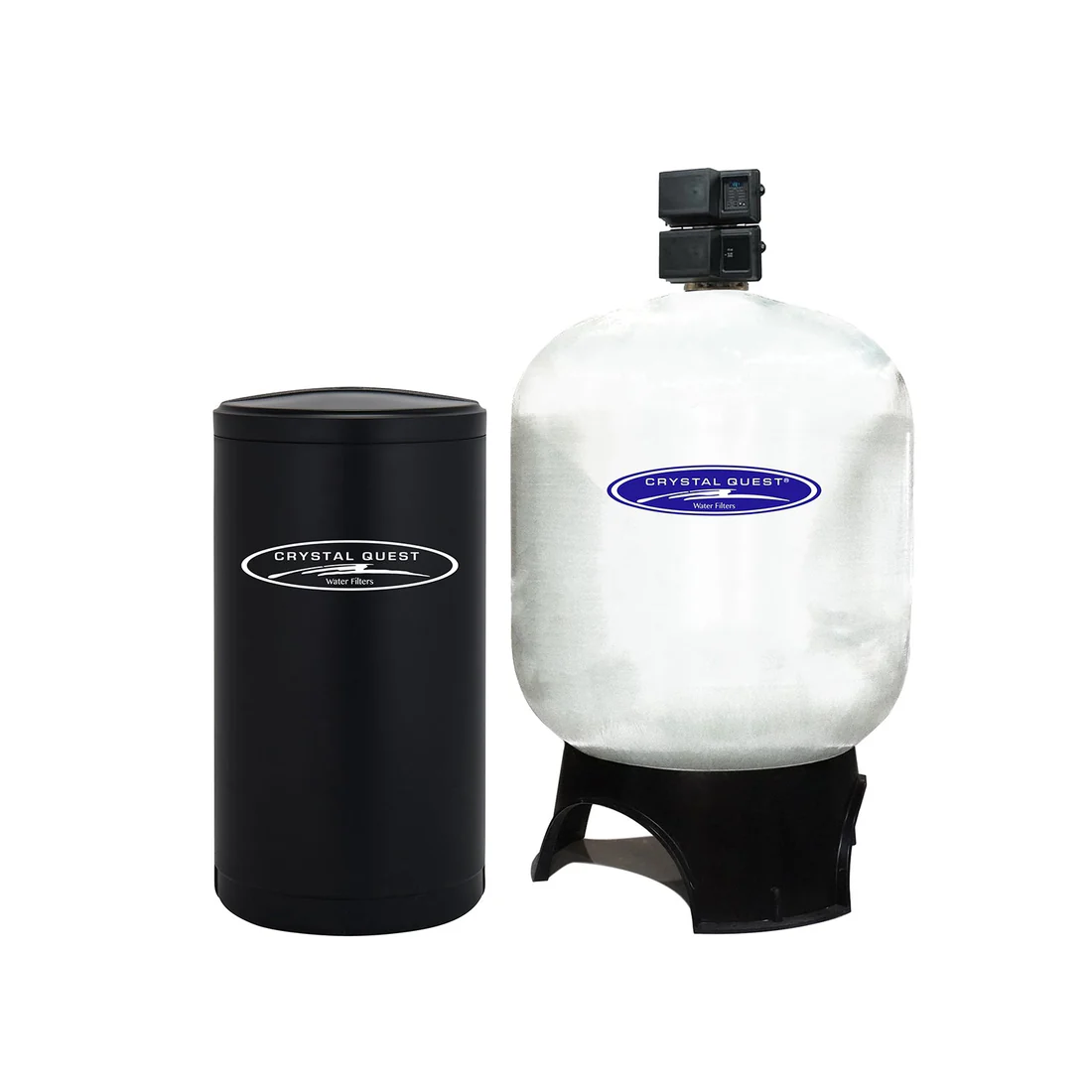
The Crystal Quest commercial nitrate removal system (SKU: CQE-CO-02083 through CQE-CO-02710) uses Eaglesorb nitrate-selective ion exchange resin in a fiberglass pressure vessel paired with a black polyethylene brine tank. The system is available in nine flow rate configurations from 15 GPM to 390 GPM, with three control head options.
Full Model Specifications
| SKU | Flow rate | Eaglesorb resin | Quartz ballast | Starting price |
|---|---|---|---|---|
| CQE-CO-02083 | 15 GPM | 3 ft³ | 30 lbs | $3,559.99 |
| CQE-CO-02084 | 20 GPM | 4 ft³ | 80 lbs | Contact for pricing |
| CQE-CO-02085 | 35 GPM | 7 ft³ | 100 lbs | Contact for pricing |
| CQE-CO-02086 | 60 GPM | 10 ft³ | 200 lbs | Contact for pricing |
| CQE-CO-02087 | 75 GPM | 15 ft³ | 400 lbs | Contact for pricing |
| CQE-CO-02088 | 185 GPM | 20 ft³ | 500 lbs | Contact for pricing |
| CQE-CO-02089 | 200 GPM | 30 ft³ | 700 lbs | Contact for pricing |
| CQE-CO-02090 | 245 GPM | 40 ft³ | 900 lbs | Contact for pricing |
| CQE-CO-02710 | 390 GPM | 50 ft³ | 1,200 lbs | Contact for pricing |
| Source: Crystal Quest product page CQE-CO-02083 through CQE-CO-02710. Prices listed are starting price for the Automatic control head configuration. Crystal Quest 15% affiliate commission on qualifying purchases. | ||||
Resin volume scales linearly with flow rate — the 15 GPM unit uses 3 ft³ of Eaglesorb resin, the 390 GPM unit uses 50 ft³. Quartz underbedding serves as a support layer and flow distribution medium. The system treats a specific volume of water per regeneration cycle determined by the resin capacity and influent nitrate concentration — higher incoming nitrate exhausts the resin faster and requires more frequent regeneration.
Control Head Options
| Configuration | Operation | Best for |
|---|---|---|
| Automatic | Metered demand-initiated regeneration. Control head measures water throughput and automatically initiates regeneration when resin capacity is reached. No manual intervention required. | Commercial facilities and well water applications where continuous unattended operation is required. Most salt-efficient option. |
| Manual (Upflow) | Manual regeneration initiation. Upflow regeneration passes brine upward through the resin bed, providing efficient resin contact and minimal disturbance of bed stratification. | Supervised operations where regeneration can be scheduled manually. Lower initial cost than automatic. |
| Manual (Downflow w/ Backwash) | Manual regeneration with downflow brine and backwash cycle. Backwash loosens and reclassifies the resin bed, removing fines and particulate accumulation. | Feed water with turbidity or iron that may cause resin bed fouling; applications requiring periodic bed cleaning. |
For most commercial applications, the Automatic control head is the correct choice. Manual systems require someone on-site to initiate regeneration before the resin exhausts — a missed regeneration cycle allows elevated nitrate to pass through to the treated water. Automatic metered systems prevent this by initiating regeneration based on actual water usage, regardless of operational schedules.
Test Your Water Before Selecting a System
Nitrate removal system sizing depends on the incoming nitrate concentration. A system treating water at 15 mg/L NO&sub3;-N will exhaust its resin significantly faster than one treating water at 25 mg/L NO&sub3;-N, requiring more frequent regeneration and higher salt consumption. Before selecting a flow rate and resin volume, you need:
- Nitrate concentration (mg/L as NO&sub3;-N) — the primary sizing input
- Sulfate concentration (mg/L) — high sulfate competes with nitrate on some resin types; Eaglesorb is nitrate-selective, but the ratio matters for sizing calculations
- Peak flow rate (GPM) — must match or exceed the system’s rated flow to maintain contact time and removal efficiency
- Total daily water volume — determines regeneration frequency and salt consumption
- Iron and turbidity — iron above 0.3 ppm and turbidity above 1 NTU will foul nitrate resin; upstream iron removal and sediment filtration are required if these limits are exceeded
Related guides and reviews
- Agricultural reverse osmosis systems guide — RO for irrigation and agricultural water management
- Matrixx InFusion Iron Filter review — upstream iron removal required before nitrate resin when Fe >0.3 ppm
- Brackish water reverse osmosis guide — RO as an alternative for combined TDS and nitrate reduction
- Crystal Quest Thunder RO review — point-of-entry RO for combined contaminant reduction
- NSF water filter certifications guide
- Iron and sediment filter systems — required pre-treatment upstream of nitrate ion exchange